After connecting at #flipcon15 with Hassan and Amanda, I was invited to join the SBL Mini PLN Voxer group to discuss all things related to standards-based learning/grading as I contemplate making the shift from traditional grades to the SGB model. Why, might you ask? Because I am dissatisfied with the 100-point scale and ABCDF grading systems. I do not feel as if the traditional model of grading provides an accurate depiction of student performance. Grades should not be the focus of learning. Grades are a symbol of student performance.
There, I said it. I have slandered the traditional grading system.
Students earn points for completing assignments and their marking period grade is calculated by dividing the number of points earned by the total points possible and then converting the decimal to a percentage on the 100-point scale. Some teachers will also weigh specific assignment types which complicate the grade calculation.
How is completing 70% of something almost failing? When does someone do zero work? And what really is the difference between 98% and 97% or 82% and 83% overall? How can educators accurately assess and symbolize student performance?
The SBL Mini PLN Voxer group discussed some of these issues in a Google Hangout today....
All of this has me thinking about HOW to manage and assess via a standards-based model. My experience with tracking SBL/SBG is limited. I've written up specific lessons, benchmark assessments, and culminating assessments that are tagged with Common Core ELA Standards, and I've created a 12-week SBL curriculum unit for my most recent graduate class. When my students read via Curriculet, questions are tagged with specific Common Core ELA Standards. I also have students complete Edmodo Snapshots that target specific ELA Common Core Standards.
This is a 12-week standards based unit plan I created based on the theme of leadership and legacy.
From a lesson and unit planning standpoint, I'm good, but I lack a method for tracking student progress via the standards throughout the marking period and school year. I use Edmodo's Progress area to track assignments turn in via Edmodo as a working-gradebook with some of the assignment scores transferred to my district gradebook. While the Edmodo Progress area is sufficient for managing online assignments, I don't have one spot where I can collate alignment with the standards. I want to create some sort of Google Form and Spreadsheet to track the standards assessed because I don't want to put the formative data in my district gradebook. I'd like the standards-based data to guide me in lesson planning and authentically assessing students' skills. The spreadsheet should provide me with a big picture view of student performance and assignments.
I also wonder about using a specific rubric for standards-based assignments. Hassan, Amanda, and others assess using a 4-point rubric:
4 = Exemplary
3 = Proficient
2 = Approaches the Standard
1 = Does not meet standard
This scaled rubric is similar to my OSU rubric:
O = Outstanding 100%
S = Satisfactory 87%
U = Unsatisfactory 74%
I do not give half scores: students are outstanding or they are not. I will not enable students with a false sense of accomplishment by protecting their egos with a S+.
When the 4 point rubric is used for a culminating PASS/FAIL grade for the marking period, it is easy to use this rubric for each standards-based assignment, but when I try to fit this into a numeric-points-grading system that my district uses, I'm stumped. I could use the 4 point or OSU rubrics to track formative learning. Formative assessment shouldn't be put in the summative gradebook, but I do need a way to track student progress and monitor their performance overall. I'm also thinking about how I can modify my peer evaluation rubrics for standards-based grading. I want a way to see the big picture of standards based learning in one spot.
If you have any ideas on how to manage the collection of data for standards-based learning or have a template you wouldn't mind sharing, please share in the comments!
I'm super stoked for today's announcement from Curriculet.
Curriculet has proven its worth and merit as I flip summer and independent reading, PARCC prep, and novel studies. Building on what they already do well--creating authentic reading experiences for students and behind the scenes data for teachers to use to drive instruction-- Curriculet is announcing a partnership with USA Today:
"Now, students and teachers can access relevant and timely news from USA TODAY through Curriculet's dynamic reading platform. In addition to its free on-demand digital library filled with popular books, Curriculet now allows students to read news articles with embedded assessments that develop literacy skills and build subject area knowledge. Known as "curriculets," these integrated checkpoints focus on specific skills and Common Core Standards.
Every day, Curriculet delivers articles curated for classrooms and pre-loaded with interactive layers of instruction that include annotations, rich media and question sets. Every article includes three differentiated layers targeted to elementary, middle and high school reading levels so that each student can interact with the text.
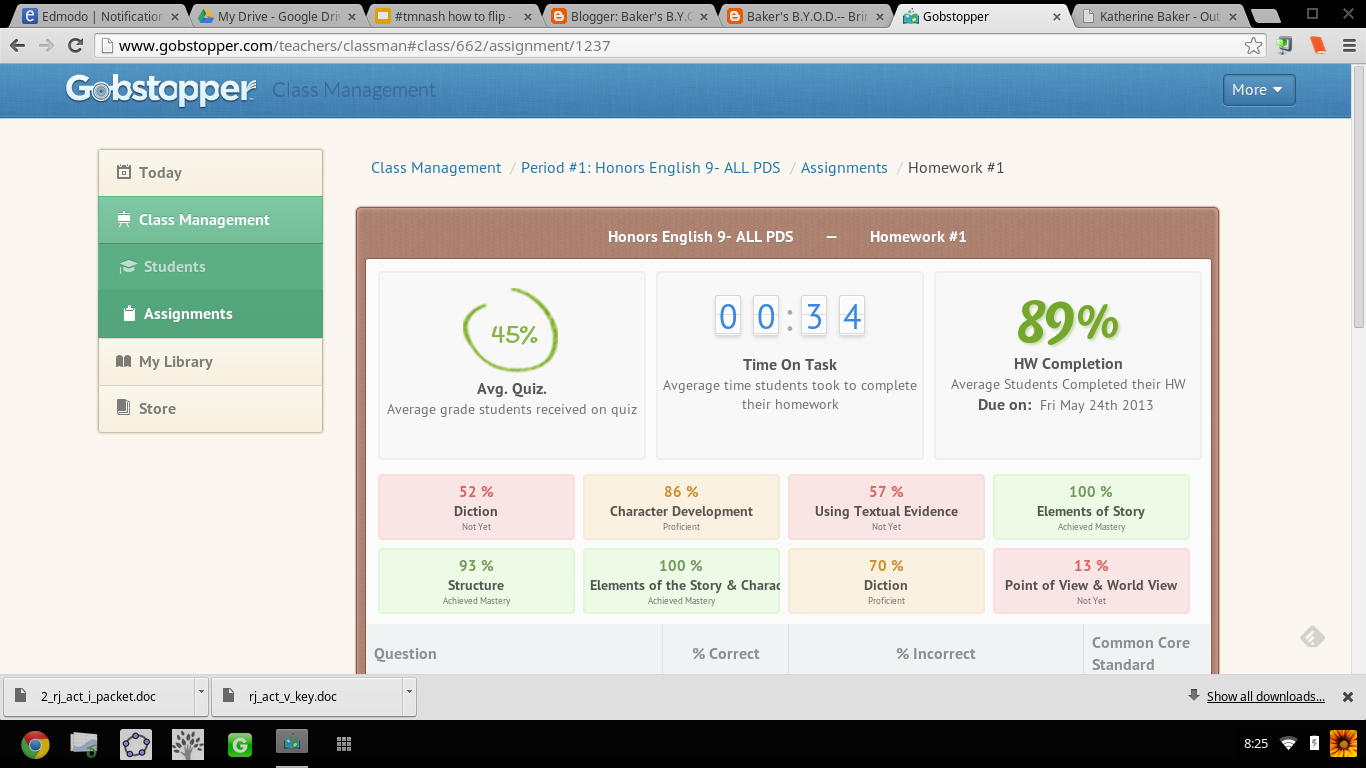
Curriculet’s real-time reporting feature lets teachers track student achievement in every assignment. Teachers can assess progress on standards and literacy skills, track time spent on-task, and identify where individual learning gaps are.
Whereas other news services for students offer outdated news stories, Curriculet’s partnership with USA TODAY makes it possible to supply students with articles the day after publication, in their original form."
Here's why I am excited about this announcement: Curriculet is providing me with another way to reach struggling readers and jaded students. To be honest, I'm not worried about my Honors students-- they will read whatever I give them--but, I'm worried about getting and keeping my lower-level freshmen and disaffected seniors reading. Asking them to sustain their attention for a whole novel is a Herculean feat. They often give up before they ever get started, intimidated by the length and preconceived notions about reading for class. But reading one, heck, even two short, high-interest articles a day (and answering a few questions and clicking on a few annotations) will build a daily habit for reading because they can do it.
Curriculet's partnership will enable me to give my students relevant and current SHORT reading pieces that appeal to their interests AND provides me with data on their skills--and I don't have to do any extra work. Like reading the newspaper, I can keep my students up to date on current events, sports, national news, international events, and my favorite category, "Good News" featuring positive focused human interest stories.
Selection of articles updated daily with older ones still available.
My seniors who usually fight me on EVERYTHING I ask them to do can't complain about reading a short article. My reluctant freshmen who don't feel like they are competent readers can feel competent with Curriculet. There's no harm; there's nothing to fear. High interest, appropriate reading level-- read it, enjoy it, and answer a few questions for me... nothing too arduous. And since each article targets one specific Common Core Standard at a time, I can keep an eye on their skills and alignment to the standards with little effort on my part.
Data on student reading performance: available by student & question
Beta-testing the USA-Today feature two weeks ago, it was seamless to choose articles and assign them to my students. Clicking on USA Today in the navigation ribbon, I selected and assigned texts the same way as I normally do in Curriculet. Since the students are already familiar with reading via Curriculet, it didn't seem like anything new to them either. I started off with articles on Mars exploration, high school basketball, and the movie American Sniper.
Whole class progress bar for easy viewing
In each of my 5 classes the same thing happened each day: my better-performing, compliant students got started right away, opened the articles, and I listened to them chat with their neighbors... "Hey, this is cool what the team did for this girl. Reminds me of the Challenger League we have here at Southern... Oh, I want to see that American Sniper movie... Wow, it is based on a true story?... Whoa they showed this movie in Baghdad? People had to freak!... What?1 There was a contest to go to Mars? That is crazy!... I think it would be cool to be part of that...No way dude, I'm happy here on Earth."
From the article, What moviegoers in Baghdad think of American Sniper,
students answer questions embedded in the text.
Overhearing the conversations, my lower-performing, not-always-compliant students were intrigued and, not wanting to miss out, opened Curriculet and started reading. I circulated around the room checking in with groups of students and then called the class together for a wrap up discussion. We talked about perspective and audience perception, inclusion of special needs folks, and setting and achieving long term goals. All of that was accomplished with three short, nonfiction articles. On days two and three of our beta-testing, I didn't need to prod any students to get started, they jumped right into reading new articles and we had a repeat of engaging class discussions. The positive energy carried into the rest of the period as we switched to reading Hamlet (seniors) or The Odyssey (also in Curriculet).
I really like that I'm not sending my students to another site for nonfiction, digital reading. Within Curriculet, students can read anything and everything from contemporary YA lit novels from publishers to canonical texts to documents I upload to current nonfiction articles. With its broad service offerings, Curriculet once again proves to me that is the only digital reading tool I need to get all my students reading.
I envision using the Curriculet-USA Today articles as a daily Do Now/Bell Ringer activity for all of my classes. Students enter the classroom, grab a Chromebook or sign on their smartphones and spend the first few minutes of class reading, answering questions, and discussing the articles with their neighbors. We could continue to do a quick round-robin discussion of the articles and what they found interesting in each. Students are staying informed on current events AND demonstrating valuable life reading skills.
There are so many MORE activities I could do with Curriculet & USA Today!
I'd love to read about your ideas, too. Please comment and share!
I had the pleasure on Tuesday last week to give a webinar on how I use Edmodo to teach my students digital literacy skills and help prepare them for digital assessments. My students piloted the PARCC last Spring and it became clear that knowing how to effectively navigate through a website will impact student scores on the Common Core assessment. Not only are my students being assessed on reading and writing literacy skills, but they are also being evaluated on understanding how to navigate and use a website.
Watch the webinar to see what I do and how I do it.
Here is a copy of my Google Slides so that you can access the resources linked in the presentation. There are lots of Easter eggs hidden in the slides, so use your digital literacy skills and explore!
This summer I spent time with family and wrote content for titles that will appear in Curriculet's premium store. One such title was the young adult novel Delirium by Lauren Oliver where love is considered a disease in a dystopian future.
I greatly enjoyed working on creating questions, quizzes, and annotations for a young adult title, applying all that I've learned from teaching canonical texts like A Tale of Two Cities, Great Expectations, Romeo & Juliet, Young Adult literature should have a place in the academic classroom. Young adult literature is the bait and hook for reading. Dr. Jung Kim from Lewis University makes the case here for young adult literature in the classroom. There are also some examples of canonical and young adult pairings. In creating the curriculet layer for Delirium, I examined the text just as I would with a canonical text: narration, structure, diction, plot, setting, etc.
While the syntax of Delirium is not difficult, I targeted Common Core Standard CCSS.ELA-LITERACY.RL.9-10.9 in the creation of the questions and annotations: Analyze how an author draws on and transforms source material in a specific work. Through out the novel, author Lauren Oliver makes allusions to Romeo & Juliet and sets the story in Portland, Maine. While author Lauren Oliver doesn't exactly copy the story of Romeo & Juliet, she does emphasize similar themes and conflicts: forbidden love, man versus society, and personal growth. The main character, Lena, begins to question the restrictive society in which she lives as she develops a relationship with another character, Alex. Not only can I have students make connections between Delirium and Romeo & Juliet, but also to 1984 and any other text where a character realizes that the world in which he/she has lived is not as it seems. If I want my students to be independent and analytic thinkers, I need them to have opportunities to do so by giving them texts that connect to them FIRST and then using the young adult text as a bridge to understand and connect with the canonical texts.
I applaud Curriculet for working to evolve reading in the digital era and making ALL texts more accessible for readers. Renting publisher-controlled digital texts for my classroom will be much more budget-friendly than asking my supervisor to purchase class-set paperback copies-- and I don't have to worry about collecting and replacing paperback copies over time. While I could send students to the library to check out individual copies of the book, I would not have enough books for the whole class to read, and even though I could have students choose their own books for independent reading, what I want is to have students reading more of the same books together.
So back to Tukey's Bridge.... Delirium is set in Portland, Maine, and Oliver continually references real locations found in the city, in addition to adapting them to suit the vision of the dystopic future. The statue of the Governor that Lena and Hana run past in Delirium is really Our Ladies of Victories statue in Monument Square. This connection provides opportunity to discuss how societies memorialize heroes and students can explore the monuments in their hometowns. In addition, if students traveled to locations mentioned in the text, they can walk in the shoes of characters.
As my family traveled to Maine for a week-long summer vacation in Bar Harbor, following 295 North through Portland, we drove over Tukey's Bridge and past Back Cove. I craned my next to spot the Promenade and envisioned Lena swimming with Alex on East End Beach. I had a moment of double vision as we rocketed along at 70 miles per hour, I imagined that we were really travelling in to the Wilds.
My all time favorite tool for digital reading is Curriculet because of its versatility and ease of use (oh, and the price: FREE!). I can assign novels, poems, short stories, and current event articles for my students to read, and they can answer Common Core aligned questions and quizzes in the text. Since it is web-browser based, Curriculet can be used on any device or computer which is a must for my BYOD, 1:1 one day a week with Chromebooks classroom.
History folks can assign primary documents with annotations and questions embedded in the historical source. Check out a Curriculet I made for the Declaration of Independence, which my students read in conjunction with our study of Steinbeck's Of Mice and Men.
Language Arts teachers of all grades can assign poems such as Jabberwocky for seamless integration of poetry into their curriculum.
Since many titles, especially in the current event section, are ready to use curriculets with questions and annotations already in embedded, I don't have to spend extra prep time creating them. I can just assign and let my students read! No matter the subject area, there is no easier tool for implementing reading instruction in your class. My students are reading more, more often, and I can see their progress and performance.
In addition, the digital literacy and navigation skills they are using while reading with Curriculet helps prepare my students for the PARCC testing that is coming (ugh.). While the visual design is different, the skills the students need for being able to navigate through the digital PARCC tests can be practiced using Curriculet.
I can get my students acclimated to digital reading and writing without stressing them out. By increasing the frequency with which we read online, the students will perform better because they are more comfortable with the technology. I can also scaffold the process and increase the difficulty level of the texts so that when they get to difficult passages and questions on the PARCC they won't shut down, but instead use the strategies I have taught them for breaking down the text and finding the answer. While I am not in favor of testing or teaching to a test, I can unobtrusively prepare my students by getting them reading more often with Curriculet.
I can't stop stop talking about Curriculet (seriously), and if you swing by the Curriculet booth at CUE 2014 (PLEASE DO!!!), I will personally show you how Curriculet has transformed my classroom and revitalized my reading instruction.
UPDATE AS OF 1/15/14: The company Gobstopper has changed its name to Curriculet, but this update hasn't changed how I use Curriculet with my students. The stories and information in the below post still hold true despite the change in company name.
While I've written quite a bit about assessing writing (ad nauseum) via digital means, reading instruction and assessment have remained a primarily paper-based enterprise in my class. While students can create projects, take quizzes, write responses digitally via BYOD and 1:1 using Google forms and docs, I've been missing a digital method for close reading of texts in my bag of instructional tricks. I've tried incorporating e-texts, PDF's, Google doc versions of texts and encouraged my students to use the Kindle Cloud Reader app on their devices and home computers, but I've been lacking a method for reading to be interactive as a whole class. I could not figure out a way to accomplish close textual analysis in an efficient and digital manner... UNTIL NOW!
I can't tell you how ridiculously THRILLED I was when an article on Gobstopper appeared in my Techcrunch feed on Feedly. I almost dropped my phone. Gobstopper is an e-reader platform that allows teachers to input and customize annotations, resources, questions, and quizzes linked to the Common Core Standards directly into a public domain text, and provides the students with immediate feedback, and the teacher with analytic data on student and class performance. Canonical texts found on the public domain are available in Gobstopper for FREE. And pair Gobstopper texts with FREE public domain Librivox audiobook recordings of the texts and you will strike gold with digital reading instruction.
AND THERE IS MORE.... Gobstopper also offers a summer reading program. Available texts are already embedded with annotations, quizzes, and questions. The content creation is already done; all the teacher has to do is assign the books. No wonder Gobstopper's name alludes to Charlie and the Chocolate Factory, because this is SWEET!
From Flowergirl to Dutchess
Appropriate, considering the themes of identity and transformation in the play, I first used Gobstopper with Shaw's Pygmalion. While on the public domain, Pygmalion was not listed as a text in the Gobstopper store, with an email request to Gobstopper support, the text was quickly added and I could begin customizing the "curriculet" with my own annotations and questions. The process was fairly simple: highlight the text, choose the option, enter the content. Questions, annotations, and quizzes can be loaded anywhere in the text and the teacher can choose to have the corresponding excerpt highlighted as well as select the appropriate Common Core Curriculum Reading Standard for each question. For annotations, I embedded screencasts I've created, links to Librivox recordings,YouTube videos, Google Forms, Google Docs, webpages, Edcanvas ... the list is never ending; anything living on the web can be linked in an annotation. Quizzes for each reading section were also easy to create. Students received their reading assignment and due dates, and I would check on their progress and accuracy.
In addition to Pygmalion, my students also read Romeo and Juliet via Gobstopper. My instruction for both texts though differed: Pygmalion was read independently out of class while we watched excerpts of My Fair Lady and West Side Story in class, and Romeo and Juliet was read synchronously as a whole class.
Prior to Gobstopper, the students were given a packet of worksheets and materials for understanding Shaw's play and we focused more so on projects that connected to the theme of the play as opposed to close textual analysis. I was never really sure if the students actually read, truly understood Shaw's play or just opted for reading the Sparknotes and viewing the film online. Pairing the Librivox recording of Pygmalion with the enhanced Gobstopper text, I had clear indicators for student performance and understanding. By hearing the text, they were able to better read along and understand, and with the Gobstopper curriculet, they could demonstrate understanding while reading instead of having to answer questions on a worksheet at the end of each act.
"Never was a story of more woe..."
For Romeo and Juliet, prior to using Gobstopper, students read the text that I put in a Word doc with arrows and boxes pointing to what I wanted the students to know. Students would pick parts (aka me coerce students into volunteering). We'd read together in class; I'd try to get students to act their parts, and stop every page and scene to go over the answers to the questions in the boxes, as well as explain to them the nuances and artistry of the language. While we got through the reading, it wasn't until that I would show the movie clips that students "got it" and understood the language. WHY? Because Shakespeare is meant to be performed not read statically sitting in an uncomfortable student desk, and seeing the actors' movements solidified understanding. While I would encourage students to act their parts out, what that really amounted to was them standing in the front of the room reading monotonously from the text. I was asking them to do too much at once: read, comprehend, and synthesize into a performance. We were also taking at least 1 week to get through each act. With 5 acts in R&J, that amounts to 5 weeks of reading-- in case you didn't know, the play is only 2 hours long.... 5 weeks vs 2 hours: no wonder students couldn't remember the opening brawl scene when we finally got to end, we were reading slower than Friar John riding a donkey in the Zeffirelli version.
Flipping the reading of Romeo and Juliet using Gobstopper and Librivox, students read asynchronously in class. I signed out the mobile lab and a class set of headphones, and assigned an act a day. What was not finished in class was for homework. I reviewed the class report the day at the beginning of the next class and clarified any misunderstandings, then let them return to reading independently. If a student had a question in class, I was able to speak to him/her one on one and address his/her concerns as needed. This process was much more successful then demanding students to be compliant and pay attention as we read together. No longer did I hear complaints of "you're going too fast!" or "can't we just move on already?!" Now that the reading of the play took only a week, we had time for creative projects that included group performances of chosen scenes and skyping with an author (that's for another blog post!).
Gobstopper allows me to efficiently and effectively flip reading instruction from synchronous and static instruction to asynchronous, supported, and student paced. By embedding instructional elements in the text and linking it to an audiobook, students can listen to people read who already understand the text and control the pace of their learning while reading. Independent and whole-class reading of complex texts while aligning with Common Core Standards is no longer a Sisyphean endeavor when using Gobstopper.
I like Gobstopper so much, I shared it at #EdCampPhilly. Photo credit: K.Jarrett
...AND, the feature I have been waiting for! Gobstopper is MOBILE! That is some sweet candy to have in your pocket!
#edmodocon On @Gobstopper students can read on a tablet, smartphone or laptop. Engaging reading experience everywhere they go!
— Gobstopper (@gobstopper) August 7, 2013
Gobstopper employs some awesome people, too! I got to meet Jason, Sean, and Marika at EdmodoCon 2013. A highlight of my experience!
From Left to Right: Sean, Marika, and I at the EdmodoCon
after party. Where's Jason?
I'm constantly writing about the dilemmas of student writing and how to grade student academic writing in an efficient and effective manner. This is probably borderline obsessive... but, I am the type of learner who when faced with an issue/problem/question, obsesses until ... ... ....
Options for Grading Writing:
Traditional: teacher does all the grading and marking up of students' writing.
Progressive: students peer edit and self assess using guided structure provided by teacher
Techie Traditional: teacher uses Google forms with the Autocrat, Doctopus, and Goobric scripts, as well as other online rubric tools to assess student work.
Options #1-3 require time and effort in class and by the teacher. I have happily peer edited on paper with my students, but there was just too much paper and it took up time in class.
Option #4 can be completed in and out of class, but it takes time to set up the forms, feedback docs, and scripts. BIG HUGE THANKS to Cheryl, Karl, Troy & all the Twitter peeps (Again & AGAIN) for walking me through creating this process, and the creator of the Autocrat script, Andrew Stillman, for answering my gazillion questions. I'm working on ways to better streamline the process (and not split my infinitives), but trust me, it is well worth the effort to guide students through troubleshooting their writing.
But, Option #5 I'm stealing (again) from Cheryl Morris. :-)
Un-grading Student Writing
In our #ElaFlip Hangout talking about assessing writing, Cheryl stated that she tries to detach grades from student writing. I forgot to ask if she was talking about creative writing or academic writing, but should it matter?
I completely agree with not scoring creative writing. I have never been comfortable putting a grade on creativity and therefore have never sought out teaching a creative writing course-- it is art and art is subjective: one critic might give Ellsworth Kelly's Blue Panel an A+ and another might give it an F. The simplest question in assessing the art is, "Does it hold meaning for me as the viewer?" The same subjective scoring can be used on student creative pieces.
I know, I know, some will say, rubrics make the scoring objective, but really? Rubrics turn writing into objects that sit on shelves. Rubrics are limiting! Students only strive to hit the points on the rubric and not beyond. They become complacent when they get the grade, and whose grade is it when the teacher designed the rubric? I know, I know, I could get my ninth grade students to design the rubric with me, but they are just learning how to write, so do they know what to even put on the rubric? And me leading them for what to put on the rubric is still me, the teacher, controlling the rubric. I could use my O-S-U rubric (again) or use standards based grading and score for mastery, but does the grade on the paper push the student to continue writing? No! As Cheryl and the other ELA flippers (Andrew, Katie, Dave, & many more) will agree, as soon as a student receives the grade, he/she thinks the process is done. The point should be about keeping students writing until ... ... ...
I fondly remember the yearly high school trip to The Metropolitan Museum of Art in NYC, and every time we flew through the exhibits just to sit in front of that blue panel and "critique" it. My naive teenage friends and I would mimic high brow folks and comment in horrendously fake British accents on the composition, scale, and other fancy art terms, nicknaming it, "The Blue Rhombus of Life". Granted, our obsession with this painting was seemingly in a joking manner, but the fact remains that painting is still hanging in Gallery 915.
"I have worked to free shape from its ground, and then to work the shape so that it has a definite relationship to the space around it; so that it has a clarity and a measure within itself of its parts (angles, curves, edges and mass); and so that, with color and tonality, the shape finds its own space and always demands its freedom and separateness."- Ellsworth Kelly
But, this got me thinking: is this why I've had so much trouble scoring student academic writing? Every method I have used, revolves around my expectations: how well did the student follow my directions, display the knowledge I taught, and use the conventions the students have been taught throughout their academic career? I can lead the students through trouble shooting and revising their essays. I can score them on participation meeting checkpoints, and being held accountable for the process, but do I, the teacher, really have to put a final grade on the essay?
During the #ELAFlip hangout, Katie Reagan explained that her students peer edit with other classes and students not at her school. Getting students out of their comfort zone certainly motivated them to perform. What about an even greater audience on the web? What about publishing their work for a bigger audience than my two hazel eyes to see? Wouldn't that "grade" the piece? It is so simple: Is the writing ready for publication and to be "hung in a gallery"? And wouldn't that prospect motivate the student to perform well? Isn't that better than any grade I could put on the page or in my gradebook?
To adapt Kelly's words, writing is also about playing with the "color and tonality" of words so that words take shape and have a "definite relationship" that has "clarity and measure". Creative writing is an obvious form of art, and academic writing should also be considered no less an art, but many teachers and students drown in the red ink and forget the art of academic writing.
So, stop grading and focus on crafting, molding, and painting with words. Turn your student writers into artists.
Post Script: Check out my next post, #OdysseyExperts, because I put into practice my ideas about showcasing writing.
Teaching students to infer and formulate arguments can easily be in context of a novel. Using Steinbeck's Of Mice & Men, students can analyze the text to create an outline for a mock trial for either George or Lennie. The final project can be completed on paper, using word processing skills and completed using a student's BYOD device.
A student's smartphone or tablet does not have to just be used for a special occasion in the classroom. I encourage my students to use their device daily for note taking, recording ideas, reflecting, and researching. For this assignment, students will use their device throughout the process and to create the final products.
Collecting Witness Statements
This project requires students to examine the story from various viewpoints and use textual evidence to support the perspective. Students begin by collecting witness statements from ALL characters mentioned in the story: The Boss, the various ranch hands and even the quickly mentioned Girl in the Red Dress. On paper, students would complete the chart and cite page numbers to reference statements. Students need to consider what each character knows and how their viewpoint is different from the reader's perspective. Not all characters know all events. After all witness statements have been collected, students would organize the characters into lists by who likes George or Lennie.
Collecting Physical Evidence
Students also need to examine the setting in various scenes to collect physical evidence that can be manipulated to support their case. The evidence can't be disregarded or changed, but it can be used to support viewpoints. This piece of the project is very important for students to formulate their arguments because there are certain things they cannot get around. For example, (spoiler alert!) the cause of death for Lennie can't be changed. Students can't get around the location of the bullet wound and state that George was attacked by Lennie and shot him in a different spot. The self-defense angle for George will have to account for the ballistics evidence as shown in the story. Lennie never handles the luger so his finger prints cannot suddenly appear on the gun.
Additionally, students can manipulate the crime scene. For example, Curley's Wife dies in the barn, but the defense team for Lennie could state that she fell from the hayloft and died as a result of her injuries. The prosecution could refute this claim with the physical evidence of hay, fibers, puppy fur, etc found on Lennie's and Curley's Wife's clothing. We know from Crooks' statements that Curley's Wife is always in the barn, poking around where she shouldn't be and even threatens Crooks in Chapter 4. It is conceivable for the defense team that CW was in the barn, wearing her little red mules, and met with an accidental death. Although, the prosecution for Lennie's case should bring up the evidence of CW's smeared make up being on Lennie's hand (which readers know got there when he "reprimanded" her for yelling).
Select a Case & Position
After witness testimonies and evidence have been collected, students need to decide which case and position they want to argue. There are four possibilities:
I tell the students that truth doesn't really exist; truth is just a bunch of people agreeing to see things the same way. The point of this project is in the process and the ability to support the case. I've watched enough CSI and Law & Order to know about circumstantial evidence and proving reasonable doubt, and I've done week-long mock trials in class where students are assigned roles, but there's always those few students who don't get into character and invalidate the activity. I've changed this over the years to just a persuasive-argumentative assignment to preserve the integrity and prevent the three-ring circus. The objective is to have the students examine all of the evidence and witness statements prior to selecting a case, so that students will realize the best argument instead of picking a side and trying to support it and then start over when they realize they don't have enough evidence to support their position. Prosecuting George for the death of Lennie is easy. There's enough evidence to prove that he did it between the lack of signs of a struggle, the ballistics evidence, and motive. George constantly belittles Lennie (as Candy overheard) and there's witnesses who can attest that George has been manipulating Lennie. The Boss will even state that George has been stealing Lennie's pay. Sympathetic readers will shout, "But Lennie can't take care of himself! George has to!" But all that matters is PERCEPTION: to a jury George can seem manipulative, controlling, and heck, with his new best friends, Slim & Candy, what does he need Lennie for?
Defending George is another viable option because he can be portrayed as a hero: the Girl in the Red Dress from the town of Weed will testify that George saved her life by beating that big lug over the head with a fence picket. Even the pugnacious Curley will state that is was George who pulled his hand from the clutches of Lennie's vice grip. But, there is that ballistics evidence to overcome: shooting someone in the back of the head usually isn't done in self-defense...
Defending Lennie is difficult. One could try the insanity plea, but throughout the novel, there are examples of Lennie knowing right from wrong, and there are are the numerous times where he threatens violence. Sympathetic readers will shout, "But Lennie only gets violent when the things he loves are threatened! He doesn't mean it!" But to a jury, the PERCEPTION is that Lennie is a menace to society who kills mice, puppies, and pretty women. Ouch. We've all read enough school uniform essays to know that the easier side to choose is in support of uniforms, and school uniforms in this day and age is a dud topic. Students like reading OMM and that connection enhances this activity. They see George and Lennie as real people instead of some nebulous persuasive essay topic, which makes this activity so valuable.
Another valuable lesson is in organization: Once students have made a selection, they organize their information into an outline. To facilitate the process, students fill in the blanks on the provided template to create a rough draft and then use the draft to type up a final copy.
The Final Product
Students type up an outline for their case and is an individual grade assessing ability to follow directions, craft a legitimate argument and demonstrate understanding of outline format. Students would peer edit each other's outlines using the provided checklist.
For the BYOD component and to make up for not doing an actual mock-trial, students would work in groups comprised of people with the same court case and position. Students would create a digital portfolio of crime scene photographs, videos of witness' testimonies, and/or scenes from the mock trial. The final group portfolio would be posted on Edmodo and as part of their online participation grade, students would comment on each of the groups' portfolios. Students would complete self evaluation forms using a checklist and OSU rubric.
I don't have student examples created just yet because we start our OMM unit next week and this project is for the end of the unit, but I am recruiting former students to create some sample witness videos They will be posted in the next few days.
I've been thinking about writing and how to evolve my students into better writers, but to be honest, I don't really consider myself an accomplished writer. The irony should be slapping you, dear reader, in the face: I am an English teacher, so shouldn't I be an accomplished writer? Other than the publishing I've done on the copier at school, what I've written here on this blog and starting to write for Teachercast, the answer, sadly, is no.
English teachers are the jacks of all trades in the academic world: we juggle reading, writing, analysis, standardized testing with a myriad of texts and techniques. While the Common Core Curriculum Standards are supposed to provide English teachers with a common core of skills and texts, English classes are not standardized because the scope is too broad. Writing gets sandwiched in context with the literature taught in class, and while I've written before about the merits of peer editing, I still feel as if there isn't enough time to get the students to become better writers.
The same dilemma is mirrored in my own life. Here I am typing on my laptop perched on the counter next to the onions caramelizing on the stove and surrounded by my daughter's first grade homework marooned on the kitchen island. And there's dishes and lunch boxes scattered about waiting to be corralled. But here I am, striking while the iron is hot, typing up this post. I'd like to think that I'm producing quality work, but I'm sure I will be editing this piece when I am less "distracted".
How can students become better writers when they too are distracted ... hold on I got to stir the onions... by all the other "stuff" that is covered in class?
I've
been asked, due to how much I'm able to produce, if I sleep. Yeah. I
need 7 hours, or I'm pretty useless. And my productivity has plummeted
since I became a father (that's not a complaint). Back when I banged out
The Master Of Verona, I had a lot of 10,000 word days. My best was a
22,000 word day. These days 5,000 is a good day. But I'm also a better
writer, and better editor, than I was ten years ago. I'd rather have
5,000 good words than 20,000 ones that have to be pared, replaced, and
eventually cut. (The second draft of MoV was 300,000 words. The one St.
Martin's bought was 192,000.) I don't know if that makes me prolific.
But it does keep me busy.
(Swap out quote above for screenshot of FB post after dinner is finished... Oh no! I forgot to start cooking the porkchops! Be back soon!)
10,000 words a day-- to write 10,000 glorious words a day. What a feat! Granted, this feat requires the desire to write. How long does it take to write 10,000 words? I'd like just 10 minutes of uninterrupted time (hold on, stirring onions again).
I wonder how many words my own students write in a day and what type of writers would they be with that quantity (and desire). If anyone out there in cyberspace has read Malcolm Gladwell's The Outliers, there's that magic number appearing again: 10,000. Granted Gladwell points out that it is 10,000 HOURS that are needed to create mastery, but I wonder, could students master writing in 10,000 words total? (We don't have 10,000 hours!) And, here comes the obvious questions, when and how do we implement writing 10,000 words in and out of class? 10 x 1,000 word essays? 2 x 5,000 word research papers? 20 x 500 word activities?
I've never taught a dedicated writing course that was exclusive to writing, but I do remember being tortured by a Creative Non-fiction class during my undergrad years. While that class was dedicated to writing, I know for a fact that it didn't make me a better writer. I did not connect well with the professor and my own insecurities about writing did not foster improvement by the end of the course. I'm sure there are plenty of other students who have had similar experiences.
The other piece of this puzzle is the use of technology to foster writing. Students have access to writing in forms that were not available to me way back when: Facebook, Twitter, blogging, email, etc. Technology has enable us to return to an epistolary society. Granted, most of the writing is in short bursts, but I do know that Twitter's 140 character limit makes me rethink sentence structure and how to be concise. I've done some quick Do Now type writing assignments where students compose a tweet in the voice of a character, but writing on paper doesn't have the same affect as using the app-- so more Twitter-type assignments will have to wait until students are allowed to have access.
So, thinking further about writing and technology, how else can I evolve my own teaching of writing into something that connects to the students, makes them think, and is fun? While using plug and play strategies with paragraph and essay structure has worked to get students started, I want to evolve their writing into something that is beyond cookie cutter. Traditional teaching strategies are not enough anymore.
For story writing, I've stumbled upon Google's Story Builder which uses text, music, and video to build a creative story that has moved beyond the bounds of paragraph structure. I'm excited to explore this with my students. I'll be starting Canterbury Tales with my not-as-academic seniors after Thanksgiving and Google Story Builder could entice the students to tell their own creative traveling tales or adapt the tales told by Chaucer. My freshmen students have excelled at using the netbooks in class, so I'm sure this tool will keep them enthralled when writing creative stories of their own or those that connect to Of Mice & Men, The Odyssey, and Romeo and Juliet.
I have this song in my head now while trying to conclude this post...
So...
If we could write 10,000 words, could we write 10,000 more...?
(Off to finish dinner!)
PS-- I think my blog post turned out better than dinner. Multitasking is definitely not the answer for cooking or writing...
Part Deux: I Need a Contractor for Google Story Builder
Using Google's Story Builder
So I started playing with Google's Story Builder today to create an example for this post, and while I like it for the potential use and the innovative way to show creative writing, I'm having an issue writing up my own example story. I feel like I'm back in that dreaded writing class again and having writer's block. Creative writing is just not my forte because it involves building and thinking forward. I think in a backwards direction by analyzing and deconstructing what is already present; I break things down instead of build them up. If I don't know where I want my story to go, how can I write the story? I am such an analytic thinker and my creativity is a MacGyver type: I synthesize things in front of me and manipulate to create something new.
Here is an example from Google and the characters of 30 Rock, which is better than any example I tried to create, and frankly, captures the process I went through.
The Writing Process
I'm fascinated by the process authors use to write because I want to learn how they create. When I am writing a blog post or an essay, I start with my subject or theme and then the post evolves as I write. I go with the flow instead of planning everything out beforehand. I just write and wander on the page and the style evolves during the editing process.
I attempted humor in part one of the post and tried showing how my life mirrors writing in the English classroom (not a dedicated writing class). The humor evolved as I was writing: I didn't start the post thinking, "Gee, let me write a humorous piece." I actually intended to write a straight forward review on the Google Story Builder, but the post just went in a different direction. I'd like to think I was funny, but only you the reader can tell me.... maybe I don't want to know.... (my attempt at humor again... ok, I know it isn't funny to have to point out the jokes and explain them....)
Teachers, writers, and authors, how do you write and what other tools have you found that students could use? Does your muse hit you on the head with divine inspiration while in the moment? Or do you go charging in with a map of what you will write and leave your strategic mark?
Claco (in Beta right now, but you can request an invite) provides a place for educators to store all their resources including files, bookmarks, websites, videos and just about any other content imaginable in organized and tagged online binders. Claco also allows for easy sharing with other educators, parents, and teachers with the ability to "snap" binders and files from other Claco users or share via Facebook, Twitter, or Pinterest. While the organization and sharing are the foundations of Claco, there are additional features and the "what is to come" that make Claco stand out on the web.
The organizational and sharing aspects of Claco are excellent. In my previously paper-based classroom, I had shelves with 3 ring binders of each unit and novels studied, and file folders of resources stashed (ok, crammed) in filing cabinets. Claco mimics this design by streamlining the binder and file folder features in the Claco cloud. No longer do I need to worry about lending out binders hoping they get returned in pristine condition or running to the copier to share resources with my colleagues, since with one click I can determine if resources, for example Short Stories, are public or private. It is now the responsibility of others to "snap" my resources to their own binders (and mine to snap their's) and I don't ever have to worry about collecting the lent out materials or remembering where I put my colleague's materials. The tagging feature is one of my favorites. Resources can be tagged by grade level, subjects, Common Core Standards (YES, Common Core Standards!), and keywords. Having the Common Core Standards already embedded is a major selling point for me. I do not have to look up the numbers or copy/paste the standards into my own plans. This feature is vital for saving time writing lesson plans online. The "What is to Come" has me very intrigued: According to Jordan Hamel (@JordanHamel), member of Team Claco, "We will have real-time lesson plan collaboration, and lesson building on Claco." Jordan also puts it best with articulating the goals of Claco, "We are creating a place where educators can build, share and store class curricula, but also a community of educators that will share and learn together." Team building and organization are vital in the online world of education, and Team Claco can help educators become connected. Claco promotes a positive networking environment that extends beyond the walls of one's own school building: teachers from across the country and world can share resources. #UnitedWeTeach
To be a progressive teacher, you find and do what works. Period.
The students should be stakeholders in their education and have accountability, responsibility, and be actively engaged in and out of the classroom. Period.
I apply the theories and philosophies of Bloom, Bandura, Vygotsky, Maslow, Gardner, and many many many others. I'm a proponent of critical thinking, cooperative learning, metacognition, blended learning, flipped learning... see a pattern? I'm a proponent of learning. Period.
Progressive teachers cannot get away from testing in the current educational climate, but at least we can make it engaging for the students in the class. The trick is in the design of the test. Despite criticism, a traditional well-written multiple choice assessment can be a valid assessment tool (I'm bracing for rebuttals). The techniques outlined below can be used for formative and summative assessments. And, this works for any subject, not just Language Arts.
Teacher Generated Multiple Choice Assessments
Some givens for my MC assessments in 9th grade English:
All test/quizzes are open resources (notebook & text).
Students only get about 30-45 seconds per question. I purposely make time an issue. They might get lucky not studying, but in order to complete the assessment in time, they need to be organized and have worksheets et al complete.
Students are assessed on a range of skills: comprehension, application, identification, etc.
How MC assessments are administered:
MC assessments vary in length, time to administer, and formative/summative purpose.
On paper in class
using scantron forms (really old school), but good back up when servers go down
photocopies
On computer in library/computer lab
On computer at home
On student personal device
For assessments administered on the computer, I use the following platforms:
As far as the questions themselves are concerned, I never write nit-picky questions: What was the color of so-so's shirt in Chapter 2? What is that type of question really assessing? To write valid MC questions and answers, constantly ask, What is the point or goal of this question? What is being assessed?
Here's some sample questions from a paper test on Dragonsong by Anne McCaffrey that assess students on comprehension and application. We live in a shore community, so many of my students are familiar with nautical themes.
In my transition to going paperless, I don't have to reinvent the wheel and throw out my paper copies; it just requires some time to copy/paste questions from tests written as Word docs to the online format.
I like Edmodo best for traditional administering of tests. The gradebook feature and automatic scoring save me time and all tests are time-stamped and teachers can set a limit on how long to take the test. Scored tests also include a pie chart for each question letting me know which questions students struggled on. As a reflective teacher, this is very helpful. And once the test is created in Edmodo, it is saved in your Edmodo cloud and can be assigned to other classes/groups and edited as needed. As of now, Edmodo tests cannot be taken through the app. I hope this changes soon! Edmodo tests are best administered on computers; I vary on whether a test is administered in class or to be done at home/in study hall.
Socrative is my choice for BYOD-esque assessments in class. Students without devices can be paired with those who do have them. I can also create group assessments and have the student with the device be the group leader. I have never laughed so hard watching my students take part in a group Space Race for Act II of Romeo & Juliet. They were so animated and engaged. I wish had video! Socrative quizzes are also very useful because they can be shared with other teachers. Check out this collaborative effort & add your own Socrative quizzes!
All this above seems pretty standard as far as MC assessments go. Nothing out of the ordinary for testing.
But how about this...
Multiple Choice Peer Assessment
This is very similar in design to the Peer Assessment for Writing & Projects. They key again is structure and design. This can be applied to any subject.
Note on rubrics: I use 2 different rubrics for facilitating the peer evaluation. The Yes-Partial-No checklist is point by point assessing whether the student completed specific aspects proficiently. Students receive 2 points for every Yes, 1 point for each Partial, and 0 points for each No. The OSU rubric is for overall effort, presentation, etc.
O= Oustanding, the student exceeded expectations for the assignment 100%/A
S= Satisfactory, the student met expectations and performed proficiently approximately 90% A-/B+
U= Unsatisfactory, the student did not meet expectations approximately 75% C/D
Notice for the OSU rubric there are no in-betweens & no coddling. Student work falls into one of the 3 categories. When students reply, "but shouldn't I get an S+, it was really good!," I rebut with, "Maybe, but it is still just a S. It either is outstanding or it isn't. Figure out what you need to do to make it outstanding next time." I'm trying to combat all of my students asking me, "What do I need to do to get an A?" and settling for "good enough." I refuse to give them the answer for how to get an A. Obviously, do what I told them to do, but I want more. I want them thinking BEYOND the requirements. Stop settling for "good enough" and excel! THINK! Don't just be a robot following commands.
One of our first novel studies of the year is Anne McCaffrey's Dragonsong. This comes at the end of our narrative short story unit in the first marking period and transitions into our 2nd marking period unit on Steinbeck and the American Dream which includes reading Of Mice & Men, The Pearl, and the short story "Chrysanthemums." In the narrative unit, all procedures and skills for the year are introduced: peer assessment, group work, active reading, narrative terms, analysis, etc. Dragonsong is read primarily out of class and students engage in cooperative critical thinking activities in class. We look at literary criticism, how to manage digesting large amounts of information, and how we think in general. In addition to taking a teacher generated test, my students use their critical thinking skills for the Multiple Choice Peer Assessment.
The Game Plan:
Students can work in groups, pairs, or individually.
To generate a test, students are supplied with a template for creating the questions that specifies number and types of questions. I adjust the template as needed, varying the types and number of questions. Students may type or hand write their questions and answers.
Students create a separate answer key for their test.
Students trade tests and take it.
While taking the test, the Test-Takers evaluate how well the test was written, completing an evaluation checklist (point by point with Yes-Partial-No) and OSU (Outstanding, Satisfactory, Unsatisfactory) rubric for the Test-Generators that assesses the validity, complexity, and over all quality of the test.
Test-Takers return the test to the Test-Generators and get assessed on right-wrong answers.
Test-Generators review the Test-Takers' evaluation, conference, sign off on the evaluation scores, AND complete the checklist on the evaluation.
Students write a journal entry reflecting on the entire process (which is turned in for credit) and we then have a class discussion debrief.
Whew! For one MC assessment, students now have... let me count.... 5 scores and used critical thinking and metacogitive skills. The whole process takes about 2-3 in-class periods. So, this is more time consuming than traditional testing, but the trade off is the depth of critical thinking and metacognition that takes place.
Call all this what you will. Is it flipped? Is it blended? Is is social learning? Does it align with Common Core Standards? Is it authentic?


.png)