Encouraging
Then cajoling
Bribing with a sirens' song
Escalating to
ordering
and demanding,
Once a Lady, now a Tiger
Disheveled shelves
scattered toys
I had Great Expectations
Stubborn
Determined
This will not be a 10 year siege,
or A Tale of Two Cities
My best laid plans have gang aft agley
I need divine intervention for laundry
I shout as the Prince to Verona
(but they don't know my allusions):
"I will be deaf to pleading and excuses;
Nor tears nor prayers shall purchase out abuses:
Therefore use none..."
Banish Barbie, drive your little ponies away
Just help me clean

Showing posts with label literature. Show all posts
Showing posts with label literature. Show all posts
Sunday, April 13, 2014

Saturday, April 5, 2014
Look What We Found: POETRY!
April is National Poetry Month, and, while I'm excited that poetry is showcased this month, really, poetry is all around us everyday. Rather than teaching an isolated poetry unit for two weeks during the school year, I incorporate poetry into every unit all year long. Look for some more blog posts highlighting poetry that connects to canonical texts.
What I like about found poetry is it allows students to play with the text on a new level using a constructivist approach. It is a creative way of actively reading and patterning, and is an artistic way to practice literary analysis. We can also talk about the choices the students as artists make in creating the poems:
I was so impressed with my students' work that I plastered the backwall of my classroom with the found poems. Students also marveled at the poetry, remarking on the ingenuity and visual design of particular poems.

Take a look at one of my students' creation. Poetry doesn't have to be scary, but her artistic choices bring out the monstrous and ghostly aspects found in pages of The Odyssey.
Showcasing another student's work, this one also chose to connect pages of The Odyssey to the Hunger Games.
From the pages of Pygmalion, this student made a poem focusing on the theme of travel and photography. When we read Pygmalion at the end of this month, I'm excited to see what she will say about her poem.

Found Poetry
Midway through the school year, I like to do a lesson on Found Poetry. I photocopy pages from the books we have read in the first half of the year and the books that we will read in the second half to use as the basis for the found poems. Titles include Of Mice and Men, The Pearl, The Odyssey, Great Expectations, Tale of Two Cities, Pygmalion, and Declaration of Independence. This is a creative review activity, and it gives students the opportunity to preview the texts that we will be reading in the second half of the year.
To learn more about Found Poetry, check out this Google Presentation.
To learn more about Found Poetry, check out this Google Presentation.
What I like about found poetry is it allows students to play with the text on a new level using a constructivist approach. It is a creative way of actively reading and patterning, and is an artistic way to practice literary analysis. We can also talk about the choices the students as artists make in creating the poems:
- Why did you choose this page or story as your foundation?
- Why did you make the choices you did in selecting the words and phrases in the text?
- What was your "writing process"?
- Did you start with an idea and pull words from the text to fit your idea or did you let your background knowledge of the text guide the writing of your poem?
- How does your poem align or contrast with the themes in the original text?
I was so impressed with my students' work that I plastered the backwall of my classroom with the found poems. Students also marveled at the poetry, remarking on the ingenuity and visual design of particular poems.
 |
| Full shot of Haley's creation |
 |
| Close up of Haley's creation. |
 |
| Another close up of Haley's creation. |
Showcasing another student's work, this one also chose to connect pages of The Odyssey to the Hunger Games.
 |
| While this student may state that she is not artistic, she was able to use a symbol from a book she had read for pleasure and overlay it on the page. The visual design is effective and draws the viewer in. |
 |
| Notice the use of white-out to create the found poem |
From the pages of Pygmalion, this student made a poem focusing on the theme of travel and photography. When we read Pygmalion at the end of this month, I'm excited to see what she will say about her poem.
Take a look at the other creations from my students in this Loupe Collage. Who knows what you may find!
Thursday, May 30, 2013
May this Gobstopper (Now Called Curriculet) be Ever Lasting!

UPDATE AS OF 1/15/14:
The company Gobstopper has changed its name to Curriculet, but this update hasn't changed how I use Curriculet with my students. The stories and information in the below post still hold true despite the change in company name.
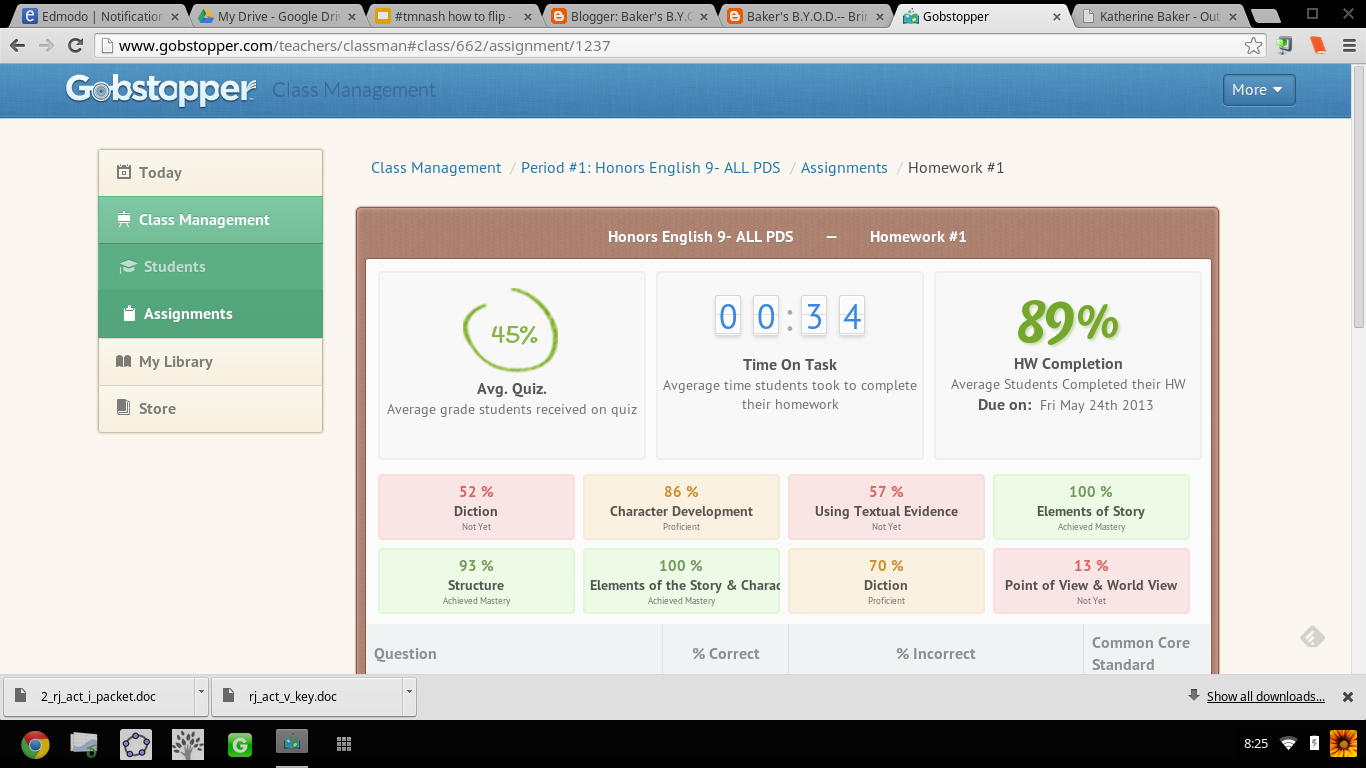
While I've written quite a bit about assessing writing (ad nauseum) via digital means, reading instruction and assessment have remained a primarily paper-based enterprise in my class. While students can create projects, take quizzes, write responses digitally via BYOD and 1:1 using Google forms and docs, I've been missing a digital method for close reading of texts in my bag of instructional tricks. I've tried incorporating e-texts, PDF's, Google doc versions of texts and encouraged my students to use the Kindle Cloud Reader app on their devices and home computers, but I've been lacking a method for reading to be interactive as a whole class. I could not figure out a way to accomplish close textual analysis in an efficient and digital manner... UNTIL NOW!

Seriously?! YES! JACK.... POT!!! Don't believe me? Try out the student demo.
AND THERE IS MORE.... Gobstopper also offers a summer reading program. Available texts are already embedded with annotations, quizzes, and questions. The content creation is already done; all the teacher has to do is assign the books. No wonder Gobstopper's name alludes to Charlie and the Chocolate Factory, because this is SWEET!
From Flowergirl to Dutchess
Appropriate, considering the themes of identity and transformation in the play, I first used Gobstopper with Shaw's Pygmalion. While on the public domain, Pygmalion was not listed as a text in the Gobstopper store, with an email request to Gobstopper support, the text was quickly added and I could begin customizing the "curriculet" with my own annotations and questions. The process was fairly simple: highlight the text, choose the option, enter the content. Questions, annotations, and quizzes can be loaded anywhere in the text and the teacher can choose to have the corresponding excerpt highlighted as well as select the appropriate Common Core Curriculum Reading Standard for each question. For annotations, I embedded screencasts I've created, links to Librivox recordings,YouTube videos, Google Forms, Google Docs, webpages, Edcanvas ... the list is never ending; anything living on the web can be linked in an annotation. Quizzes for each reading section were also easy to create. Students received their reading assignment and due dates, and I would check on their progress and accuracy.
In addition to Pygmalion, my students also read Romeo and Juliet via Gobstopper. My instruction for both texts though differed: Pygmalion was read independently out of class while we watched excerpts of My Fair Lady and West Side Story in class, and Romeo and Juliet was read synchronously as a whole class.
Prior to Gobstopper, the students were given a packet of worksheets and materials for understanding Shaw's play and we focused more so on projects that connected to the theme of the play as opposed to close textual analysis. I was never really sure if the students actually read, truly understood Shaw's play or just opted for reading the Sparknotes and viewing the film online. Pairing the Librivox recording of Pygmalion with the enhanced Gobstopper text, I had clear indicators for student performance and understanding. By hearing the text, they were able to better read along and understand, and with the Gobstopper curriculet, they could demonstrate understanding while reading instead of having to answer questions on a worksheet at the end of each act.
"Never was a story of more woe..."
For Romeo and Juliet, prior to using Gobstopper, students read the text that I put in a Word doc with arrows and boxes pointing to what I wanted the students to know. Students would pick parts (aka me coerce students into volunteering). We'd read together in class; I'd try to get students to act their parts, and stop every page and scene to go over the answers to the questions in the boxes, as well as explain to them the nuances and artistry of the language. While we got through the reading, it wasn't until that I would show the movie clips that students "got it" and understood the language. WHY? Because Shakespeare is meant to be performed not read statically sitting in an uncomfortable student desk, and seeing the actors' movements solidified understanding. While I would encourage students to act their parts out, what that really amounted to was them standing in the front of the room reading monotonously from the text. I was asking them to do too much at once: read, comprehend, and synthesize into a performance. We were also taking at least 1 week to get through each act. With 5 acts in R&J, that amounts to 5 weeks of reading-- in case you didn't know, the play is only 2 hours long.... 5 weeks vs 2 hours: no wonder students couldn't remember the opening brawl scene when we finally got to end, we were reading slower than Friar John riding a donkey in the Zeffirelli version.
Flipping the reading of Romeo and Juliet using Gobstopper and Librivox, students read asynchronously in class. I signed out the mobile lab and a class set of headphones, and assigned an act a day. What was not finished in class was for homework. I reviewed the class report the day at the beginning of the next class and clarified any misunderstandings, then let them return to reading independently. If a student had a question in class, I was able to speak to him/her one on one and address his/her concerns as needed. This process was much more successful then demanding students to be compliant and pay attention as we read together. No longer did I hear complaints of "you're going too fast!" or "can't we just move on already?!" Now that the reading of the play took only a week, we had time for creative projects that included group performances of chosen scenes and skyping with an author (that's for another blog post!).
Gobstopper allows me to efficiently and effectively flip reading instruction from synchronous and static instruction to asynchronous, supported, and student paced. By embedding instructional elements in the text and linking it to an audiobook, students can listen to people read who already understand the text and control the pace of their learning while reading. Independent and whole-class reading of complex texts while aligning with Common Core Standards is no longer a Sisyphean endeavor when using Gobstopper.
 |
| I like Gobstopper so much, I shared it at #EdCampPhilly. Photo credit: K.Jarrett |
-----------------------------------------------------------------------------------------------------
UPDATE UPDATE UPDATE UPDATE as of 8/8/2013
I will be writing more about using Gobstopper in the very near future, but I couldn't wait to share this...
Curriculets are now share-able Let me SHOW YOU!
Sign up/in to Gobstopper first, then click on this link, and you can see the curriculet I made for A Midsummer Night's Dream.
...AND, the feature I have been waiting for! Gobstopper is MOBILE!
That is some sweet candy to have in your pocket!
That is some sweet candy to have in your pocket!
#edmodocon On @Gobstopper students can read on a tablet, smartphone or laptop. Engaging reading experience everywhere they go!
— Gobstopper (@gobstopper) August 7, 2013
Gobstopper employs some awesome people, too! I got to meet Jason, Sean, and Marika at EdmodoCon 2013. A highlight of my experience!
 |
| From Left to Right: Sean, Marika, and I at the EdmodoCon after party. Where's Jason? |
Monday, December 10, 2012
Integrating Technology in the Classroom
Using Screencast-O-Matic and Windows Live Movie Maker, here is a "quick" tour of how I integrate technology in my classroom. Be sure to check out the complete list of projects and resources by clicking on the Integrating Technology tab.
Friday, November 16, 2012
CSI: Salinas
Teaching students to infer and formulate arguments can easily be in context of a novel. Using Steinbeck's Of Mice & Men, students can analyze the text to create an outline for a mock trial for either George or Lennie. The final project can be completed on paper, using word processing skills and completed using a student's BYOD device.
A student's smartphone or tablet does not have to just be used for a special occasion in the classroom. I encourage my students to use their device daily for note taking, recording ideas, reflecting, and researching. For this assignment, students will use their device throughout the process and to create the final products.

 This project requires students to examine the story from various viewpoints and use textual evidence to support the perspective. Students begin by collecting witness statements from ALL characters mentioned in the story: The Boss, the various ranch hands and even the quickly mentioned Girl in the Red Dress. On paper, students would complete the chart and cite page numbers to reference statements. Students need to consider what each character knows and how their viewpoint is different from the reader's perspective. Not all characters know all events. After all witness statements have been collected, students would organize the characters into lists by who likes George or Lennie.
 Students also need to examine the setting in various scenes to collect physical evidence that can be manipulated to support their case. The evidence can't be disregarded or changed, but it can be used to support viewpoints. This piece of the project is very important for students to formulate their arguments because there are certain things they cannot get around. For example, (spoiler alert!) the cause of death for Lennie can't be changed. Students can't get around the location of the bullet wound and state that George was attacked by Lennie and shot him in a different spot. The self-defense angle for George will have to account for the ballistics evidence as shown in the story. Lennie never handles the luger so his finger prints cannot suddenly appear on the gun.
Additionally, students can manipulate the crime scene. For example, Curley's Wife dies in the barn, but the defense team for Lennie could state that she fell from the hayloft and died as a result of her injuries. The prosecution could refute this claim with the physical evidence of hay, fibers, puppy fur, etc found on Lennie's and Curley's Wife's clothing. We know from Crooks' statements that Curley's Wife is always in the barn, poking around where she shouldn't be and even threatens Crooks in Chapter 4. It is conceivable for the defense team that CW was in the barn, wearing her little red mules, and met with an accidental death. Although, the prosecution for Lennie's case should bring up the evidence of CW's smeared make up being on Lennie's hand (which readers know got there when he "reprimanded" her for yelling).


A student's smartphone or tablet does not have to just be used for a special occasion in the classroom. I encourage my students to use their device daily for note taking, recording ideas, reflecting, and researching. For this assignment, students will use their device throughout the process and to create the final products.

Collecting Witness Statements
 This project requires students to examine the story from various viewpoints and use textual evidence to support the perspective. Students begin by collecting witness statements from ALL characters mentioned in the story: The Boss, the various ranch hands and even the quickly mentioned Girl in the Red Dress. On paper, students would complete the chart and cite page numbers to reference statements. Students need to consider what each character knows and how their viewpoint is different from the reader's perspective. Not all characters know all events. After all witness statements have been collected, students would organize the characters into lists by who likes George or Lennie.
Collecting Physical Evidence

Additionally, students can manipulate the crime scene. For example, Curley's Wife dies in the barn, but the defense team for Lennie could state that she fell from the hayloft and died as a result of her injuries. The prosecution could refute this claim with the physical evidence of hay, fibers, puppy fur, etc found on Lennie's and Curley's Wife's clothing. We know from Crooks' statements that Curley's Wife is always in the barn, poking around where she shouldn't be and even threatens Crooks in Chapter 4. It is conceivable for the defense team that CW was in the barn, wearing her little red mules, and met with an accidental death. Although, the prosecution for Lennie's case should bring up the evidence of CW's smeared make up being on Lennie's hand (which readers know got there when he "reprimanded" her for yelling).
Select a Case & Position
After witness testimonies and evidence have been collected, students need to decide which case and position they want to argue. There are four possibilities:

I tell the students that truth doesn't really exist; truth is just a bunch of people agreeing to see things the same way. The point of this project is in the process and the ability to support the case. I've watched enough CSI and Law & Order to know about circumstantial evidence and proving reasonable doubt, and I've done week-long mock trials in class where students are assigned roles, but there's always those few students who don't get into character and invalidate the activity. I've changed this over the years to just a persuasive-argumentative assignment to preserve the integrity and prevent the three-ring circus. The objective is to have the students examine all of the evidence and witness statements prior to selecting a case, so that students will realize the best argument instead of picking a side and trying to support it and then start over when they realize they don't have enough evidence to support their position.
Prosecuting George for the death of Lennie is easy. There's enough evidence to prove that he did it between the lack of signs of a struggle, the ballistics evidence, and motive. George constantly belittles Lennie (as Candy overheard) and there's witnesses who can attest that George has been manipulating Lennie. The Boss will even state that George has been stealing Lennie's pay. Sympathetic readers will shout, "But Lennie can't take care of himself! George has to!" But all that matters is PERCEPTION: to a jury George can seem manipulative, controlling, and heck, with his new best friends, Slim & Candy, what does he need Lennie for?
Defending Lennie is difficult. One could try the insanity plea, but throughout the novel, there are examples of Lennie knowing right from wrong, and there are are the numerous times where he threatens violence. Sympathetic readers will shout, "But Lennie only gets violent when the things he loves are threatened! He doesn't mean it!" But to a jury, the PERCEPTION is that Lennie is a menace to society who kills mice, puppies, and pretty women. Ouch.
We've all read enough school uniform essays to know that the easier side to choose is in support of uniforms, and school uniforms in this day and age is a dud topic. Students like reading OMM and that connection enhances this activity. They see George and Lennie as real people instead of some nebulous persuasive essay topic, which makes this activity so valuable.
Prosecuting George for the death of Lennie is easy. There's enough evidence to prove that he did it between the lack of signs of a struggle, the ballistics evidence, and motive. George constantly belittles Lennie (as Candy overheard) and there's witnesses who can attest that George has been manipulating Lennie. The Boss will even state that George has been stealing Lennie's pay. Sympathetic readers will shout, "But Lennie can't take care of himself! George has to!" But all that matters is PERCEPTION: to a jury George can seem manipulative, controlling, and heck, with his new best friends, Slim & Candy, what does he need Lennie for?
Defending George is another viable option because he can be portrayed as a hero: the Girl in the Red Dress from the town of Weed will testify that George saved her life by beating that big lug over the head with a fence picket. Even the pugnacious Curley will state that is was George who pulled his hand from the clutches of Lennie's vice grip. But, there is that ballistics evidence to overcome: shooting someone in the back of the head usually isn't done in self-defense...
Defending Lennie is difficult. One could try the insanity plea, but throughout the novel, there are examples of Lennie knowing right from wrong, and there are are the numerous times where he threatens violence. Sympathetic readers will shout, "But Lennie only gets violent when the things he loves are threatened! He doesn't mean it!" But to a jury, the PERCEPTION is that Lennie is a menace to society who kills mice, puppies, and pretty women. Ouch.
We've all read enough school uniform essays to know that the easier side to choose is in support of uniforms, and school uniforms in this day and age is a dud topic. Students like reading OMM and that connection enhances this activity. They see George and Lennie as real people instead of some nebulous persuasive essay topic, which makes this activity so valuable.
Another valuable lesson is in organization: Once students have made a selection, they organize their information into an outline. To facilitate the process, students fill in the blanks on the provided template to create a rough draft and then use the draft to type up a final copy.

The Final Product
Students type up an outline for their case and is an individual grade assessing ability to follow directions, craft a legitimate argument and demonstrate understanding of outline format. Students would peer edit each other's outlines using the provided checklist.
For the BYOD component and to make up for not doing an actual mock-trial, students would work in groups comprised of people with the same court case and position. Students would create a digital portfolio of crime scene photographs, videos of witness' testimonies, and/or scenes from the mock trial. The final group portfolio would be posted on Edmodo and as part of their online participation grade, students would comment on each of the groups' portfolios. Students would complete self evaluation forms using a checklist and OSU rubric.
I don't have student examples created just yet because we start our OMM unit next week and this project is for the end of the unit, but I am recruiting former students to create some sample witness videos They will be posted in the next few days.
For the BYOD component and to make up for not doing an actual mock-trial, students would work in groups comprised of people with the same court case and position. Students would create a digital portfolio of crime scene photographs, videos of witness' testimonies, and/or scenes from the mock trial. The final group portfolio would be posted on Edmodo and as part of their online participation grade, students would comment on each of the groups' portfolios. Students would complete self evaluation forms using a checklist and OSU rubric.
I don't have student examples created just yet because we start our OMM unit next week and this project is for the end of the unit, but I am recruiting former students to create some sample witness videos They will be posted in the next few days.
Thursday, November 15, 2012
Beware of Teachers Speaking About Greeks
I am a fanatic about Homer's Odyssey and all things related to the epic poem. I am such a fanatic that I convinced my colleagues the past 4 years to let me give a 2-day lecture to the entire 9th grade on background information associated with the Trojan War. I cram 10 years of war and mythology into two 45 minute periods (repeated 7 times for the various class periods). It is an epic task that I love. I may be the sage on the stage, but I use engaging story-telling techniques so that students can practice auditory processing. For the visual learners, my lecture is supplemented with a PowerPoint presentation and complimentary handouts.
For those students who are absent and those who want to review the presentation at home or on devices in class, I created a video version of the PPT with enhanced notes that students can pause and rewind to gain understanding.
After the 2-day lecture has concluded, students return to their respective classrooms and complete review activities of the material via review sheets on paper and on Edmodo and group Socrative Space Races. All of this culminates in a multiple choice test taken on Edmodo on the characters and plot of the Trojan War. Once students have demonstrated understanding of the material, study of the text of The Odyssey begins.
Wednesday, October 24, 2012
Capturing Classroom Videos
Screencasting
Using the FREE and super easy Screencast O Matic web tool and a $25 headset, I've started to create videos that will supplement my explanation of concepts studied in class. I haven't really used videos all the much for flipping my classes because of accessibility and inequity with technology in the classroom, but now that those issues are close to being resolved, I am very interested in learning how to to add videos to my bag of tricks.This is a 15 minute video that I created which explains elements of an adapted version of "The Cask of Amontillado" by Edgar Allan Poe. I just made this video today during the 2nd half of my prep period in one take. I had the document previously created, and I recorded myself discussing the text. Students don't have a copy of my answer sheet, but now they can use the video to make sure their pages are complete.
For one of my students on homebound instruction, I created a personalized screencast to show her how to navigate Edmodo and answer some of her questions. As I always tell my writers, showing is much more effective than telling. Now I can show them showing is more effective!
For our study of Steinbeck's Of Mice and Men, I opened the book using the Kindle Cloud Reader and recorded myself discussing elements of Chapter 1. Students then completed various tasks reviewing Chapter 1 and viewed the screencasts prior to taking a quiz. Many students stated that they preferred the screencasts to a live lecture because they could control the pace. As a delivery method for information, the screencast is efficient, and using Screencast-O-Matic, I was able to create the video in under about 20 minutes taking into account the time for uploading to Youtube.
Smartphone
And while this isn't a screencast, I used my android cellphone to record a quick video of students reviewing the site No Red Ink. Students were using No Red Ink for the first time and since they were really enjoying using the site for grammar instruction, I captured their responses. Using cellphone video recorders are an easy way for students to do book reports, show group work in process, or record a group discussion.
And for something REALLY COOL, Karl Lindgren-Streicher, a 9/10 world hisotry teacher in San Mateo, CA used his iPhone and a time lapse app to create a video showing a day in his class.
Whether for information delivery or capturing the moment, video production in the classroom can be as easy as using a screencasting or smartphone app. If you have any tips, tricks or feedback for making videos and using them for supplemental purposes, please share your ideas and examples.
Monday, October 22, 2012
Heroes & Big Huge Labs (I'm not talking about Brody)
Both my 9th grade Honors students and my one section of 12th grade general-level students start the year off studying the Hero's Journey concept and connect it to literature. The freshmen work with their summer reading books (The Hobbit by J.R.R. Tolkien and Abarat by Clive Barker) and the seniors apply the concept to Beowulf. For both sets of students, they are at the cusp of a new beginning: the freshmen need to be called to action and learn how to think for themselves, and the seniors need to be pushed into thinking about being out in the abyss of the real world beyond the school.
For independent reading, two weeks ago, I assigned my 9th grade Honors students the novel Dragonsong by Anne McCaffrey and the seniors Grendel by John Gardner. For the freshmen, I posted resources to facilitate their understanding of the novel on Edmodo and stated that there will be a Hero's Journey Unit Test that will assess students' understanding of the Hero's Journey concept and their application of the concept to the two summer reading novels and Dragonsong. I told the students, "Do what you know to do when reading a novel. All your past and present English teachers have modeled how to study a novel. Now this is your call to adventure to show that you know how to apply the same process." That's it. I got the usual questions...
"What will be on the test?"
"What do I write down?"
"Will you be collecting the stuff that is on Edmodo?"
"Will you be grading this?"
Essentially, they wanted to play the game of school: do what the teacher tells the students to do. They wanted to be lead instead of becoming leaders. I refused to give in. Any student question was answered with an additional question.
I wasn't as tortuous for the seniors. I gave them a handout on paper with questions organized by topic (setting, theme, character, etc) instead of by chapter and told them they had 12 days to finish the novel (essentially a chapter a day). Trying to sound like a college professor, I said, "Get it done. Period."
I did want to check on the students and make sure that they were reading, but I didn't want to do it in the traditional manner (despite giving a traditional test later) and just give a quiz assessing reading comprehension, and I did want to use higher-level thinking skills without it turning into a huge project. So, when introduced to Big Huge Labs in my MAIT class, I thought, "Ah-ha! This is how I will check and get students to synthesize!"
Big Huge Labs has nothing to do with dogs (as far as I know) or my therapy dog, Brody, but it is a FREE, useful site for creating quick digital projects. More like a personal photography laboratory, users can upload pictures to create motivational posters, trading cards, magazine covers, mosaics and just about any photo-based project. Assessments for reading do not necessarily need to be a "Gotcha" traditional quiz that assesses comprehension. Quick digital projects such as these will show whether students have "gotten it."
For grading, students could do peer assessment using a checklist and OSU rubric or the teacher could assess using the OSU rubric, evaluating the use of the text, the choice of image, and the overall presentation of the card or motivational poster.
The freshmen were assigned to create trading cards based on the characters in Dragonsong and the seniors created a motivational poster for either "Beowulf" or Grendel. Students doing a keyword Google Image search found relevant pictures, pulled information from the text and synthesized it into the trading card or motivational poster as applicable.
Comparing two cards on the same character, I know one paid more attention than the other while reading. I also can guess based on the character chosen and the description how far the student read into the text.


The not-so academic seniors made some phenomenal and easy posters on "Beowulf" and Grendel. Students were able to quickly and adeptly show they understood concepts in the two stories. Students can customize the colors, fonts, and borders of the text and picture. Notice, that while two students used the same picture, the feel of the end product is unique to each. This project can also provide a quick glimmer into the personality of the student with the choices he/she makes.


For independent reading, two weeks ago, I assigned my 9th grade Honors students the novel Dragonsong by Anne McCaffrey and the seniors Grendel by John Gardner. For the freshmen, I posted resources to facilitate their understanding of the novel on Edmodo and stated that there will be a Hero's Journey Unit Test that will assess students' understanding of the Hero's Journey concept and their application of the concept to the two summer reading novels and Dragonsong. I told the students, "Do what you know to do when reading a novel. All your past and present English teachers have modeled how to study a novel. Now this is your call to adventure to show that you know how to apply the same process." That's it. I got the usual questions...
"What will be on the test?"
"What do I write down?"
"Will you be collecting the stuff that is on Edmodo?"
"Will you be grading this?"
Essentially, they wanted to play the game of school: do what the teacher tells the students to do. They wanted to be lead instead of becoming leaders. I refused to give in. Any student question was answered with an additional question.
I wasn't as tortuous for the seniors. I gave them a handout on paper with questions organized by topic (setting, theme, character, etc) instead of by chapter and told them they had 12 days to finish the novel (essentially a chapter a day). Trying to sound like a college professor, I said, "Get it done. Period."
I did want to check on the students and make sure that they were reading, but I didn't want to do it in the traditional manner (despite giving a traditional test later) and just give a quiz assessing reading comprehension, and I did want to use higher-level thinking skills without it turning into a huge project. So, when introduced to Big Huge Labs in my MAIT class, I thought, "Ah-ha! This is how I will check and get students to synthesize!"
Big Huge Labs has nothing to do with dogs (as far as I know) or my therapy dog, Brody, but it is a FREE, useful site for creating quick digital projects. More like a personal photography laboratory, users can upload pictures to create motivational posters, trading cards, magazine covers, mosaics and just about any photo-based project. Assessments for reading do not necessarily need to be a "Gotcha" traditional quiz that assesses comprehension. Quick digital projects such as these will show whether students have "gotten it."
For grading, students could do peer assessment using a checklist and OSU rubric or the teacher could assess using the OSU rubric, evaluating the use of the text, the choice of image, and the overall presentation of the card or motivational poster.
The freshmen were assigned to create trading cards based on the characters in Dragonsong and the seniors created a motivational poster for either "Beowulf" or Grendel. Students doing a keyword Google Image search found relevant pictures, pulled information from the text and synthesized it into the trading card or motivational poster as applicable.
Comparing two cards on the same character, I know one paid more attention than the other while reading. I also can guess based on the character chosen and the description how far the student read into the text.


 |
| This one above has spelling errors and a poor choice in the picture. |


The not-so academic seniors made some phenomenal and easy posters on "Beowulf" and Grendel. Students were able to quickly and adeptly show they understood concepts in the two stories. Students can customize the colors, fonts, and borders of the text and picture. Notice, that while two students used the same picture, the feel of the end product is unique to each. This project can also provide a quick glimmer into the personality of the student with the choices he/she makes.


Sunday, October 14, 2012
Easy as Fish in a Barrel: Structured Socratic Discussions
Having all students involved in a focused class discussion instead of being prompted and lead by the teacher, requires all students to be invested in the process. When the discussion is structured so that all students are vested in the process, students can use critical thinking to practice crafting and supporting arguments.
In this video posted on Edutopia, KIPP King Collegiate High School teachers learn to facilitate fishbowl discussions to promote the Socratic process in class.Using a critical thinking model, the teacher serves as a facilitator of the discussion and orchestrator of the activity. While this isn't a new technique, there are key components mentioned in the video that are applicable for any classroom.
The Socratic Seminar or fishbowl discussion begins with the layout of the classroom and the assigning of roles to students. The classroom is set up with an inner square of about 12 desks, surrounded by an outer square of 12-14 desks. Students sitting in the inner square are discussing, debating, and arguing the specific topic as they reference texts, use analytic language, connect to other statements made, and agree or disagree with the other participants. Students sitting in the outer square evaluate the participants in the discussion by being assigned a specific role: reporter, silent contributor, and shadow-er.
The video does not explain in great detail the exact tasks each role plays. Generally, the reporter "reports" on the action of the discussion (provides a report after or during the discussion?); the silent contributor participates in the discussion as if he/she were in the middle, but is not allowed to speak until the conversation has ended; and the shadow-er is directly assigned a student in the inner square to evaluate on specific and multiple points.I would think it is awkward for the silent contributor to contribute at the end of the discussion-- although both the reporter and silent contributor would provide an opportunity for reviewing the discussion overall. The silent contributor would also have to be a student who has self-control, something many students need practice one. The shadower would be the most assigned role by pairing up students in both the inner and outer squares.
Why I like this...
Students need structure: The classroom set up promotes the discussion and puts students on the spot and the specific roles keep everyone involved. The roles are different from the ones I've seen before and I can see practical application-- my favorite being the shadow-er. I also like that it is another opportunity for peer review/evaluation and that the students are taking responsibility for the discussion instead of listening to the teacher lecturing. I also like that this activity promotes face to face conversation--something modern students need to practice since they like having their faces glued to a computer or cell phone screen.
What I dislike...
The 4:22 video does not provide suggestions for shy students to overcome fear of speaking in class nor does it provide specific examples of what happens after the discussion. The video assumes that all students will be prepared and responsible in the discussion process-- I can't always assume students will be model citizens of the process. Also, specific rubrics are not provided. In theory, I like the possibilities of this activity, but realistically, the teacher and students need to be organized, prepared, and structured.
Previously, I've used a koosh ball or other soft material ball to facilitate whole class discussions. The room is arranged so that all students are facing one another in a large square or circle (no one in the middle). Students come to class having written down 3 questions on the assigned topic. They take turns throwing the ball to either ask a question or answer a question. One student is charged with keeping track of who speaks and how many times. The goal is to have everyone in class ask at least one question and add to an answer for one question. This works well as an introductory activity to class discussions, but the conversation becomes too disjointed having to rely on the throwing of the ball to keep it going. I will say that the baseball players in the class usually get a kick out of this type of discussion.
 Applying the KIPP fishbowl technique in my classroom, instead of being in small groups (which is my usual set up for structured discussions), my students could as a whole class argue answers to open-ended questions. Since my classroom layout is similar to the fishbowl layout, it would be easy enough to move some desks around so that students could debate on topics that connect to the literature studied (heroism, leadership, euthanasia, resolving conflict, civil rights, attaining the American Dream, etc). The Socratic discussion could be used as a precursor for writing an argumentative essay. Also, as stated in the video, the skills used in a Socratic discussion are the same skills that are used in daily life when arguing or supporting any point made. Small group, whole class, or just speaking to one person, the critical thinking skills used in the Socratic discussion are skills that students need for every class and beyond.
------------------------------------------------------------------------------------------
For the first time doing a backchannel discussion, things went well. I'm pleased with the level of engagement and can ignore the silly comments. Some of the students' comments were spot on and most haven't read to the end of the novella. One student stated that George was the kind of friend who would take a bullet for Lennie-- little does he know where George will "take" that bullet! A few knowing students did chuckle at the use of the cliche in period 8.
Today went so well because it was structured but still allowed the students to take control. I just hovered and monitored until needed. The next step will be to add the role of the shadower so that students can get peer evaluations on their speaking and participation skills.
In this video posted on Edutopia, KIPP King Collegiate High School teachers learn to facilitate fishbowl discussions to promote the Socratic process in class.Using a critical thinking model, the teacher serves as a facilitator of the discussion and orchestrator of the activity. While this isn't a new technique, there are key components mentioned in the video that are applicable for any classroom.
The Socratic Seminar or fishbowl discussion begins with the layout of the classroom and the assigning of roles to students. The classroom is set up with an inner square of about 12 desks, surrounded by an outer square of 12-14 desks. Students sitting in the inner square are discussing, debating, and arguing the specific topic as they reference texts, use analytic language, connect to other statements made, and agree or disagree with the other participants. Students sitting in the outer square evaluate the participants in the discussion by being assigned a specific role: reporter, silent contributor, and shadow-er.
The video does not explain in great detail the exact tasks each role plays. Generally, the reporter "reports" on the action of the discussion (provides a report after or during the discussion?); the silent contributor participates in the discussion as if he/she were in the middle, but is not allowed to speak until the conversation has ended; and the shadow-er is directly assigned a student in the inner square to evaluate on specific and multiple points.I would think it is awkward for the silent contributor to contribute at the end of the discussion-- although both the reporter and silent contributor would provide an opportunity for reviewing the discussion overall. The silent contributor would also have to be a student who has self-control, something many students need practice one. The shadower would be the most assigned role by pairing up students in both the inner and outer squares.
Why I like this...
Students need structure: The classroom set up promotes the discussion and puts students on the spot and the specific roles keep everyone involved. The roles are different from the ones I've seen before and I can see practical application-- my favorite being the shadow-er. I also like that it is another opportunity for peer review/evaluation and that the students are taking responsibility for the discussion instead of listening to the teacher lecturing. I also like that this activity promotes face to face conversation--something modern students need to practice since they like having their faces glued to a computer or cell phone screen.
What I dislike...
The 4:22 video does not provide suggestions for shy students to overcome fear of speaking in class nor does it provide specific examples of what happens after the discussion. The video assumes that all students will be prepared and responsible in the discussion process-- I can't always assume students will be model citizens of the process. Also, specific rubrics are not provided. In theory, I like the possibilities of this activity, but realistically, the teacher and students need to be organized, prepared, and structured.

------------------------------------------------------------------------------------------
Update 12/7/12: Applying the Socratic Seminar in Class
Students engaged in their first Socratic Seminar based on questions connected to Chapters 1-2 in Steinbeck's Of Mice and Men. I adapted the process shown in the video above.
My Process:
- Desks were arranged to create an inner circle of about 8 students and outer circle with the remaining members of class. Ground rules and expectations were discussed.
- Students in the outer circle used their devices or a netbook to sign on to TodaysMeet.com and join the chat room I created for the backchannel discussion. The outer circle asked questions and made comments.
- Four students in the outer circle volunteered to be the two Recorders of Answers and the two Reporters of Interesting Points. They kept track of the conversation on a collaborative Google Doc.
- The discussion questions were posted one at a time on the front board and I moved the conversation along as needed.
- After about 10-15 minutes, the students changed roles and new questions were asked of the inner circle.
The questions themselves were open-ended, connected to the novel, and controversial so that students could reference the text, provide numerous opinions, and support their arguments. Students stated that they liked being given the choice to participate in the spotlight of the inner circle or keep a lower profile, but still strong presence, in the chat room.
After some initial trepidation, silliness in the backchannel chat room, and the inner circle learning not to talk over each other, the conversation progressed smoothly. I was able to moderate and facilitate the conversation as needed--which was minimal, except as you'll see towards the end of period 2's conversation. Notice the students aren't shy for calling out the inner circle or noting when students are monopolizing the conversation.
For the first time doing a backchannel discussion, things went well. I'm pleased with the level of engagement and can ignore the silly comments. Some of the students' comments were spot on and most haven't read to the end of the novella. One student stated that George was the kind of friend who would take a bullet for Lennie-- little does he know where George will "take" that bullet! A few knowing students did chuckle at the use of the cliche in period 8.
Today went so well because it was structured but still allowed the students to take control. I just hovered and monitored until needed. The next step will be to add the role of the shadower so that students can get peer evaluations on their speaking and participation skills.
Wednesday, October 10, 2012
Wordle for Visual Analysis & Prediction
Wordle is a nifty little site that creates word clouds that can be used as an introductory "Do Now" or "Anticipatory Set" (using steps 1-5 below), and later as a culminating activity and project (steps 6 & 7) using analytic thinking, prediction, collaboration, writing, and presentation skills that align with the Common Core Standards. This activity could be used for any age group.
The Process:
 Here is a sample Wordle based on the short story, "Priscilla and the Wimps" by Richard Peck. I start the year off with this story because I can introduce all skills needed for being successful in the class, scaffold it with other short stories taught, and align with NJ's Week of Respect that targets bullying prevention. This story is excellent for 9th graders who are just entering high school because, while it seems simple to understand, there is actually a complexity in the motif and theme of the story and a focus on conflict resolution. Peck builds his entire story around the Biblical story of Adam and Eve in the Garden of Eden, and allows for discussion of reliable narrators and how to resolve conflicts (or not to resolve conflicts). Themes presented in Peck's story are also found in Richard Connell's "The Most Dangerous Game" and Edgar Allan Poe's "The Cask of Amontillado" --- two texts that challenge the students' comprehension and analysis skills.
Later in the year, I can use Wordles to facilitate in student understanding when we study poetry with Pygmalion and Shakespeare's sonnets and Romeo and Juliet in the 4th Marking Period. Students get discouraged when struggling with the language, but if the text is presented in a visually appealing word cloud that only uses the most frequently used words (and not all those thee's and thou's), they should gain an initial understanding of the poem's or soliloquy's themes and motifs.
This is a Wordle of Eliza Doolittle's final monologue to Professor Henry Higgins where she tries to explain her analysis of their relationship. Students can view this Wordle prior to reading George Bernard Shaw's play, Pygmalion, and complete the process above. Based on this Wordle, we can see that this monologue (and thereby the play) is focused on answering the question, what does a girl want? Here's the answer...

While Wordle is describes as a "toy" on their site, this "toy" could be used to facilitate the use of higher level thinking, writing, collaboration, and presentation skills.
The Process:
- Copy/paste the text of the story in Wordle to create the word cloud. Adjust the settings to create the desired effect.
- Project the Wordle for all students to see.
- Student individually write reactions/impressions of the wordle (5 mins) and create sentences using only the words presented in the Wordle.
- Students turn to their neighbor or work in groups and discuss the varying view points and create a group sentence (10 mins).
- Groups share their sentences with the class (5 mins) and make sure a copy is saved to access later.
- After studying the text, project the Wordle and the group sentences back on the board and discuss the accuracy of the Wordle and sentences (10-15 mins)
- In groups or individually, students could, as a final project, create their own word cloud of the text (or keywords from the text) focusing this time on the size and placement of the words in relationship to how the words are connected to each other in the story. Instead of a random Wordle, students would create an intentional word cloud. Students would also include a written rationale or present their word cloud and rationale to the class.
 Here is a sample Wordle based on the short story, "Priscilla and the Wimps" by Richard Peck. I start the year off with this story because I can introduce all skills needed for being successful in the class, scaffold it with other short stories taught, and align with NJ's Week of Respect that targets bullying prevention. This story is excellent for 9th graders who are just entering high school because, while it seems simple to understand, there is actually a complexity in the motif and theme of the story and a focus on conflict resolution. Peck builds his entire story around the Biblical story of Adam and Eve in the Garden of Eden, and allows for discussion of reliable narrators and how to resolve conflicts (or not to resolve conflicts). Themes presented in Peck's story are also found in Richard Connell's "The Most Dangerous Game" and Edgar Allan Poe's "The Cask of Amontillado" --- two texts that challenge the students' comprehension and analysis skills.
Later in the year, I can use Wordles to facilitate in student understanding when we study poetry with Pygmalion and Shakespeare's sonnets and Romeo and Juliet in the 4th Marking Period. Students get discouraged when struggling with the language, but if the text is presented in a visually appealing word cloud that only uses the most frequently used words (and not all those thee's and thou's), they should gain an initial understanding of the poem's or soliloquy's themes and motifs.
This is a Wordle of Eliza Doolittle's final monologue to Professor Henry Higgins where she tries to explain her analysis of their relationship. Students can view this Wordle prior to reading George Bernard Shaw's play, Pygmalion, and complete the process above. Based on this Wordle, we can see that this monologue (and thereby the play) is focused on answering the question, what does a girl want? Here's the answer...

While Wordle is describes as a "toy" on their site, this "toy" could be used to facilitate the use of higher level thinking, writing, collaboration, and presentation skills.
Sunday, October 7, 2012
Claco: Teachers & Technology Team Up
Claco (in Beta right now, but you can request an invite) provides a place for educators to store all their resources including files, bookmarks, websites, videos and just about any other content imaginable in organized and tagged online binders. Claco also allows for easy sharing with other educators, parents, and teachers with the ability to "snap" binders and files from other Claco users or share via Facebook, Twitter, or Pinterest. While the organization and sharing are the foundations of Claco, there are additional features and the "what is to come" that make Claco stand out on the web.
The organizational and sharing aspects of Claco are excellent. In my previously paper-based classroom, I had shelves with 3 ring binders of each unit and novels studied, and file folders of resources stashed (ok, crammed) in filing cabinets. Claco mimics this design by streamlining the binder and file folder features in the Claco cloud. No longer do I need to worry about lending out binders hoping they get returned in pristine condition or running to the copier to share resources with my colleagues, since with one click I can determine if resources, for example Short Stories, are public or private. It is now the responsibility of others to "snap" my resources to their own binders (and mine to snap their's) and I don't ever have to worry about collecting the lent out materials or remembering where I put my colleague's materials.

The tagging feature is one of my favorites. Resources can be tagged by grade level, subjects, Common Core Standards (YES, Common Core Standards!), and keywords. Having the Common Core Standards already embedded is a major selling point for me. I do not have to look up the numbers or copy/paste the standards into my own plans. This feature is vital for saving time writing lesson plans online. The "What is to Come" has me very intrigued: According to Jordan Hamel (@JordanHamel), member of Team Claco, "We will have real-time lesson plan collaboration, and lesson building on Claco."
Jordan also puts it best with articulating the goals of Claco, "We are creating a place where educators can build, share and store class curricula, but also a community of educators that will share and learn together." Team building and organization are vital in the online world of education, and Team Claco can help educators become connected. Claco promotes a positive networking environment that extends beyond the walls of one's own school building: teachers from across the country and world can share resources. #UnitedWeTeach

The tagging feature is one of my favorites. Resources can be tagged by grade level, subjects, Common Core Standards (YES, Common Core Standards!), and keywords. Having the Common Core Standards already embedded is a major selling point for me. I do not have to look up the numbers or copy/paste the standards into my own plans. This feature is vital for saving time writing lesson plans online. The "What is to Come" has me very intrigued: According to Jordan Hamel (@JordanHamel), member of Team Claco, "We will have real-time lesson plan collaboration, and lesson building on Claco."
Jordan also puts it best with articulating the goals of Claco, "We are creating a place where educators can build, share and store class curricula, but also a community of educators that will share and learn together." Team building and organization are vital in the online world of education, and Team Claco can help educators become connected. Claco promotes a positive networking environment that extends beyond the walls of one's own school building: teachers from across the country and world can share resources. #UnitedWeTeach
Friday, September 21, 2012
Start the Year with Contracts, 9/11 & BWP
Breaking Down the First Week:
1. BWP
2. Class Contract for Mid-level classes
3. Class Procedures for all
4. Using Edmodo for posting activities and assignments and having online discussions
5. Using Quizlet as a study resource
6. Student reflection responses
Blank White Page Project was a big hit for starting off the year. Students were intrigued about the idea of questioning and researching for the sake of questioning and researching. I'm still in the process of categorizing my students' questions, but I'm hopeful that in October, I can get them started on the researching process. This was certainly a quick way for me to get to know my students. They revealed much about themselves in the questions they asked. I am looking forward to getting them connected to students across the country. This will be a valuable lesson in learning to be part of a greater community.
On to the Contracts: My "general" or "average" level classes are usually where I have the most behavior problems. Could it be a vicious cycle: student is placed in general/average level and will therefore act in a general/average way because he/she was not identified as advanced despite possessing unrecognized "advanced" potential? In the MS, students are labeled as advanced or general, but when they move up to 9th grade, there are 4 tracks to take: Basic, General, Advanced, Honors. Placement is based on test scores and marking period grades, but it isn't a perfect system. I've also noticed a pattern: the students who are more well-behaved (good at playing the game of school) are placed in Advanced. There are some smart students in those General classes, but the lack of maturity in 9th grade impedes learning. My opinion: too many tracks for 9th graders and if the student is not placed in his/her desired track, the student shuts down. To combat this vicious cycle, this year the classes and I negotiated an academic contract and am implementing a hybrid-mastery model.

In order for this to work, I and the students both need to follow through. I need to stay organized and up to date on assignments, and the students need to honor holding themselves to a higher standard. Edmodo's quiz feature will help with managing tests. I have two options to explore:
A third option is to forgo technology for the retakes and do paper-pen tests. I have a cache of them at my fingertips. I'm still in the process of moving to paperless environment, so this would alleviate the issue of having to get multiple versions on the web. Ugh, I dunno....trials and errors!
The writing revisions will be the most time consuming on my part. I need to mull this over more. I intend on doing more frequent small formative writing that is not graded, but I need to make sure the students are getting valid feedback. Peer assessment will help, but it won't be able to do all. I could do screencast videos and discuss common errors, but I don't know if students will be able to apply the general comments to their specific writing. Must mull this....The goal is to be efficient and effective!
Speaking of small groups, the 9-11 mini-discussion in assigned Edmodo small groups went well. Students examined two infographs, read articles from a New York Times site, found something interesting and wrote a post in their small group about what they found interesting and why. Part two of the activity involved students watching an amazing video from Mrs. Syollis' class on how to write a quality comment and then applied the newly acquired knowledge to replying to other group members' posts.
Finally for week one, students reflected on this week using a google form. Many enjoyed the 9-11 activity-- weird to think that they enjoyed learning about something that was so gut-wrenching. I have to keep reminding myself that they do not have an active memory of this event. I clearly remember everything about that day, my students were too young to understand. I received positive responses on the contract process, the introduction to Edmodo and Quizlet, and overall favorable outlook for the year.
Week 1 is DONE!
1. BWP
2. Class Contract for Mid-level classes
3. Class Procedures for all
4. Using Edmodo for posting activities and assignments and having online discussions
5. Using Quizlet as a study resource
6. Student reflection responses
Blank White Page Project was a big hit for starting off the year. Students were intrigued about the idea of questioning and researching for the sake of questioning and researching. I'm still in the process of categorizing my students' questions, but I'm hopeful that in October, I can get them started on the researching process. This was certainly a quick way for me to get to know my students. They revealed much about themselves in the questions they asked. I am looking forward to getting them connected to students across the country. This will be a valuable lesson in learning to be part of a greater community.
On to the Contracts: My "general" or "average" level classes are usually where I have the most behavior problems. Could it be a vicious cycle: student is placed in general/average level and will therefore act in a general/average way because he/she was not identified as advanced despite possessing unrecognized "advanced" potential? In the MS, students are labeled as advanced or general, but when they move up to 9th grade, there are 4 tracks to take: Basic, General, Advanced, Honors. Placement is based on test scores and marking period grades, but it isn't a perfect system. I've also noticed a pattern: the students who are more well-behaved (good at playing the game of school) are placed in Advanced. There are some smart students in those General classes, but the lack of maturity in 9th grade impedes learning. My opinion: too many tracks for 9th graders and if the student is not placed in his/her desired track, the student shuts down. To combat this vicious cycle, this year the classes and I negotiated an academic contract and am implementing a hybrid-mastery model.

In order for this to work, I and the students both need to follow through. I need to stay organized and up to date on assignments, and the students need to honor holding themselves to a higher standard. Edmodo's quiz feature will help with managing tests. I have two options to explore:
- Create a small group with in my class for retakes, loading the retake tests to just the small group and selecting the students as needed. I'm toying with the idea of delineating each retake group: instead of one large retake group, create a group for each unit. I'm just afraid that I will have too many small groups within the main class group. And if I deselect students from the small group, I think their scores get erased as well, so I want to make sure I think this through.
- My other option is to create an additional class for students to join to take the retakes. I would be able to set permissions to read-only if needed, but their scores would be in a separate gradebook. I want all scores in one place....maybe this won't work.
A third option is to forgo technology for the retakes and do paper-pen tests. I have a cache of them at my fingertips. I'm still in the process of moving to paperless environment, so this would alleviate the issue of having to get multiple versions on the web. Ugh, I dunno....trials and errors!
The writing revisions will be the most time consuming on my part. I need to mull this over more. I intend on doing more frequent small formative writing that is not graded, but I need to make sure the students are getting valid feedback. Peer assessment will help, but it won't be able to do all. I could do screencast videos and discuss common errors, but I don't know if students will be able to apply the general comments to their specific writing. Must mull this....The goal is to be efficient and effective!
Speaking of small groups, the 9-11 mini-discussion in assigned Edmodo small groups went well. Students examined two infographs, read articles from a New York Times site, found something interesting and wrote a post in their small group about what they found interesting and why. Part two of the activity involved students watching an amazing video from Mrs. Syollis' class on how to write a quality comment and then applied the newly acquired knowledge to replying to other group members' posts.
Finally for week one, students reflected on this week using a google form. Many enjoyed the 9-11 activity-- weird to think that they enjoyed learning about something that was so gut-wrenching. I have to keep reminding myself that they do not have an active memory of this event. I clearly remember everything about that day, my students were too young to understand. I received positive responses on the contract process, the introduction to Edmodo and Quizlet, and overall favorable outlook for the year.
Week 1 is DONE!
Sunday, August 19, 2012
Working out the Worksheet
With two weeks until school is back in session and in preparing for my presentation on Edmodo for the upcoming TeachMeetNJ unconference, I've been reflecting on past practices and thinking about how I structure the educational process in my class. Prior to the digital revolution, I used worksheets as the hub for lessons and content. I can hear the gasps of horror right now, but let me explain....
When students are not allowed to write in school issued books, having a place to write information and react to the text is vital, and being able to keep the number of worksheets to a minimum helps students as well. The worksheet was a way to organize the lesson structure and give students a location to put information. When teaching 9th graders, there is often an issue with organization. The worksheets provided guidance and structure for the content. Over the 14 years I have taught, I designed worksheets using Word and was diligent in use of space and the layout efficiently using 1 piece of paper 2-sided. Take a peek at what I created for our study of Romeo & Juliet and a group work review for Cask of Amontillado. Some of the Word formatting unfortunately does not translate well into Gdocs, but the gist of the layout and content is there.
One criticism of worksheets is that they are used for busy work. While my students are busy working, the worksheet is not mindless and time wasting. My students are busy working, not doing busywork. There is a difference. Another criticism or misconception is that the worksheet promotes students sitting at their desks, heads bent, pencils scribbling... no interaction with others. The worksheets I have designed over the years have portability in mind: rather than lug textbooks and overflowing binders around the class, students carried one piece of paper to various locations for group work and stations.
Now that the digital revolution is in full swing, I am trying to devise means for moving to a paperless and digital classroom while facing the following challenges:
So here is my game plan for this year: generally, avoid paper and turn the students' devices into digital notebooks.
While I'll be using Edmodo as my hub for digital learning, I still need to "grease the wheels" for BYOD.
This is all a work in progress, and as always, I welcome any ideas, thoughts, comments on how to make the BYOD integration work.
When students are not allowed to write in school issued books, having a place to write information and react to the text is vital, and being able to keep the number of worksheets to a minimum helps students as well. The worksheet was a way to organize the lesson structure and give students a location to put information. When teaching 9th graders, there is often an issue with organization. The worksheets provided guidance and structure for the content. Over the 14 years I have taught, I designed worksheets using Word and was diligent in use of space and the layout efficiently using 1 piece of paper 2-sided. Take a peek at what I created for our study of Romeo & Juliet and a group work review for Cask of Amontillado. Some of the Word formatting unfortunately does not translate well into Gdocs, but the gist of the layout and content is there.
One criticism of worksheets is that they are used for busy work. While my students are busy working, the worksheet is not mindless and time wasting. My students are busy working, not doing busywork. There is a difference. Another criticism or misconception is that the worksheet promotes students sitting at their desks, heads bent, pencils scribbling... no interaction with others. The worksheets I have designed over the years have portability in mind: rather than lug textbooks and overflowing binders around the class, students carried one piece of paper to various locations for group work and stations.
Now that the digital revolution is in full swing, I am trying to devise means for moving to a paperless and digital classroom while facing the following challenges:
- Availability of technology: there is a reason why I'm focused on BYOD with this blog; I do not teach in a 1:1 district. While the tech department is wonderful, I can't always get into the computer lab or sign out the laptop cart. Practical & free BYOD resources are a must.
- Changing technology: Web 2.0 tools are constantly changing; new technology is always popping up and disappearing. I love new tools, but the technology needs to be organized and centralized: students can't have 20 log-ins. And how many of these tools can be used with BYOD? Having students' resources scattered all over the web is akin to the exploding 3-ring binder loaded with all materials from multiple classes: it doesn't work.
- Turning in through technology: Being at home or in the lab, turning in assignments is easy when the technology is at one's fingertips. Students turn in assignments via Edmodo at home or in the lab, but in the classroom, I need a BYOD method that allows students to access, create, answer, and turn in to the teacher. Socrative is excellent for multple choice and short answer, but for other types of assessments and activities, the technology is still evolving. Any ideas? Delivery is easy, but assessment via BYOD is more problematic.
- Avoid reinventing the wheel and having a seamless transition: I have a massive library of resources that I've created that need to evolve for use in the digital cloud. As evident in the Word docs above that were transferred to Google, the formatting isn't exact. How can resources be adapted to BYOD?
So here is my game plan for this year: generally, avoid paper and turn the students' devices into digital notebooks.
- Worksheets are uploaded to Edmodo for students to access, complete, and turn in. I won't have to worry about file types and formatting with Edmodo. This will be fine for in class use when we can get in the lab or use the cart, but for BYOD, I'll need a different strategy. I'm still working on that...
- Adapt previously created resources/worksheets for use in mobile apps such as Socrative, Evernote, Springpad, and GDocs, GForms, etc. I anticipate lots of copy/pasting.
- Students take quizzes/tests on Edmodo and Socrative. Again, more copy/pasting from paper-based tests to the quiz generators.
- For BYOD word processing, students should be able to use the Google Docs/ Drive app on their devices. The files can then be accessed later on computers and with the integration with Edmodo, students can turn in the files on Edmodo. For BYOD in the classroom, the focus will be on smaller and more frequent writing assignments (paragraphs, journals, etc) that can later be collated and revised into larger documents on the computers.
- For active reading, I can deliver poetry and short stories via Google docs and have students use tools to mark up the text. We could have a class copy of annotated text that all students collaborated on.
- Using Edshelf and scouring twitter posts, find more apps to use in class. Additionally, students will be assigned to find an app that can be used in school and write a review. By putting students to work, I should be able to find even more resources than the ones listed here.
- Google Drive
- Edmodo
- Youtube
- Skype
- Kindle reader
- Quizlet
- Socrative
- Evernote or Sprinpad
- Document camera/scanner
- Skitch or other photo editor
While I'll be using Edmodo as my hub for digital learning, I still need to "grease the wheels" for BYOD.
Friday, August 3, 2012
MC Assessment = Meta Cognitive Assessment
To be a progressive teacher, you find and do what works. Period.
The students should be stakeholders in their education and have accountability, responsibility, and be actively engaged in and out of the classroom. Period.
I apply the theories and philosophies of Bloom, Bandura, Vygotsky, Maslow, Gardner, and many many many others. I'm a proponent of critical thinking, cooperative learning, metacognition, blended learning, flipped learning... see a pattern? I'm a proponent of learning. Period.
Progressive teachers cannot get away from testing in the current educational climate, but at least we can make it engaging for the students in the class. The trick is in the design of the test. Despite criticism, a traditional well-written multiple choice assessment can be a valid assessment tool (I'm bracing for rebuttals). The techniques outlined below can be used for formative and summative assessments. And, this works for any subject, not just Language Arts.
Some givens for my MC assessments in 9th grade English:
How MC assessments are administered:
How students are organized:
As far as the questions themselves are concerned, I never write nit-picky questions: What was the color of so-so's shirt in Chapter 2? What is that type of question really assessing? To write valid MC questions and answers, constantly ask, What is the point or goal of this question? What is being assessed?
Here's some sample questions from a paper test on Dragonsong by Anne McCaffrey that assess students on comprehension and application. We live in a shore community, so many of my students are familiar with nautical themes.


In my transition to going paperless, I don't have to reinvent the wheel and throw out my paper copies; it just requires some time to copy/paste questions from tests written as Word docs to the online format.
I like Edmodo best for traditional administering of tests. The gradebook feature and automatic scoring save me time and all tests are time-stamped and teachers can set a limit on how long to take the test. Scored tests also include a pie chart for each question letting me know which questions students struggled on. As a reflective teacher, this is very helpful. And once the test is created in Edmodo, it is saved in your Edmodo cloud and can be assigned to other classes/groups and edited as needed. As of now, Edmodo tests cannot be taken through the app. I hope this changes soon! Edmodo tests are best administered on computers; I vary on whether a test is administered in class or to be done at home/in study hall.
Socrative is my choice for BYOD-esque assessments in class. Students without devices can be paired with those who do have them. I can also create group assessments and have the student with the device be the group leader. I have never laughed so hard watching my students take part in a group Space Race for Act II of Romeo & Juliet. They were so animated and engaged. I wish had video! Socrative quizzes are also very useful because they can be shared with other teachers. Check out this collaborative effort & add your own Socrative quizzes!
All this above seems pretty standard as far as MC assessments go. Nothing out of the ordinary for testing.
But how about this...
Note on rubrics:
I use 2 different rubrics for facilitating the peer evaluation. The Yes-Partial-No checklist is point by point assessing whether the student completed specific aspects proficiently. Students receive 2 points for every Yes, 1 point for each Partial, and 0 points for each No. The OSU rubric is for overall effort, presentation, etc.
One of our first novel studies of the year is Anne McCaffrey's Dragonsong. This comes at the end of our narrative short story unit in the first marking period and transitions into our 2nd marking period unit on Steinbeck and the American Dream which includes reading Of Mice & Men, The Pearl, and the short story "Chrysanthemums." In the narrative unit, all procedures and skills for the year are introduced: peer assessment, group work, active reading, narrative terms, analysis, etc. Dragonsong is read primarily out of class and students engage in cooperative critical thinking activities in class. We look at literary criticism, how to manage digesting large amounts of information, and how we think in general. In addition to taking a teacher generated test, my students use their critical thinking skills for the Multiple Choice Peer Assessment.
The Game Plan:
Whew! For one MC assessment, students now have... let me count.... 5 scores and used critical thinking and metacogitive skills. The whole process takes about 2-3 in-class periods. So, this is more time consuming than traditional testing, but the trade off is the depth of critical thinking and metacognition that takes place.
Call all this what you will. Is it flipped? Is it blended? Is is social learning? Does it align with Common Core Standards? Is it authentic?
Whatever it is, it works. Period.
The students should be stakeholders in their education and have accountability, responsibility, and be actively engaged in and out of the classroom. Period.
I apply the theories and philosophies of Bloom, Bandura, Vygotsky, Maslow, Gardner, and many many many others. I'm a proponent of critical thinking, cooperative learning, metacognition, blended learning, flipped learning... see a pattern? I'm a proponent of learning. Period.
Progressive teachers cannot get away from testing in the current educational climate, but at least we can make it engaging for the students in the class. The trick is in the design of the test. Despite criticism, a traditional well-written multiple choice assessment can be a valid assessment tool (I'm bracing for rebuttals). The techniques outlined below can be used for formative and summative assessments. And, this works for any subject, not just Language Arts.
Teacher Generated Multiple Choice Assessments
Some givens for my MC assessments in 9th grade English:
- All test/quizzes are open resources (notebook & text).
- Students only get about 30-45 seconds per question. I purposely make time an issue. They might get lucky not studying, but in order to complete the assessment in time, they need to be organized and have worksheets et al complete.
- Students are assessed on a range of skills: comprehension, application, identification, etc.
How MC assessments are administered:
- MC assessments vary in length, time to administer, and formative/summative purpose.
- On paper in class
- using scantron forms (really old school), but good back up when servers go down
- photocopies
- On computer in library/computer lab
- On computer at home
- On student personal device
For assessments administered on the computer, I use the following platforms:
- Alone
- In partners-- one stipulation for working with a partner: students cannot communicate audibly, no sounds allowed. They can communicate textually.
- In groups-- the Socrative space race is great for this!
As far as the questions themselves are concerned, I never write nit-picky questions: What was the color of so-so's shirt in Chapter 2? What is that type of question really assessing? To write valid MC questions and answers, constantly ask, What is the point or goal of this question? What is being assessed?
Here's some sample questions from a paper test on Dragonsong by Anne McCaffrey that assess students on comprehension and application. We live in a shore community, so many of my students are familiar with nautical themes.


In my transition to going paperless, I don't have to reinvent the wheel and throw out my paper copies; it just requires some time to copy/paste questions from tests written as Word docs to the online format.
I like Edmodo best for traditional administering of tests. The gradebook feature and automatic scoring save me time and all tests are time-stamped and teachers can set a limit on how long to take the test. Scored tests also include a pie chart for each question letting me know which questions students struggled on. As a reflective teacher, this is very helpful. And once the test is created in Edmodo, it is saved in your Edmodo cloud and can be assigned to other classes/groups and edited as needed. As of now, Edmodo tests cannot be taken through the app. I hope this changes soon! Edmodo tests are best administered on computers; I vary on whether a test is administered in class or to be done at home/in study hall.
Socrative is my choice for BYOD-esque assessments in class. Students without devices can be paired with those who do have them. I can also create group assessments and have the student with the device be the group leader. I have never laughed so hard watching my students take part in a group Space Race for Act II of Romeo & Juliet. They were so animated and engaged. I wish had video! Socrative quizzes are also very useful because they can be shared with other teachers. Check out this collaborative effort & add your own Socrative quizzes!
All this above seems pretty standard as far as MC assessments go. Nothing out of the ordinary for testing.
But how about this...
Multiple Choice Peer Assessment
This is very similar in design to the Peer Assessment for Writing & Projects. They key again is structure and design. This can be applied to any subject.Note on rubrics:
I use 2 different rubrics for facilitating the peer evaluation. The Yes-Partial-No checklist is point by point assessing whether the student completed specific aspects proficiently. Students receive 2 points for every Yes, 1 point for each Partial, and 0 points for each No. The OSU rubric is for overall effort, presentation, etc.
- O= Oustanding, the student exceeded expectations for the assignment 100%/A
- S= Satisfactory, the student met expectations and performed proficiently approximately 90% A-/B+
- U= Unsatisfactory, the student did not meet expectations approximately 75% C/D
One of our first novel studies of the year is Anne McCaffrey's Dragonsong. This comes at the end of our narrative short story unit in the first marking period and transitions into our 2nd marking period unit on Steinbeck and the American Dream which includes reading Of Mice & Men, The Pearl, and the short story "Chrysanthemums." In the narrative unit, all procedures and skills for the year are introduced: peer assessment, group work, active reading, narrative terms, analysis, etc. Dragonsong is read primarily out of class and students engage in cooperative critical thinking activities in class. We look at literary criticism, how to manage digesting large amounts of information, and how we think in general. In addition to taking a teacher generated test, my students use their critical thinking skills for the Multiple Choice Peer Assessment.
The Game Plan:
- Students can work in groups, pairs, or individually.
- To generate a test, students are supplied with a template for creating the questions that specifies number and types of questions. I adjust the template as needed, varying the types and number of questions. Students may type or hand write their questions and answers.
- Students create a separate answer key for their test.
- Students trade tests and take it.
- While taking the test, the Test-Takers evaluate how well the test was written, completing an evaluation checklist (point by point with Yes-Partial-No) and OSU (Outstanding, Satisfactory, Unsatisfactory) rubric for the Test-Generators that assesses the validity, complexity, and over all quality of the test.
- Test-Takers return the test to the Test-Generators and get assessed on right-wrong answers.
- Test-Generators review the Test-Takers' evaluation, conference, sign off on the evaluation scores, AND complete the checklist on the evaluation.
- Students write a journal entry reflecting on the entire process (which is turned in for credit) and we then have a class discussion debrief.
Whew! For one MC assessment, students now have... let me count.... 5 scores and used critical thinking and metacogitive skills. The whole process takes about 2-3 in-class periods. So, this is more time consuming than traditional testing, but the trade off is the depth of critical thinking and metacognition that takes place.
Call all this what you will. Is it flipped? Is it blended? Is is social learning? Does it align with Common Core Standards? Is it authentic?
Whatever it is, it works. Period.
Subscribe to:
Posts (Atom)