Showing posts with label books. Show all posts

Thursday, November 26, 2015

Crowdsourcing Book Recommendations #CEL15 #NCTE15

I am continuing to decompress from attending the National Council of Teachers of English (NCTE) and Conference on English Leadership (CEL) events in Minneapolis, Minnesota where sessions, keynotes, and roundtables were brimming with resources and book recommendations.  Throughout Penny Kittle's book-loving CEL closing keynote, I live-tweeted many of her recommendations, but I know I was not able to tweet out them all.


Penny Kittle (as well as Jeff Wilhelm, Carol Jago, and all of the keynote speakers) are so inspiring (what an understatement!), and after 6 days of the NCTE and CEL conferences, I am struggling to retain all of what I learned. While I know I can go to Goodreads or Amazon to find books to read, I get overwhelmed with all of the choices and reviews.  In an effort to simplify the process and capitalize on crowdsourcing, I created a Google Form for Book Recommendations.


If you think a book is worth reading, complete the form.  Quick and simple.  Notice this form does not provide a place for 5-star ratings or reviews. As Penny Kittle pointed out when we recommend a specific book, we are imposing our own thoughts on the person to whom we are making the recommendation.


Transferring this same notion to general book recommendations (not just for students to read books in class), the books recommended via this Google Form will serve as our digital stack. The spreadsheet results can be filtered by fiction or nonfiction, alphabetized by author or title, and we can then venture to Amazon or Goodreads to find more information on the text. The form and spreadsheet are intended to serve as a starting point, a quick list of recommendations.


Even if you did not attend NCTE15 or CEL15, fill out the form!  Thank you!


Thursday, May 30, 2013

May this Gobstopper (Now Called Curriculet) be Ever Lasting!


UPDATE AS OF 1/15/14:  
The company Gobstopper has changed its name to Curriculet, but this update hasn't changed how I use Curriculet with my students. The stories and information in the below post still hold true despite the change in company name.


While I've written quite a bit about assessing writing (ad nauseum) via digital means, reading instruction and assessment have remained a primarily paper-based enterprise in my class. While students can create projects, take quizzes, write responses digitally via BYOD and 1:1 using Google forms and docs, I've been missing a digital method for close reading of texts in my bag of instructional tricks. I've tried incorporating e-texts, PDF's, Google doc versions of texts and encouraged my students to use the Kindle Cloud Reader app on their devices and home computers, but I've been lacking a method for reading to be interactive as a whole class. I could not figure out a way to accomplish close textual analysis in an efficient and digital manner...  UNTIL NOW!


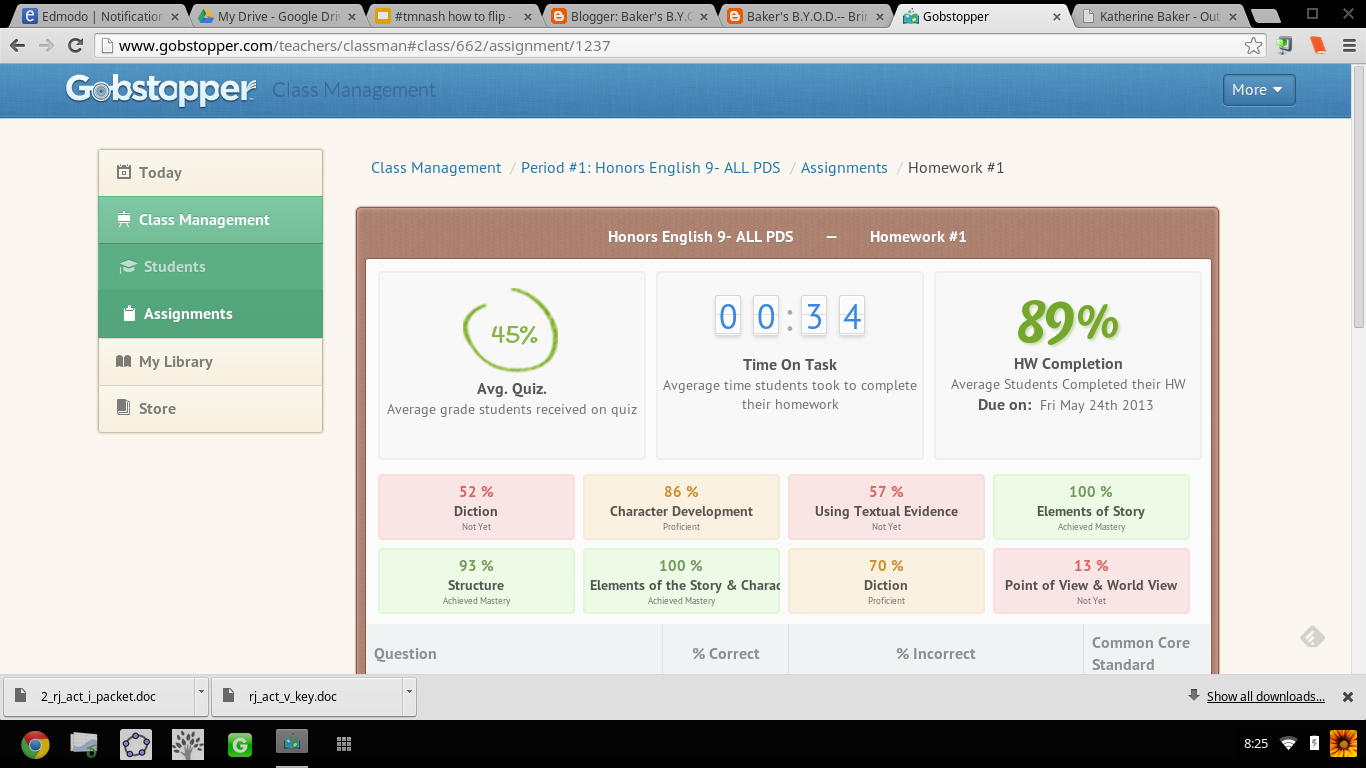
I can't tell you how ridiculously THRILLED I was when an article on Gobstopper appeared in my Techcrunch feed on Feedly.  I almost dropped my phone. Gobstopper is an e-reader platform that allows teachers to input and customize annotations, resources, questions, and quizzes linked to the Common Core Standards directly into a public domain text, and provides the students with immediate feedback, and the teacher with analytic data on student and class performance. Canonical texts found on the public domain are available in Gobstopper for FREE. And pair Gobstopper texts with FREE public domain Librivox audiobook recordings of the texts and you will strike gold with digital reading instruction.

Seriously?!  YES!  JACK.... POT!!! Don't believe me? Try out the student demo.

AND THERE IS MORE....  Gobstopper also offers a summer reading program. Available texts are already embedded with annotations, quizzes, and questions. The content creation is already done; all the teacher has to do is assign the books. No wonder Gobstopper's name alludes to Charlie and the Chocolate Factory, because this is SWEET!

From Flowergirl to Dutchess


Appropriate, considering the themes of identity and transformation in the play, I first used Gobstopper with Shaw's Pygmalion. While on the public domain, Pygmalion was not listed as a text in the Gobstopper store, with an email request to Gobstopper support, the text was quickly added and I could begin customizing the "curriculet" with my own annotations and questions. The process was fairly simple: highlight the text, choose the option, enter the content.  Questions, annotations, and quizzes can be loaded anywhere in the text and the teacher can choose to have the corresponding excerpt highlighted as well as select the appropriate Common Core Curriculum Reading Standard for each question. For annotations, I embedded  screencasts I've created, links to Librivox recordings,YouTube videos, Google Forms, Google Docs, webpages, Edcanvas ... the list is never ending; anything living on the web can be linked in an annotation. Quizzes for each reading section were also easy to create. Students received their reading assignment and due dates, and I would check on their progress and accuracy.

In addition to Pygmalion, my students also read Romeo and Juliet via Gobstopper. My instruction for both texts though differed: Pygmalion was read independently out of class while we watched excerpts of My Fair Lady and West Side Story in class, and Romeo and Juliet was read synchronously as a whole class.

Prior to Gobstopper, the students were given a packet of worksheets and materials for understanding Shaw's play and we focused more so on projects that connected to the theme of the play as opposed to close textual analysis. I was never really sure if the students actually read, truly understood Shaw's play or just opted for reading the Sparknotes and viewing the film online. Pairing the Librivox recording of Pygmalion with the enhanced Gobstopper text, I had clear indicators for student performance and understanding. By hearing the text, they were able to better read along and understand, and with the Gobstopper curriculet, they could demonstrate understanding while reading instead of having to answer questions on a worksheet at the end of each act.


"Never was a story of more woe..."


For Romeo and Juliet, prior to using Gobstopper,  students read the text that I put in a Word doc with arrows and boxes pointing to what I wanted the students to know. Students would pick parts (aka me coerce students into volunteering). We'd read together in class; I'd  try to get students to act their parts, and stop every page and scene to go over the answers to the questions in the boxes, as well as explain to them the nuances and artistry of the language. While we got through the reading, it wasn't until that I would show the movie clips that students "got it" and understood the language. WHY? Because Shakespeare is meant to be performed not read statically sitting in an uncomfortable student desk, and seeing the actors' movements solidified understanding. While I would encourage students to act their parts out, what that really amounted to was them standing in the front of the room reading monotonously from the text. I was asking them to do too much at once: read, comprehend, and synthesize into a performance. We were also taking at least 1 week to get through each act. With 5 acts in R&J, that amounts to 5 weeks of reading-- in case you didn't know, the play is only 2 hours long....   5 weeks vs 2 hours: no wonder students couldn't remember the opening brawl scene when we finally got to end, we were reading slower than Friar John riding a donkey in the Zeffirelli version.

Flipping the reading of Romeo and Juliet using Gobstopper and Librivox, students read asynchronously in class. I signed out the mobile lab and a class set of headphones, and assigned an act a day. What was not finished in class was for homework. I reviewed the class report the day at the beginning of the next class and clarified any misunderstandings, then let them return to reading independently.  If a student had a question in class, I was able to speak to him/her one on one and address his/her concerns as needed. This process was much more successful then demanding students to be compliant and pay attention as we read together. No longer did I hear complaints of "you're going too fast!" or "can't we just move on already?!" Now that the reading of the play took only a week, we had time for creative projects that included group performances of chosen scenes and skyping with an author (that's for another blog post!).

Gobstopper allows me to efficiently and effectively flip reading instruction from synchronous and static instruction to asynchronous, supported, and student paced. By embedding instructional elements in the text and linking it to an audiobook, students can listen to people read who already understand the text and control the pace of their learning while reading. Independent and whole-class reading of complex texts while aligning with Common Core Standards is no longer a Sisyphean endeavor when using Gobstopper.

I like Gobstopper so much, I shared it at #EdCampPhilly. Photo credit: K.Jarrett


-----------------------------------------------------------------------------------------------------

UPDATE UPDATE UPDATE UPDATE as of 8/8/2013

I will be writing more about using Gobstopper in the very near future, but I couldn't wait to share this...

Curriculets are now share-able   Let me SHOW YOU!
Sign up/in to Gobstopper first, then click on this link, and you can see the curriculet I made for A Midsummer Night's Dream.

...AND, the feature I have been waiting for! Gobstopper is MOBILE!
That is some sweet candy to have in your pocket! 


Gobstopper employs some awesome people, too! I got to meet Jason, Sean, and Marika at EdmodoCon 2013. A highlight of my experience!

From Left to Right: Sean, Marika, and I at the EdmodoCon
after party.  Where's Jason? 


Thursday, July 26, 2012

I have a confession...

I have a horrible confession to make. I'm totally ashamed. As a HS English teacher, this is really bad... really really bad...


Totally horrible... and I'm not using hyperbole...


I can't efficiently and effectively grade my students' writing by myself... those long labor intensive essays and research papers... yup, those, I can't grade them. I'm horrible at it. 1 page quick essay responses, I'm a little better at grading, but I still end up banging my head against the desk due to repetitive mistakes. Weren't they paying attention?! Didn't I go over this?! Ugh, another pronoun mistake?! I've been teaching for 14 years and I can't get students to improve their writing based on my assessment alone no matter how many times I try.


And how about this scenario for major writing assignments: students get assigned an essay to write that connects to the novel studied in class. Students engage in writing workshops, do some peer review, have mini-conferences with the teacher, write a draft, revise the draft, and hand it in. Those 130 ninth grade essays, double spaced, typed in 12 pt font Times New Roman, with 1 inch margins, will not get handed back to the students for months.... *GASP* and one time, not until the end of the year. I try and band-aid the situation telling the students (and myself) the process will be assessed on Marking Period A, while the final product will be part of Marking Period B's grade (ok, in rare cases Marking Period C or D). Who am I fooling?!?!?


Do the math: 130 essays x 10 mins minimum per essay (without student conferences) = 1300 mins, divided by 60 (hold on let me get my calculator...) = 21.6 consecutive hours.


21.6 hours MINIMUM for each set of assignments of consecutive grading without interruption. You got that time? Me neither. And on the rare occasions that I have sequestered myself in a locked room without distractions and interruptions (where's that?), what happens when I give the graded essays/papers back to the students? Absolutely nothing. They flip through, find the grade, grumble or cheer and then throw every rewritten, revised essay into a folder. Seriously?! 21.6 hours MINIMUM of my time wasted for a quick glance?! Rather anti-climatic if you ask me. There should be emanating from the page an enlightening glow illuminating the students' faces with understanding. But, again, who am I kidding?!


So What Happened? Where do I go wrong?

Part of the problem is in the assignment itself. Students will not become better writers if they are only assessed on one major writing task a marking period or semester. Less is more: students need to engage in smaller assignments more frequently.


The other part of the problem is in the assessment from the teacher and the effects (or lack of) of the assessment.


Was I sincere in my comments and critique for their writing? Yes.

Did I supply positive feedback and recommendations for improvement? Yes.

Were my recommendations and critiques valid? Yes.


Did my comments create an epiphany for students? No.

Did my students suddenly "get it" and become amazing writers from my grading? No.

Did they avoid making the same mistakes in their next writing assignment? Not usually.

Did they internalize anything from the comments and the grades for future improvement? Maybe, but probably not.


I have always wrestled with assessing writing in this manner because I never felt it was an effective and efficient method for improving student writing. It is one-sided and time consuming. Even though I am the "expert" and professional in the room, I am still only providing one opinion/viewpoint on the writing. And honestly, if I were such a fantastic writer, wouldn't I be living life as professional author? And if I was such a fantastic editor, wouldn't I be working for a publishing company?


The fault here lies in the system-- an archaic, antiquated system where the teacher is the only voice for evaluation. It is a failing cycle that does not produce results.


Cue, Ben Harper...I Believe in a Better Way!

The peer assessment framework I've devised was born out of necessity for time and sanity. This all started 14 years ago when I was a bleary-eyed student teacher wanting to figure out how to make grading essays less overwhelming, and every year since, and especially during the even more bleary-eyed and chaotic years when my daughters were infants and toddlers and now when they are in elementary school, I have refined the techniques to make it less about saving me time and more about giving the students an authentic evaluation experience.


Every educator vaguely familiar with Bloom's taxonomy will tell you that evaluation is one of the highest levels of thinking skills. Why should the teacher be the only one using this skill? And why should one teacher, no matter how wonderful and fabulous, be the only input for student writing? Quality writing requires quantity of writing. Quality and quantity both require time. In order to get to the quality, the teacher can not be the only one assessing the quantity of it. There's no time for it!


But there is time for Peer-Self Evaluation & Assessment!


Structure

The first key to implementing Peer & Self Evaluation is in the design. Students need to be guided in all aspects. One can't expect them to authentically and effectively evaluate each other and themselves... not unless everyone wants an A! Woo-who! #WINNING!


In order to build rapport, trust, and an opportunity for valid comments, I scaffold the process and start with small assignments that introduce the skills needed. I do mini-lessons on grammar, writing structure, etc. Many students are familiar with the 6 + 1 Trait Writing from their middle school years, so that gets mentioned as well. I have students constantly trade papers from quick worksheets to quick writes. They become used to sharing their work. I also preface every peer-self evaluation activity with a quick reminder on the need for valid, honest commentary.


General Game Plan for Peer Evaluation:
  1. Students trade assignments 
  2. Read through multiple times and complete evaluation worksheet 
  3. Complete scoring checklist & OSU rubric 
  4. Return assignment to the writer, and writer reviews worksheet and rubrics 
  5. Writer critiques evaluator completing the evaluation checklist. 
  6. Writer agrees or disagrees with evaluation and signs off on the score. 
  7. In case of disagreement, writer and evaluator conference and discuss specific points of disagreement. When compromise is reached, all is turned in to me. If no compromise can be met (rarely happens), I conference with both and review the total evaluation. 
  8. Teacher reviews the assignment and evaluation and provides a wholistic score on the entire process using an OSU rubric. 

Use of Rubrics:

I use 2 different rubrics for facilitating the peer evaluation. The Yes-Partial-No checklist is point by point assessing whether the student completed specific aspects proficiently. Students receive 2 points for every Yes, 1 point for each Partial, and 0 points for each No. The OSU rubric is for overall effort, presentation, etc.

O= Oustanding, the student exceeded expectations for the assignment 100%/A
S= Satisfactory, the student met expectations and performed proficiently approximately 90% A-/B+
U= Unsatisfactory, the student did not meet expectations approximately 75% C/D

Notice for the OSU rubric there are no in-betweens & no coddling. Student work falls into one of the 3 categories. When students reply, "but shouldn't I get an S+, it was really good!," I rebut with, "Maybe, but it is still just a S. It either is outstanding or it isn't. Figure out what you need to do to make it outstanding next time." I'm trying to combat all of my students asking me, "What do I need to do to get an A?" and settling for "good enough." I refuse to give them the answer for how to get an A. Obviously, do what I told them to do, but I want more. I want them thinking BEYOND the requirements. Stop settling for "good enough" and excel! THINK! Don't just be a robot following commands.


The total points for each rubric vary depending on the assignment. Students receive four different scores: Checklist, OSU, Evaluator, and Overall score (from me using a seprate OSU rubric). Students must sign off on all scores received and engage in conferences when scores are in dispute. I step in to moderate as needed, but so far I rarely need to do so. So not only are students getting assessed on their writing skills, but their evaluation skills are also taken into account, and they are receiving feedback on mutliple levels in a timely fashion.


Sample Evaluation Worksheets & Rubrics:


I also adapt these worksheets for self-evaluation and students critique themselves.


Keeping it Fresh

I constantly keep students on their toes switching up a piece of the pattern for each different assignment:

  • Editors/Evaluators are student or teacher or randomly selected, sometimes with names, sometimes without. 
  • Round-robin group evaluations where students obtain 3 total critiques on the same assignment from different people. 
  • The class creates the rubric & checklist together. 

The Secret of this Success

If this were an action research project, I would provide stats and evidence on writing before and after implementing the peer evaluation framework, but I can tell you this works. The proof is in the attitude of the students and in seeing the process take place. The students are engaged, on task, take responsibility/ownership of their work, and have learned how to defend and communicate their ideas to others. The proof is also in the efficiency of the system: we spend a total of 86 mins (2 class periods, each 43 mins) on the evaluation process. Students receive immediate feedback instead of waiting for me to return papers sporadically.

I've crafted this framework and refined it every year. So this works because I keep working at making it better. This framework can also be adapted for every subject. Have students critique each other on lab reports in Science, completing equations in Math, performing a piece in music... it works for every subject! If you would like additional samples or more clarification, let me know!

My next task is to figure out how to evolve this into a paperless and tech-y format. Blogs? Google docs? Google form? Edmodo?

Any ideas are welcome! (Chime in #Cheesebuckets!)

Saturday, June 23, 2012

Tell me about the rabbits, George

Ideas about flipping reading (sorry typing this on my phone before I forget my ideas)

-interactive texts that point out narrative terms and have links to relevant info
-audio texts
-videos of e texts being read aloud

I usually read aloud to my students in the beginning of the year, pointing out narrative terms along the way. My Lennie voice is infamous for Of Mice & Men.  How can they get the same experience at home?