My first answer is that social media provides the venue for people to get connected. Twitter without a doubt is my number one tool for finding people to talk to about educational topics. While the 140 characters is limiting, Twitter is where we start to talk and the conversations are later expanded via email or in Voxer groups. I don't know how I collaborated before Twitter and Voxer. Being a connected educator to the ever-flowing stream keeps me energized and constantly thinking, "What if...?" because I know there is someone out there on Twitter and Voxer who will help me answer that question.
Thinking about other social media tools, Facebook is primarily where I connect with family and local educators, but little collaboration takes place. But Facebook is a good place to share, share, share! Although, Kate Messner & company's Teachers Write online summer camp through a closed Facebook group is sparking creative writing for teachers. And while I haven't used Instagram much for educational purposes, it too is primarily for documenting and sharing. YouTube, like Instagram, is an area to showcase collaboration, but not necessarily kindle it. And while Pinterest will keep me occupied for hours pinning things, I wonder how it could be better suited for collaboration instead of mere archiving.
So to get the collaborative connections going and see how Pinterest can foster collaboration, I have a task for you! Pick something from my Teaching Board and in the comments to this post reply with an idea of how we can make the item better.
I LOVE it when students are just as nerdy as I am.
Last year reading Homer's Odyssey and watching the 1997 made-for-TV movie starring ArmandAssante, a trio of students were so intrigued (read: obssessed) with Odysseus' son Telemachus, that they tracked down the actor, Alan Stenson, who played him in the film, created fan club t-shirts (including one for me!), and shared pictures of the us wearing the shirts via social media, declaring themselves "Stensonites."
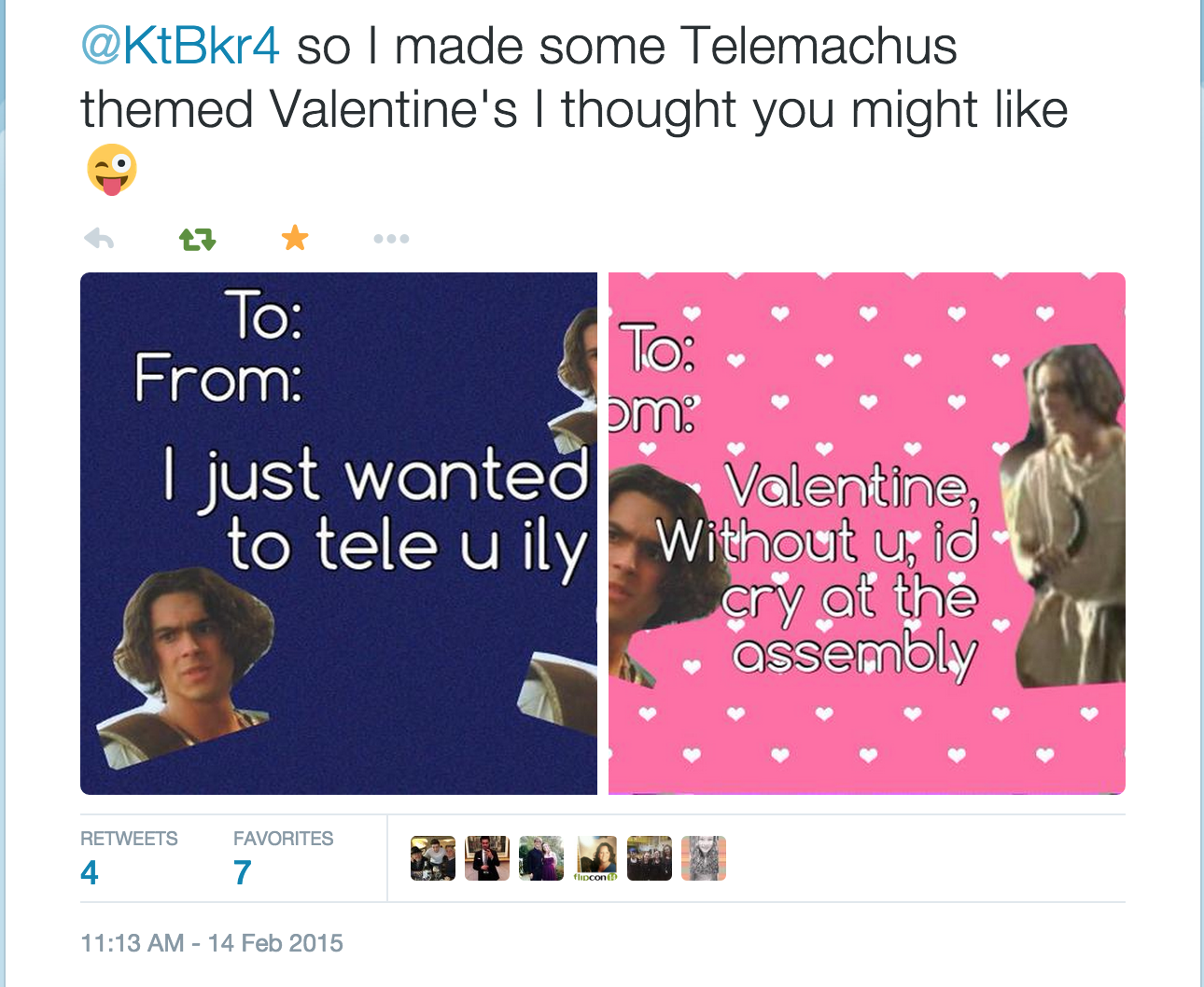
And if that wasn't enough, almost a year later on Valentine's Day, one of these same students sent me Telemachus themed valentines via Twitter and, of course, tweeted them to Mr. Stenson.
So here we are, April 17th, and this year's crop of students are reading/watching The Odyssey, and in honor of seeing Telemachus projected on the screen in my room, my wonderfully nerdy former students deemed today "Telemachus Appreciation Day."
Happy Alan Stenson fan club day everyone! 🎉🎉
— ❁Kelly Zuzic❁ (@kellykpizzle) April 17, 2015
My current senior students aren't as impressed with our nerdiness, but one joined the fun, tweeting...
While at #ISTE2014, I attended the TechSmith party at De Biergarten in Atlanta, GA. It was thoroughly enjoyable chatting with Twitter & FlipCon folks face to face over some GOOD German food. There was Foosball and even pictures with our heads atop German attired folks (Here are some pictures from Kristin D.) We chatted about FlipCon vs ISTE, general ed tech issues, the value of open-source internet, and at one point with Brian Bennett, a very important topic: how to make homemade Spaetzle (Brian Bennett & Aaron Sams make sure you read the post script).
ISTE, while a mind-blowing event in itself, can be overwhelming, and I found the small TechSmith gathering a hospitable, intimate affair. It was so nice to enjoy the company of like-minded folks over food and drinks without having to shout over the gaggle of the throng and the cacophony of a DJ. It was so interesting to see how small pockets were sewn into the fabric of ISTE-- the Blogger's cafe and Welcome lounge being two such spaces where people collected in the conference center in addition to other small events like drinks with Class Dojo, dinner with Edmodo, and TechSmith's reception. And while I value the ways companies show their appreciation for their users, I greatly appreciate the smaller communal events more so than a big blow-out bash because in the end it isn't the product or technology that matters-- it is the COMMUNITY of PEOPLE that make an event worth attending or a product worth using.
Back at home this week I had a hankering for Spaetzle, and as promised for Brian and Aaron, here is my homemade Spaetzle recipe and a video of the process (Sorry for the flipped camera half way through. I forgot which way I was holding my phone, but hey, you get the idea-- and rather apropos since that is how we all met!)
Ingredients:
1 1/2 cups flour
1/2 tsp salt
1/8 tsp baking powder
1/8 tsp nutmeg (add more as suited to taste)
2 eggs
1/2 cup milk
Directions:
Combine flour, salt, baking powder, and nutmeg in a large mixing bowl.
Stir in eggs and milk.
Use a Spaetzle maker or colander (too difficult with slotted spoon) to drop the batter--about 1-2 large spoonfuls at a time-- into a pot of boiling water.
The batter will rise to the top and after about 1 minute or so (but not longer than 2), scoop out the Spaetzle into a bowl with a bit of butter.
Cover the bowl with a cloth and continue to drop the batter into the pot. Repeat steps 3 & 4 until all batter is gone.
Serve.
I usually make my great-grandma's meatballs and sauce to have over the Spaetzle in the winter. It is a red sauce, but not the same marinara sauce that you would have with spaghetti. Very hearty & comforting on a cold day. Come for a visit and I'll make it for you in person!
My #ISTE2014 trip with Liz and Kyle Calderwood and Michelle Wendt was supposed to begin in Atlantic City with a flight on Spirit Airlines to Atlanta, Georgia, but after a cancelled flight and an unexpected roadtrip, we eventually reached our destination, 12 hours after our expected arrival time.
There are two tech tools that were essential for transforming this ordeal into an adventure: Twitter and Voxer. Using our smartphones, our group made a concerted effort to devise a new flight plan, all which would not have been accomplished had we not been able to use real-time communication.
Using Twitter, I shared our plight of a flight with my PLN, documenting the experiencing and encouraging Spirit Airlines to notice the issue. Even my #FlipCon14 buddy, Ken Bauer, who lives in Mexico made sure to make some noise. While many businesses use Twitter to blast out deals and connect with customers, it is evident that Twitter is a one-way street with Spirit Airlines. We received absolutely no replies from the Spirit Airlines Twitter account.
Thanks @SpiritAirlines! Flight canceled & had to book diff flight 2hrs away w/o help. Got 1/2 refund & $50 voucher to use within 30 days.
— Kyle Calderwood (@kcalderw) June 27, 2014
Humorous Shenanigans from the PLN:
Twitter also provided an avenue for adding humor to the situation. My buddies in elsewhere in the country provided me with comic relief with their sad-faced pictures. Knowing that I wasn't alone helped me stay objective and not react emotionally to the situation. When my frustration level would reach atomic level, my PLN made me laugh and stay focused on problem-solving the situation. Can you stay mad looking at these faces??? Thank you Jason & Steve!
Voxer is a walk-talkie app that allows for quick, realtime communication. I know quite a few educators are using Voxer as a podcast tool for group chats with participants sharing philosophical ideas in a group conversation, but in this situation we were focused on practical applications. Our group relied on Voxer to keep all members in the know as we talked to Spirit ticket folks, located baggage, and made alternative travel arrangements.
Kyle was on the phone talking directly to Spirit Airlines. Liz was in line at the Spirit ticket counter making arrangements with one of the employees-- Patty was amazing calm and professional the entire time despite facing an angry and impatient mob. Michelle and I were running from the gate to the ticket and baggage areas, all the while making sure our adopted travel partner, Amy B. was involved in our plans. Without Voxer, we would not have been able to coordinate and would have wasted valuable time and energy running back and forth through the airport. With Voxer, we stayed focused on solving the problem and making new travel arrangements with each person doing his/her part.
Serendipity is something that can be found in any situation, no matter how dire. Sitting near us at the gate as we learned about the delayed plane was Amy B., a first-time solo flyer and recent high school graduate who was visiting friends in NJ and now trying to make her way home. Not knowing what to do once the flight was cancelled, Amy followed me as we made our way from the gate to the Spirit ticket area. Our group quickly adopted her and made it our mission to get Amy home.
As a mother, I can only hope that if my daughters were in a similar situation, that they would find caring folks to help. So often the news is filled with horror stories, but I know that there are good folks out there who do the right thing for strangers. I wish the news would promote the positive instead of always sensationalizing the negative-- but that is a post for another day. Amy stayed in contact texting with her mom in Georgia and her mom followed us via Twitter. Modern communication systems and social media provided transparency to our travels, reassuring a nervous mother that her daughter was in good hands as we left Atlantic City to catch a flight out of Philly.
Roadtrip Tweets:
Flight was cancelled... Traveling with angels to Philadelphia for a flight to ATL tonight. What a journey 😅 pic.twitter.com/dc7wbh7B3J
— Amy Bullock (@amy_bullock) June 27, 2014
After arriving at Atlanta, a very grateful and relieved mother met us and transported us each to our prospective hotels. Amy's mom dubbed us "Amy's Angels" through out the trip. While her mom may say we were heaven sent, I'd like to think we were just doing what we, as teachers and good human beings, naturally do: take care of each other.
I wanted a creative way to compile and share my pictures from my recent trip with Curriculet to CUE 2014 conference in Palm Springs, California. Searching through the Chrome Web Store, I found Loupe Collage. Similar to creating a customized word cloud in Tagxedo, Loupe Collage allows users to pull in pictures from Facebook, Google +, Drive, Dropbox, Twitter, the web, Instagram, and files (ok, everywhere) to create a collage where the shape and background can be customized. Once the collage is created, users can share it via Facebook, Twitter, Pinterest, Gmail, Drive, link, and embed.
I am really impressed with the ease of this tool. I grabbed all my pictures from CUE and pulled in those that others took and shared with me to create the collage below. It took me just a few minutes to create! While I love social photography, I do get overwhelmed trying to manage the photos, and while I have automatic backup of my pictures via Facebook and Google +, I don't often do much with the pictures after they are backed up. Using Loupe Collage, I can create a collage for each special event and share it with my colleagues, friends and family who were also there. To see each image, simply hover over it to enlarge.
Rather appropriate, this is my 100th blog post. While I write about edtech tools and activities, what is more important are the people and enriching experiences. Edtech is more so about fostering connections than the tool itself. The technology brings us all together: friends, colleagues, companies, we are all digital compatriots. Thank you all for reading, sharing, and collaborating.
Confused colleagues will ask me about Twitter: What are those number sign thingies? How do you chat? Do I friend or follow someone? Where do I find people to follow?
Hashtags (those number sign # thingies) are used to tag posts and help organize people in a chat. Tagging means to label with a keyword. The number sign provides a visual cue signifying the label. Tags can be self generated or recognized by groups of people as "official". When tweeting out links to resources, I tag the tweet (ie. include the hashtag and keyword) for the appropriate audience. For example, if I'm sharing a resource that English teachers would find helpful, I use the tag #engchat (English chat). I can incorporate as many tags as I can fit in 140 characters when trying to reach a larger audience. So if I my tweet was appropriate for English teachers who use technology and flip their classroom, I would use the hashtags #Engchat, #flipclass, and #edtech.
Professors and school-approved twitter accounts may also use hashtags for classes, athletics, and district events. You will often see me use the hashtag #teamMAIT when I want to share posts with my Masters in Instructional Technology classmates. Twitter and hashtags are an effective method for sharing resources and announcements. Since the tweets are always being sent, I can search for the hashtag to find relevant posts that I may have missed.
Besides tagging tweets, hashtags are also used to connect people during a chat. To participate in a live Twitter chat, sign on at the scheduled time and search for the hashtag. The moderator of the chat will post questions using an alphanumeric system: Q1 for question 1, Q2 for question 2, and so on. Participants reply by including A1, A2, respectively with their answers to the questions AND include the appropriate hashtag of the chat. If you don't include the hashtag, people who do not follow you and are participating in the chat will not see your posts, and you will miss out on the conversation.
Chats usually last an hour, but I can tell you from experience that it does not feel like an hour! My favorite chats to participate in are #Flipclass on Monday nights, #NJED on Tuesday nights, #patue and #edmodochat which are on Thursdays, and Teachercast's#TechEducator chat and podcast on Sunday nights. I try to participate weekly, but I'm not always able to when balancing home, school, and coaching. But if I miss the chat, all I have to do is search for the hashtag the next day and scroll through the tweets. Moderators of chats may also archive the chat using Storify or a Google Script.
The Official Twitter Educational Chat Schedule is a useful resource for looking for specific chats. Aside from being scheduled weekly, Twitter chats have been known to organically grow out of circumstances and when opportunities present themselves. Conferences will encourage participants to use a common hashtag to continue the conversation online (#CEL, #EdmodoCon, #NCTE to name a few), and I had the pleasure of moderating a serediptious #SnowEDin chat during a snow day-- educators who were off from school because of a snow day joined in at noon to talk about relevant topics. Just be aware of the hastags you choose: while those of us were focused on the educational aspects of being snowed in (hence the capitalization of ED in #snowEDin), others not participating in the chat posted generally about being snowed in using #snowedin. "Official" hashtags aren't all that official-- it is just a group of people agreeing on a common meaning of the hashtag.
Search the hashtag, then click on PEOPLE to see who is
uses this hashtag. Then click on follow to make a connection.
Twitter chats are an excellent way to find people to follow. By following people who share common interests, you are constructing meaningful connections in an ever-ongoing stream of information. You can then see who those people follow to find others to connect with. Visit my profile, @KtBkr4, and take a look at who I follow and begin to build your own Personal Learning Network in a few short clicks. There's no "friend requests" needed, and you can choose to unfollow someone at any time.
To learn all there is about using Twitter, visit Cybrary Man's Twitter Page. Jerry Blumengarten, aka the Cybrary Man, is simply amazing, and his superpower of curating information for educators to access on the web is a tremendous gift to all of us who engage in online learning.
As you become more adept with using hashtags, be sure to engage in some hashtag shenanigans or #hashtaggery to add some pizzazz to your tweets. Just be ware of excessively incorporating hashtagging in your daily life, as seen in the hilarious skit by Jimmy Fallon and Justin Timberlake.
I connected with Ross LeBrun via Twitter this past year and met face to face at TeachMeetNJ 2013. Ross is an ELA supervisor and an awesome #NJED educator. I greatly value his opinion and use him as a sounding board for some of my crazy ideas. He has commissioned me and 10 others to complete a 4-part blog post as a way for us to connect and share. Here we go!
Part 1: 11 Facts about Me
My favorite holiday is Thanksgiving.
Despite being an extrovert online, I'm an introvert in person. Online, I like the ability to interact when I want and through a portal that keeps everyone literally at arms length. Despite being an introvert, I have no problem with public speaking. Put me in front of a crowd and I will keep on talking.
I have a very loud voice. Others have stating hearing me teach from across the building. My husband has to constantly remind me that I'm not on the pool deck at home.
I have a fear of falling. I like heights, but only if I am secure and can have a white-knuckled hold on something. Dangle my feet and I'm done.
I was taught how to swim by my mom, who was also my summer swim coach. I never swam for a high school team (we didn't have one then) or for a Y team (couldn't afford it), and I walked on to my college team, which I captained my senior year.
With help from administration and fellow coaches, I started the swim team at my high school in 2000. In more ways than one, the Girls Varsity Swim Team is my dream team.
I like to drive fast. I would seriously try being a racecar driver if given the opportunity.
My favorite color is green-- especially the green of the marsh in late Spring.
I like to garden. My specialties are marigolds, petunias, and tomatoes.
My grandma, step-grandma, and I all share the same birthday.
Part 2: 11 Questions from Mr. LeBrun:
What would you do with a lottery win of $50,000? I would figure out how to invest/save it to make more money later on. A good chunk would be used for my daughters' education, and I'd like to stash the rest away for a "rainy day."
What was the first thing you read that you remember loving? I have always been a reader, and I remember my parents and siblings always bringing books with us wherever we went. I can't remember much of specific books I read when I was little, but I do remember the first book that got me hooked on sci-fi/fantasy: My dad gave me a copy of Anne McCaffrey's Dragonsong when I was in middle school, and after reading about Menolly and her fire lizards, I devoured any and every Pern book by Anne McCaffrey. I was enthralled with the world of Pern.
Diving - Sky or Scuba? Scuba! Put me in water, not the air! (See #4 above!)
What is your favorite season? Summer and Fall. Living at the beach, I love summer, but I also love the beginning of Fall and the start of a new school year.
Would you move for a job? I would consider moving IF it was the right fit for me and my family, and it would have to be a very cool place for a cool job. It took us 5 years to buy our current house-- we refused to settle!
Have you monetized your blog? Do you plan to? I haven't monetized my blog yet, but I would seriously consider it. How much do bloggers make?
Are you a cat or a dog person? There can be only one! DOG!!!!!!!!! (See title of this blog)
Pick one musical instrument to learn now that you're an adult. Why that one? Cello. I love classical music and grew up playing the piano and clarinet. I haven't played in years. My piano skills have since transferred to the computer keyboard-- I can type very fast!
To where did you fly on your first flight? Does anything about the experience stand out as significant? First flight was senior trip to Orlando, Florida when I was in high school. Nothing very significant--thank heavens when there were 100s of high school students on a plane. I've only flown a handful of times in the 20 years since: California (twice), Florida (4 times, during college for winter swim training), Dominican Republic (once), Colorado (once). I usually drive where ever I need to go. I like the adventure of flying-- just not the cost.
Do you play video games? If not, WHY? If yes, which system/games? I grew up playing Nintendo. I fondly remember one Christmas staying up very late trying to learn how to play Super Mario Bros-- everytime we wanted a character to jump we'd lift our hands/controller. We have a Wii now, but I haven't played it much lately. I've been playing some games on my phone/iPad (Candy Crush, Plants v. Zombies 2). I like play as a form of distraction when I need to take a few minutes and zone out.
What was the first CD you ever bought? Do you still have it? Oh boy. I have no idea. I remember buying U2 bootlegs on the boardwalk in Seaside. Ordering free CDs from that company that would send you a new one every month...
Part 3: Nominate Other Bloggers
Every blogger listed below is on my must-read list-- and my partner in crime WOULD BE on my must-read list if she blogged more (here's to getting you going, Liz!) :-D
What was your best Christmas/Birthday/Holiday gift ever (either given to you or you gave to someone else)?
Why was that the best gift ever?
What is your favorite tech tool?
Oxford comma, necessary or superfluous?
What is your favorite book?
If you could have 3 wishes, what would they be?
If you were to name one piece of clothing that describes you, what would you say?
Would you rather visit the world 100 years into the past or 100 years into the future?
What's the kindest act you have ever seen done (either to/by you or another)?
For those I nominated, now it is your turn!
1. Acknowledge the nominating blogger.
2. Share 11 random facts about yourself.
3. Answer the 11 questions the nominating blogger has created for you.
4. List 11 bloggers after you write this.
5. Post 11 questions for the bloggers you nominate to answer and let all the bloggers know they have been nominated. Don’t nominate a blogger who has nominated you.
I've been thinking about writing and how to evolve my students into better writers, but to be honest, I don't really consider myself an accomplished writer. The irony should be slapping you, dear reader, in the face: I am an English teacher, so shouldn't I be an accomplished writer? Other than the publishing I've done on the copier at school, what I've written here on this blog and starting to write for Teachercast, the answer, sadly, is no.
English teachers are the jacks of all trades in the academic world: we juggle reading, writing, analysis, standardized testing with a myriad of texts and techniques. While the Common Core Curriculum Standards are supposed to provide English teachers with a common core of skills and texts, English classes are not standardized because the scope is too broad. Writing gets sandwiched in context with the literature taught in class, and while I've written before about the merits of peer editing, I still feel as if there isn't enough time to get the students to become better writers.
The same dilemma is mirrored in my own life. Here I am typing on my laptop perched on the counter next to the onions caramelizing on the stove and surrounded by my daughter's first grade homework marooned on the kitchen island. And there's dishes and lunch boxes scattered about waiting to be corralled. But here I am, striking while the iron is hot, typing up this post. I'd like to think that I'm producing quality work, but I'm sure I will be editing this piece when I am less "distracted".
How can students become better writers when they too are distracted ... hold on I got to stir the onions... by all the other "stuff" that is covered in class?
I've
been asked, due to how much I'm able to produce, if I sleep. Yeah. I
need 7 hours, or I'm pretty useless. And my productivity has plummeted
since I became a father (that's not a complaint). Back when I banged out
The Master Of Verona, I had a lot of 10,000 word days. My best was a
22,000 word day. These days 5,000 is a good day. But I'm also a better
writer, and better editor, than I was ten years ago. I'd rather have
5,000 good words than 20,000 ones that have to be pared, replaced, and
eventually cut. (The second draft of MoV was 300,000 words. The one St.
Martin's bought was 192,000.) I don't know if that makes me prolific.
But it does keep me busy.
(Swap out quote above for screenshot of FB post after dinner is finished... Oh no! I forgot to start cooking the porkchops! Be back soon!)
10,000 words a day-- to write 10,000 glorious words a day. What a feat! Granted, this feat requires the desire to write. How long does it take to write 10,000 words? I'd like just 10 minutes of uninterrupted time (hold on, stirring onions again).
I wonder how many words my own students write in a day and what type of writers would they be with that quantity (and desire). If anyone out there in cyberspace has read Malcolm Gladwell's The Outliers, there's that magic number appearing again: 10,000. Granted Gladwell points out that it is 10,000 HOURS that are needed to create mastery, but I wonder, could students master writing in 10,000 words total? (We don't have 10,000 hours!) And, here comes the obvious questions, when and how do we implement writing 10,000 words in and out of class? 10 x 1,000 word essays? 2 x 5,000 word research papers? 20 x 500 word activities?
I've never taught a dedicated writing course that was exclusive to writing, but I do remember being tortured by a Creative Non-fiction class during my undergrad years. While that class was dedicated to writing, I know for a fact that it didn't make me a better writer. I did not connect well with the professor and my own insecurities about writing did not foster improvement by the end of the course. I'm sure there are plenty of other students who have had similar experiences.
The other piece of this puzzle is the use of technology to foster writing. Students have access to writing in forms that were not available to me way back when: Facebook, Twitter, blogging, email, etc. Technology has enable us to return to an epistolary society. Granted, most of the writing is in short bursts, but I do know that Twitter's 140 character limit makes me rethink sentence structure and how to be concise. I've done some quick Do Now type writing assignments where students compose a tweet in the voice of a character, but writing on paper doesn't have the same affect as using the app-- so more Twitter-type assignments will have to wait until students are allowed to have access.
So, thinking further about writing and technology, how else can I evolve my own teaching of writing into something that connects to the students, makes them think, and is fun? While using plug and play strategies with paragraph and essay structure has worked to get students started, I want to evolve their writing into something that is beyond cookie cutter. Traditional teaching strategies are not enough anymore.
For story writing, I've stumbled upon Google's Story Builder which uses text, music, and video to build a creative story that has moved beyond the bounds of paragraph structure. I'm excited to explore this with my students. I'll be starting Canterbury Tales with my not-as-academic seniors after Thanksgiving and Google Story Builder could entice the students to tell their own creative traveling tales or adapt the tales told by Chaucer. My freshmen students have excelled at using the netbooks in class, so I'm sure this tool will keep them enthralled when writing creative stories of their own or those that connect to Of Mice & Men, The Odyssey, and Romeo and Juliet.
I have this song in my head now while trying to conclude this post...
So...
If we could write 10,000 words, could we write 10,000 more...?
(Off to finish dinner!)
PS-- I think my blog post turned out better than dinner. Multitasking is definitely not the answer for cooking or writing...
Part Deux: I Need a Contractor for Google Story Builder
Using Google's Story Builder
So I started playing with Google's Story Builder today to create an example for this post, and while I like it for the potential use and the innovative way to show creative writing, I'm having an issue writing up my own example story. I feel like I'm back in that dreaded writing class again and having writer's block. Creative writing is just not my forte because it involves building and thinking forward. I think in a backwards direction by analyzing and deconstructing what is already present; I break things down instead of build them up. If I don't know where I want my story to go, how can I write the story? I am such an analytic thinker and my creativity is a MacGyver type: I synthesize things in front of me and manipulate to create something new.
Here is an example from Google and the characters of 30 Rock, which is better than any example I tried to create, and frankly, captures the process I went through.
The Writing Process
I'm fascinated by the process authors use to write because I want to learn how they create. When I am writing a blog post or an essay, I start with my subject or theme and then the post evolves as I write. I go with the flow instead of planning everything out beforehand. I just write and wander on the page and the style evolves during the editing process.
I attempted humor in part one of the post and tried showing how my life mirrors writing in the English classroom (not a dedicated writing class). The humor evolved as I was writing: I didn't start the post thinking, "Gee, let me write a humorous piece." I actually intended to write a straight forward review on the Google Story Builder, but the post just went in a different direction. I'd like to think I was funny, but only you the reader can tell me.... maybe I don't want to know.... (my attempt at humor again... ok, I know it isn't funny to have to point out the jokes and explain them....)
Teachers, writers, and authors, how do you write and what other tools have you found that students could use? Does your muse hit you on the head with divine inspiration while in the moment? Or do you go charging in with a map of what you will write and leave your strategic mark?
No words can convey the sense of loss and devastation. This is the irony of being an English teacher: I cannot articulate my feelings over this disaster. The island has shaped who I am today and who my children will be.
Rebuilding will be a long process that will be ongoing even after the media has turned their eyes to a new story and the fervor for donating has diminished. If you can help, please do so. If you cannot contribute now, please contribute in the future.
For information on how you can help support those in need from Hurricane Sandy, please click on the following links. I will only post links to reputable sites. Stafford Storm Relief Center on Bay Ave in Manahawkin and the King of Kings Church on Rt 9 in Barnegat has FREE items for displaced families.
From the Long Beach Township Police Department: Of importance FEMA’s strongest recommendation is to file a claim with your insurance company and also register a claim with FEMA at1-800-621-3362or online at disasterassistance.gov FEMA strongly recommends if in doubt register your claim and generalities can be analyzed at a later point. FEMA guidance will be available to you in the immediate future.
Cleaning, Rebuilding and After the Storm Information
On FaceBook, follow Stafford Strong, Stafford Bucket Brigade, Waretown Bucket Brigade, and Tuckerton Bucket Brigade to find ways to be part of the clean up effort for the Long Beach Island and mainland areas. Networking on FaceBook and Twitter has been a vital way for communities to stay informed and take action. Throughout the storm and the power outages, mobile FaceBook and Twitter have been the only ways for people to gain information, so all the cross-posting and sharing has had a powerful influence. Below are additional links to information about the cleaning and rebuilding process and the opening of the island to residents.
For more information and images on how the Long Beach Island and surrounding mainland areas were impacted by Hurricane Sandy, please visit the links below.
WPVI Channel 6 ABC in Philadelphia has chopper footage organized by town name. Just go through their video page to find the town. Also there are videos of reports given from the affected areas.
CBS Philly also has video of reports from the area.
Just wanted to take a quick moment and share this podcast for the Flipped Learning Network and EdReach. I was interviewed by Troy Cockrum, another English flipper. We discuss aspects of flipping in the HS English Classroom and discussed how to engage students in effective peer editing.
With all this use of technology and the notion that prospective employers and college admissions officers are researching applicants, students should learn how to be responsible digital citizens and consider the effects of their digital footprints. Are students stomping through the online world, tip-toeing delicately, or dancing madly through the streets a la Mardi Gras?
This topic came up in last night's #engchat on Twitter about college admissions essays. Students tracking their digital footprint could make for a horrifying or surprising project and very relevant in this world where social media puts one's actions on full display.
In thinking about Wordle for analyzing texts, students could complete similar steps for social network aggregation and create a word cloud of their Twitter tweets and blog posts by using Tagxedo or copy/pasting FaceBook status updates into Wordle.
The Process:
Students would go to Tagxedo.com and enter in their Twitter handle. Tagxedo collects the tweets and creates the word cloud. Students can adjust the shape, color, font, and layout of the word cloud to create a desired effect. Students could also use a social network aggregator or copy-paste the statuses and tweets into Wordle and create a word cloud.
Students would analyze the word clouds and write a reflection journal entry. Is this an accurate portrayal of the student?
The teacher could share with the class the word clouds (without the owner's name) and have the class infer and make judgments about the owner of the Wordle.
The class could discuss ways to "clean up" profiles and how to market one's self appropriately on social media. Brainpop offers a site where users can take online quizzes on various digital topics and teachers can access additional lesson plans on digital citizenship.
This project requires some honesty and openness to not leave out "scandalous" posts. The point is to see the messiness and the nefariousness of social networking to open students' eyes to how other's perceive their actions on the web: Enlightenment should then lead to personal growth and improvement.
Grading
Students can be graded on the completion of the process, the journal writing, and discussion participation using the OSU rubric. The epiphany and final outcome is more important than the grade. I'm actually reluctant to grade an assignment such as this because the formative process is much more valuable for the students' learning than a summative grade.
Sample
This word cloud was created on Tagxedo using my blog posts. It is obvious what I write most about!
Like an academic version of 6 Degrees of Kevin Bacon, all literature and concepts studied my class connect and then refer back to one another: where we start, we end. I tell my students that what we learn in my class is like getting caught in a spiderweb: Everything connects together, and like when one walks into a web unknowingly, the web will get stuck to one's face and is annoying to remove. As they can attest (and sometimes protest), Pygmalion, Steinbeck, The Odyssey, "Priscilla & the Wimps," & Romeo & Juliet, "Cask of Amontillado" et al will forever be stuck in their heads.
My students also picked up on my habit of mimicking Dr. Evil's riiiiiiight, Mr. Burns' "excellent Smithers," in class discussions, but they really fear my evil laugh because they never know what I will come up with next.
But I digress, the point of today's post is to show connections and the pursuits of happiness... Muhahahaha....
Common Threads, Common Core
Literature is a time machine and time so tying History and English classes is appropriate given that many English teachers provide historical context for novels taught in class -- and, of course, there is the Common Core (that is for another post). As part of the Steinbeck Unit, my fellow 9th grade teachers and I at SRHS tackled the theme of the American Dream analyzing the inability to achieve the dream, the reality of the dream, and how one pursues it while reading Of Mice and Men and The Pearl. Obvious connections to history include the explanation of the Great Depression and the cultural climate of the 1920's & 30's. Every teacher who has taught Steinbeck has lessons on this. I won't bore you with mine here, but if you are interested in sharing resources, let me know!
One part of the unit I want to highlight is in defining the American Dream. Identifying the Declaration of Independence as one of the first (if not the first) manifestations of the American Dream defined as having the "unalienable rights of Life, Liberty, and the pursuit of Happiness," students connected Steinbeck, history, and their own pursuits of happiness. Through textual analysis and some later help from Chris Gardner's film, The Pursuit of Happyness, starring Will Smith, my students finally realized something that they take for granted: people are not entitled to be happy (ie. the American Dream); people are only entitled to PURSUE it-- everyone is allowed to chase the dream and be happy, but few are able to achieve it. Life and liberty are not a guarantee that one will be happy. For 9th grade students who are embarking on the transition from childhood to young adulthood, this lesson is extremely relevant and necessary to learn.
What is at the core of all of this is the notion that in order to achieve anything--- and happiness is an appropriate word to generalize our goals & lump all goals together, because our goals are a manifestation of wanting to be happy in the most simplest terms--- we must be active and move towards it. As Will Smith's character muses in the clip, Jefferson's word choice is specific: Why did T.J. use the word pursuit in the declaration?
I could make this post really long with a lesson on close textual analysis on the Declaration, but I won't today-- if you are interested, I'll send you some materials...keep in mind this is an English teacher's version of interpreting the Declaration. I may be missing some of the finer historical points, but academics aside, I will say that my bicentennial birthday on the 4th of July provides me with a strong personal connection to this text. And I'm a sap for the Star Bangled Banner, too. A quick point about word choice though: the word "declaration" is a strong word-- that in naming, identifying, knowing what one wants and shouting it aloud, there is finality and commencement inherent in the word: "I know what I want" and/or "I know that I have achieved it." Is the declaration a beginning or an ending? In teaching critical thinking and analysis skills, students need to learn how to declare and speak with conviction, using strong words. Take a look at this clip from Taylor Mali:
Pursuit & Achievement of Happiness
Many of my friends are noting that I've been spending time poking around on the internet & tweeting & sharing educational stuff. Given that it is summer and technically my time off from teaching, they are perplexed. But, I'll be honest; I really like researching, reading, and writing about education. Poking, tweeting, and sharing relaxes me and makes me happy. (I can hear your thoughts: "Awwww, how sweet and totally dorky that is! Gag me with a spoon and get me to the beach! Whateverrrrrrr." ) Hey! just because it is summer, doesn't mean my brain shuts down.
What I have to declare
I am not declaring my independence; on the contrary, I'm declaring the connections I've made and showing my convictions. My active pursuit of happiness this summer has lead me to get tangled in an awesome web of learning about technology and flipping instruction, following threads of ideas from...
Cheryl @guster4lovers,
Andrew @thomasson_engl,
Crystal @crystalkirch,
Karl @kls4711,
and others on Twitter. Follow them & check out their blogs too. Links are to the right! Who knows what wicked things we'll weave for students!
So, go, be active, pursue what makes you happy and you may just make some new connections and achieve your goals.
BTW, I did it again: made some wacky connections a la 6 Degrees: Dr. Evil, Steinbeck, Jefferson, Will Smith, Taylor Mali, Twitter...
And can you guess my favorite & overly used literary devices? Provide 3 examples from this post and you'll earn a gold start!