Showing posts with label social media. Show all posts

Wednesday, July 29, 2015

Social Media & Collaborative Relationships #EdTechBridge

This week #EdTechBridge via a #slowchat on Twitter is discussing...

What role does social media have in developing collaborative relationships?

My first answer is that social media provides the venue for people to get connected.  Twitter without a doubt is my number one tool for finding people to talk to about educational topics.  While the 140 characters is limiting, Twitter is where we start to talk and the conversations are later expanded via email or in Voxer groups.  I don't know how I collaborated before Twitter and Voxer. Being a connected educator to the ever-flowing stream keeps me energized and constantly thinking, "What if...?" because I know there is someone out there on Twitter and Voxer who will help me answer that question.  

Thinking about other social media tools, Facebook is primarily where I connect with family and local educators, but little collaboration takes place. But Facebook is a good place to share, share, share! Although, Kate Messner & company's Teachers Write online summer camp through a closed Facebook group is sparking creative writing for teachers. And while I haven't used Instagram much for educational purposes, it too is primarily for documenting and sharing. YouTube, like Instagram, is an area to showcase collaboration, but not necessarily kindle it.  And while Pinterest will keep me occupied for hours pinning things, I wonder how it could be better suited for collaboration instead of mere archiving.

Follow Kate B.'s board Teaching on Pinterest.


So to get the collaborative connections going and see how Pinterest can foster collaboration, I have a task for you! Pick something from my Teaching Board and in the comments to this post reply with an idea of how we can make the item better.


Friday, April 24, 2015

One Word: Vocab in Context Mystery

Earlier this week, I was asked on Voxer by California colleague Beth Oing if I knew what "oam" means in Book IV of Samuel Butler's translation of The Odyssey.   The understanding of the meaning of this one three letter word has sparked a journey of discovery spanning across various states and social media.


Here is the passage in question, as captured from The Internet Classics Archive:


In context, Helen is stating that during this time in the Trojan War she has begun to yearn or long for home.  But why didn't Butler just use the words "yearn" or "long"? There has to be a particular reason for that particular word. If readers understand "oam", will we see something more into Helen's character and mindset during this period?

Refiling through my Latin dictionary, I didn't recognize "oam" and assumed,  since I'm not versed in Greek, that "oam" must be some sort of play on words and Butler was using a Greek word as a pun. But why would there be a Greek word mixed in with the Latin names of Ulysses and Menelaus?  That didn't make sense either.

Carrying the conversation over to Twitter, I consulted 2014 Indiana State Teacher of the Year and Latin teacher Steve Perkins....


Thinking about diction and author's purpose, the literal English translation of the Greek as "her heart has turned to go toward home." By stating that Helen's heart had "turned" toward home, it implies that at one point she had turned away from home.  So the mystery of the Rape of Helen -- whether she went willingly with Paris or was forcibly kidnapped-- seems to have an answer in Homer: Helen wanted to go with Paris!  Could the word "oam" in Butler's translation signify this as well?  But then why didn't Butler use the literal translation? I love reading The Odyssey with my students for so many reasons, but being able to explore word choice in the various translations (Lattimore is still my favorite) and discuss how individual words can shape the meaning has taught my students that words do matter!


Still not satisfied, Steve then broached the topic with contacts via email and  his Latin educators group on Facebook....


Did you catch that??? Steve's friend at Cambridge looked at THE Butler manuscripts. Talk about consulting the source!  This is like six degrees of separation-- with a few tweets, emails, and posts we were able to find a scholar with access to an original document to guide our understanding.  What else can we research?! 


This has be such an engaging and fun use of modern social media to solve an ancient mystery. I echo Mr. Steve Perkins' sentiments!

I contacted the Classics professor at my local university, but we still haven't come upon an answer for oam.


The mystery continues!  


Friday, April 17, 2015

Happy Telemachus Appreciation Day!

I LOVE it when students are just as nerdy as I am.

Last year reading Homer's Odyssey and watching the 1997 made-for-TV movie starring Armand Assante, a trio of students were so intrigued (read: obssessed) with Odysseus' son Telemachus, that they tracked down the actor, Alan Stenson, who played him in the film, created fan club t-shirts (including one for me!), and shared pictures of the us wearing the shirts via social media, declaring themselves "Stensonites."


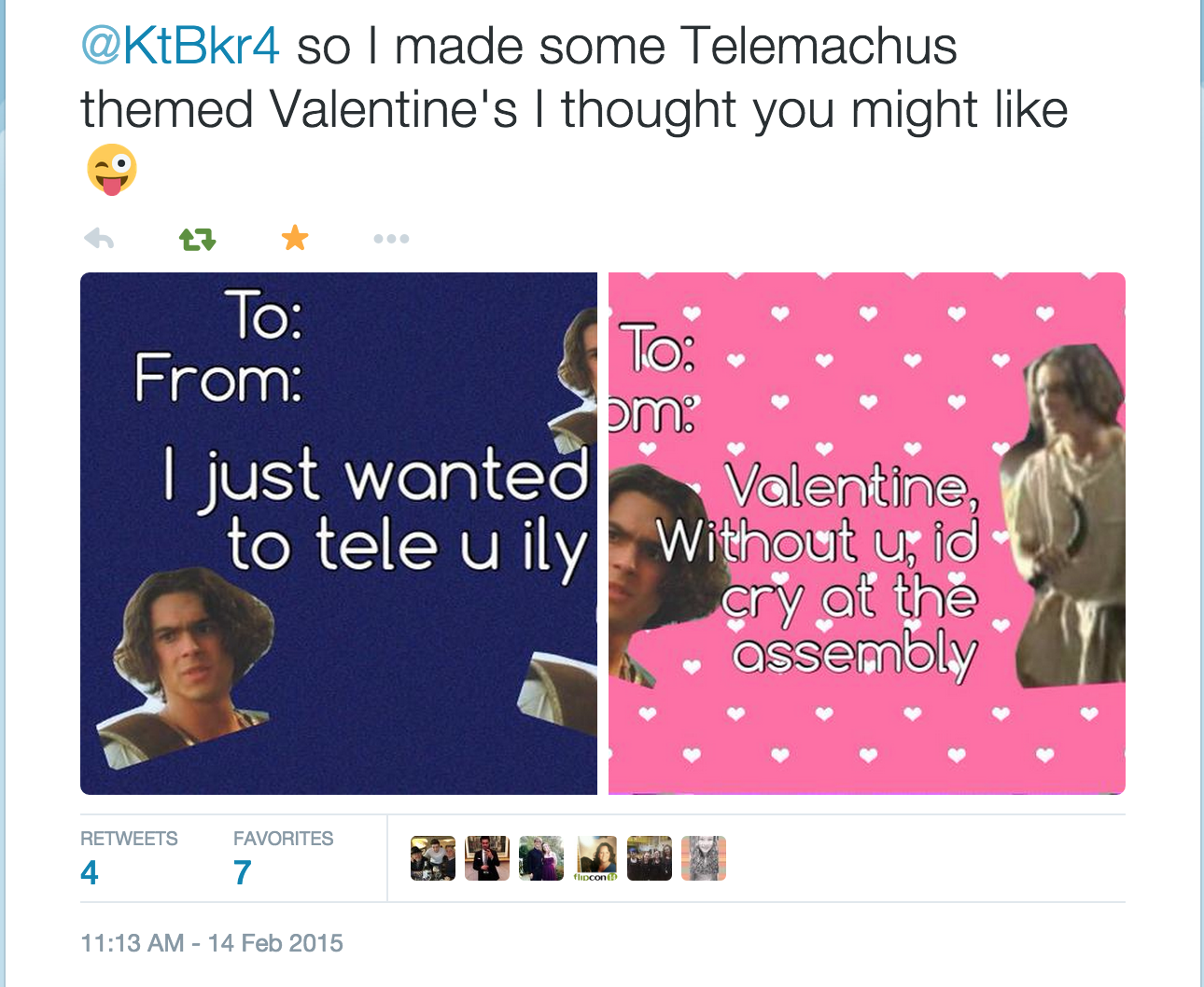
And if that wasn't enough, almost a year later on Valentine's Day, one of these same students sent me Telemachus themed valentines via Twitter and, of course, tweeted them to Mr. Stenson.


So here we are, April 17th, and this year's crop of students are reading/watching The Odyssey, and in honor of seeing Telemachus projected on the screen in my room, my wonderfully nerdy former students deemed today "Telemachus Appreciation Day."


My current senior students aren't as impressed with our nerdiness, but one joined the fun, tweeting...


So in honor of Telemachus Appreciation Day, we wore our shirts again...


And tweeted more pics to Alan Stenson....


Thank the gods, actor Alan Stenson is a good sport!


Wednesday, November 5, 2014

Connecting with Authors via Social Media

While many will vilify social media and focus only on the posts where folks are acting inappropriately or unprofessionally, social media is very powerful tool for connecting regular ol' folks like you and me with experts in a field.  I use Facebook to share photos of my girls with family who live elsewhere and to keep up to date on what some of my favorite authors are up to.  I've had a guest post by author MJ Fletcher, and I've written before about connecting with Shakespearean actor/director and author David Blixt via Facebook and this week I had the opportunity to converse briefly with Diana Gabaldon.

Diana Gabaldon's Outlander series is at the top of my must-read list if you like historical fiction/sci-fi/fantasy/timetravel books. Her work is really knows no bounds of genre, and it so wonderfully well researched and written. Much to the delight of her fans, Gabaldon's novels have recently been turned in to a TV show on the Starz network sparking a whole series of blogs and websites dedicated to all things Outlandish which Gabaldon frequently shares the links to such sites via Facebook. One such site, Outlander Anatomy, is a fascinating read about the science of anatomy using the characters and events in the TV series as inspiration for the posts.  Gabaldon also shares excerpts from her novels and current projects, and she will even share HOW she writes.

As an English teacher, I deconstruct and analyze texts with my students, and often I am (and every English teacher out there is) accused of close reading too far into the text. My students will question, "How do you KNOW that Poe is using irony in "Cask of Amontillado?"  "How do you KNOW Shakespeare intended to invert the gender roles in the balcony scene of Romeo & Juliet?" My defense often involves supporting my opinion with proof from the text and, if available from the author, researched explanations. We also have a discussion about who creates meaning in texts: the writer or the reader? The answer is both.

I also use literature as a means for modeling writing for students.  We examine the techniques used by acclaimed authors and students attempt to use the same technique in their own writing. We examine Richard Peck's use of literary devices and motif in "Priscilla and the Wimps," Poe's use of narration, verbal irony and dialogue in "Cask of Amontillado," and Richard Connell's use of ellipsis and characterization in "The Most Dangerous Game". We analyze each author's style, diction, sentence structure, and I challenge students to attempt using these same techniques in our Create a Hero project. The students draft a profile of a hero they create, map out the storyline following Joseph Campbell's monomyth/hero's journey, and write a scene as if ripped from the pages of a larger novel. Students are now sharing their scenes and talking about the choices they made in crafting the story. So not only have we discussed how an author writes, but the students take on the role as authors and showcase how/why they wrote the scene they way they did.

Thanks to Facebook and the power of social media, I can share with students an example of how one author crafts a story and makes intentional choices when writing.  Take a look at these screenshots of Diana Gabaldon sharing an excerpt from her novel, Written in My Own Heart's Blood, complete with annotations explaining the scene. The original post is much, much longer, so you will have to go to Facebook to read the rest.


And if I didn't think Diana Gabaldon sharing her work was cool enough, she also REPLIED to my comments on her post validating how I teach writing through literature.