Integrating geography concepts into the ELA classroom is easy to do when a story features characters undertaking a physical journey. Students and teachers can create collaborative Google Maps pinned with specific locations to practice digital literacy and research skills.
To enliven our study of Homer's Odyssey, students worked collaboratively to create a map of Odysseus' and Telemachus' journeys. Using evidence from the text, students pinned a specific location on the map, selected an appropriate and symbolic icon for the pin, typed up a blurb about the location, inserted an image for the location, and attached a link to a source that would extend visitors' understanding of the location.
To facilitate the process, students were directed on the daily agenda posted to Edmodo to visit the Chrome Web Store and install the Google URL Shortener, Tab Scissors, and Tab Glue extensions.
The extensions allowed students to split their browser windows, placing them side by side for easier jumping between tabs, and the URL Shortener truncated the long links for inclusion in the pin description. Each pin's description can be color coded and enhanced with images, text, and links to other sources.
In addition to marking locations, students could map the travel routes, customizing the color and width of the line. Additionally, the style of the map can be changed as well.
Odysseus' journey from Ithaca to Troy and then to the Land of the Ciccones, and the Lotus Eaters. I can quickly see that this class is starting to get off course as they have skipped the Cyclops Island.
Throughout this "fun" collaborative class activity, students demonstrated digital literacy skills that included typing, searching, using the trackpad, and jumping between browser windows all the while speaking to each other face to face as they divvied up tasks and reviewed the content.
Brainstorming other ways to incorporate Google Maps in the ELA classroom, students could....
Pin where they went during summer or school-year breaks.
Research their heritage and pin locations where their families originated
Write a creative travel-themed short-story with pins of scene locations and the text of the scene in each pin's description
Compose poetry based on specific pinned locations.
How have you used Google Maps with your students?
What other ways could Google Maps be incorporated into your classroom?
Earlier this week, I was asked on Voxer by California colleague Beth Oing if I knew what "oam" means in Book IV of Samuel Butler's translation of The Odyssey. The understanding of the meaning of this one three letter word has sparked a journey of discovery spanning across various states and social media.
In context, Helen is stating that during this time in the Trojan War she has begun to yearn or long for home. But why didn't Butler just use the words "yearn" or "long"? There has to be a particular reason for that particular word. If readers understand "oam", will we see something more into Helen's character and mindset during this period?
Refiling through my Latin dictionary, I didn't recognize "oam" and assumed, since I'm not versed in Greek, that "oam" must be some sort of play on words and Butler was using a Greek word as a pun. But why would there be a Greek word mixed in with the Latin names of Ulysses and Menelaus? That didn't make sense either.
Carrying the conversation over to Twitter, I consulted 2014 Indiana State Teacher of the Year and Latin teacher Steve Perkins....
Thinking about diction and author's purpose, the literal English translation of the Greek as "her heart has turned to go toward home." By stating that Helen's heart had "turned" toward home, it implies that at one point she had turned away from home. So the mystery of the Rape of Helen -- whether she went willingly with Paris or was forcibly kidnapped-- seems to have an answer in Homer: Helen wanted to go with Paris! Could the word "oam" in Butler's translation signify this as well? But then why didn't Butler use the literal translation? I love reading The Odyssey with my students for so many reasons, but being able to explore word choice in the various translations (Lattimore is still my favorite) and discuss how individual words can shape the meaning has taught my students that words do matter!
Still not satisfied, Steve then broached the topic with contacts via email and his Latin educators group on Facebook....
@KtBkr4 I will contact some friends. Just emailed lib at St. John's College, Cambridge, which has the Butler manuscript, as well.
— INTOY2014 (@INTOY2014) April 23, 2015
Did you catch that??? Steve's friend at Cambridge looked at THE Butler manuscripts. Talk about consulting the source! This is like six degrees of separation-- with a few tweets, emails, and posts we were able to find a scholar with access to an original document to guide our understanding. What else can we research?!
This has be such an engaging and fun use of modern social media to solve an ancient mystery. I echo Mr. Steve Perkins' sentiments!
I contacted the Classics professor at my local university, but we still haven't come upon an answer for oam.
I LOVE it when students are just as nerdy as I am.
Last year reading Homer's Odyssey and watching the 1997 made-for-TV movie starring ArmandAssante, a trio of students were so intrigued (read: obssessed) with Odysseus' son Telemachus, that they tracked down the actor, Alan Stenson, who played him in the film, created fan club t-shirts (including one for me!), and shared pictures of the us wearing the shirts via social media, declaring themselves "Stensonites."
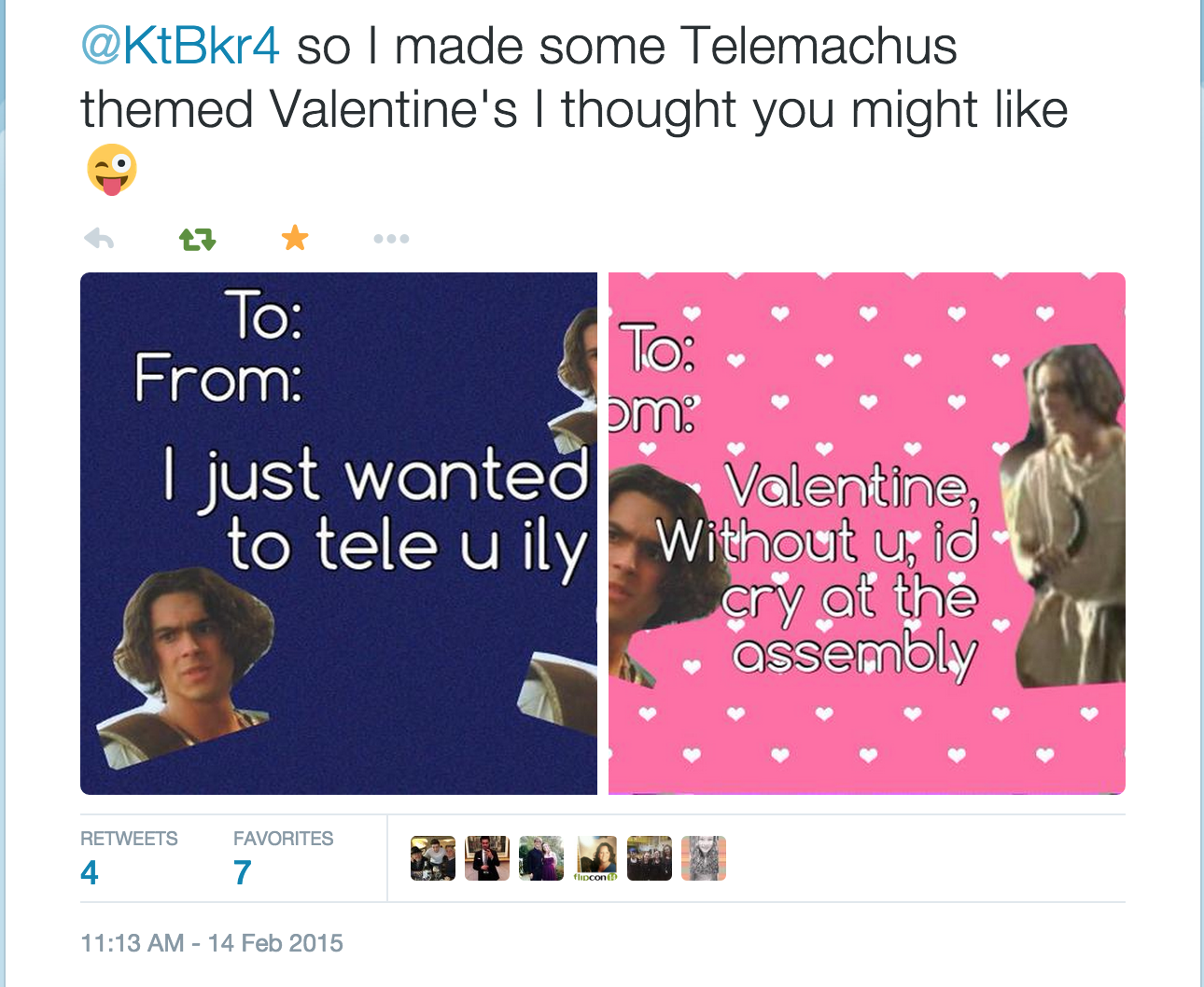
And if that wasn't enough, almost a year later on Valentine's Day, one of these same students sent me Telemachus themed valentines via Twitter and, of course, tweeted them to Mr. Stenson.
So here we are, April 17th, and this year's crop of students are reading/watching The Odyssey, and in honor of seeing Telemachus projected on the screen in my room, my wonderfully nerdy former students deemed today "Telemachus Appreciation Day."
Happy Alan Stenson fan club day everyone! 🎉🎉
— ❁Kelly Zuzic❁ (@kellykpizzle) April 17, 2015
My current senior students aren't as impressed with our nerdiness, but one joined the fun, tweeting...
February is Odyssey time for my students. I have been teaching Homer's Odyssey for every year of my career, even during student teaching. If there is a text to dive into deeply, this is it. There are so many topics I cover with this epic.
To name a few...
Joseph Campbell's Hero Journey-- students analyze how both Odysseus and Telemachus undergo a heroic transformation
Oral storytelling techniques-- Trojan War Stories, Odysseus' guest-gift of the story of his journey to the Phaiakians
Persuasive techniques-- compare and contrast Telemachus' speech at the Assembly (Book 2) with Athena's request to Zeus during the Council of the Gods (Book 1).
Societal Norms-- how literature teaches readers to behave in society and what happens when one doesn't behave (oh, those haughty suitors!)
Poetry Explications-- analyze contemporary poems inspired by the epic and write poetry explications
How I get students to dive deep into the Odyssey has changed over the years as I've tried different pedagogical approaches and infused educational technology tools. Last year was the first attempt at gamifying my instruction and, boy, did I get in over my head. While the delivery of the content and the tasks for completion were effective, I got swamped with managing "the game". I had too many moving pieces and I couldn't effectively "level up" individual students. The content was organized in one Edmodo group with subtopics divided into small groups. Students had to be manually added to the small groups when they were ready to level up.
Problem solving this with my colleagues in my Master of Arts in Instructional Technology cohort, Mr. Astin recommended automating the leveling up by using Google Forms and Flubaroo. Rather than keeping all the content in one Edmodo group, Mr. Astin recommended having an Edmodo group for each topic, students complete the tasks, then take a mastery test on a Google Form with Flubaroo set to automatically score the test. If students scored proficiently, they would receive an email with join URL for the next group. I would get a notification stating that a student wanted to join the group and I could quickly see if they completed the previous group's tasks. If so, I approved access; if not, I sent a message to the student that he/she needed to make sure all tasks were completed proficiently.
So far, this tweaked "game" design has worked very well! I front loaded the content in each group and let students begin their epic quest to become an #OdysseyExpert. Students are engaged, taking responsibility for their learning, and diving in deep.
And if this evident of having an impact, one of my students from last year tweeted me on Valentine's Day with Telemachus themed cards she made! My favorite is the one on the right.
In addition to all this awesome deeper learning, I'm surreptitiously preparing my students for the PARCC -- they are using the exact digital literacy skills needed to be successful on the PARCC without me teaching to the test. By the way, we begin PARCC testing on Monday. And my opinions on the PARCC are reserved for another blog post...
Since chatting with Tom Driscoll via Google Hangout and Brian Germaine at the EdSurge RIDE event in the Fall, meeting up with Chris Aviles at Techspo14, viewing Mr. Lewis' Edmodo Webinar on Gamification, and engaging with my #TeamMAITs in class, I'm intrigued by the didactic nature of games. I've been thinking about how to use gamification with my students to restructure the learning activities to mimic aspects of a video game that encourage student involvement in the classroom. Using a simplistic approach, I decided not to go full tilt with a backstory and XP spreadsheets and instead tried this out by first changing how I deliver content to the students. Because gamification promotes blended-flipped learning, behaviorism conditioning techniques and self-paced instruction, I'm hopeful that this instructional design will help meet the needs of some of my lower-level, reluctant learners.
Deploying a combination of 1:1, BYOD, and paper-based activities, I am able to give my students an opportunity to pace themselves through the levels. Scheduling consistent time in the computer lab, 3 days a week throughout the unit we are 1:1 with Chromebooks and computers. But keep in mind, while the students are allowed to go at their own pace within the window I give them, they do not have to work alone. Even when in front of the computers, my students discuss the material and engage with each other. The other two days a week, we are in the classroom using BYOD for group and teacher-led activities.
Instructional Game Design
In Edmodo, I created a separate group exclusively for our Greek Mythology and Odyssey Unit. On the main newsfeed, there is one welcoming message that provides an overview of the design and unit. All of the subtopics for the unit are organized in individual small groups, of which all of my students are members of. I also have all groups set to read-only. Students will access resources and assignments in the small groups, but all discussions and sharing of their work will take place in our original class group. Students can only see the small groups they have completed or are currently in. As students successfully complete the tasks of one group, I "unlock" and add the students to the next small group--my version of "leveling up".
Take a look at this screencast to see the group set up:
I think this is an effective design because the students won't get lost scrolling through the myriad of posts that appear on our ever-updating class newsfeed. All content is organized by subject/keyword, so if a students needs to refer to resources on the gods and goddesses of Greek Mythology, they simply go to that small group and see the 5-10 items listed on the newsfeed. Organization and archiving of resources is much more manageable than trying to rifle through a three-ring binder or online folders.
Also, I like this design because I will have student performance organized by topic/unit. I see very quickly how well a student performs in this particular unit, as opposed to my district gradebook which keeps a running tally of all grades for the marking period. I can also use the Edmodo gradebook as my leaderboard for the "game".
I'm considering setting up all of my units for next year using this "game" design with each unit having its own Edmodo group, and as I become more proficient I can incorporate more gaming techniques.
Behaviorism is a Game
Video games are behaviorism in action. We've all felt the addictive pull of playing a video game: look at the popularity of games such as Candy Crush, Plants vs. Zombies, Fruit Ninja, and systems such as Xbox, Wii, and PlayStation. We are bombarded with positive and negative reinforcement every time we play: extra points, bonuses, difficult levels, and the thrill of success. So attempting to mimic these elements, I use badges, positive comments, and quick tasks to encourage students to "level-up" to the next small group.
In Edmodo, I created badges specific to the Odyssey unit and award them as students perform. I am surprised at how badges positively reinforce the students-- they keep doing more to get more badges. I can barely keep up with them! Some badges are awarded for completing a level, other badges are awarded for behavior (helping others, quick problem solving, etc.). Luckily badge making in Edmodo is very simple and adding badges to a group is even easier. I'm torn though: I'm glad that my students are motivated, but I wish that they weren't so externally motivated. Then again, you can't have intrinsic motivation if you are told to do it.
Since the tasks in each group take about 15-30 minutes maximum, students can quickly level up after demonstrating proficiency. This was a big tip from Tom Driscoll: in order to keep students hooked, they should be able to "level up" quickly. So rather than cramming a bazillion assignments in each group, I created more groups with few assignments in each. This also helps to keep me on track with grading. I have caught myself procrastinating on grading big assignments because they take so long to grade, but with smaller assignments, I too can feel the success of leveling up and completing a task because I can grade a set of small assignments quickly adding positive and constructive comments as needed. By increasing the frequency of completion, we all receive the positive reinforcement more often.
I will agree that gamification seems gimmicky, but keep the notion of the game in mind. How many levels are in Candy Crush? How many can you get through in one sitting? And what happens when you can't get through a level quickly? Yup, you use up all of your "life," get bored and walk away from the game. But progress quickly and you find enjoyment playing. But I can't help wonder: Do we play the game because we want to, or do we keep playing the game because we've been conditioned to?
I'm still figuring this out as I go, and I have lots of room for improvement both in design and execution. Look for some more posts on this topic and my students and I continue our quest. If you have any tips, tricks, or best practices, please share!




.png)