Saturday, July 18, 2015

Clicking with Cliques at Conferences #Flipcon15 #ISTE2015 #ECET2


We've been having a discussion in the newly formed #Flipcon15 Continued Voxer group about how to get new attendees more comfortable and connected at the conference. Check out Jason Bretzmann's blog post and Christina Roy's post on this subject too.  Attending large conferences is an overwhelming experience:  so many sessions, so many people, so many places!  I would not recommend STARTING to form a Professional Learning Network when attending a conference for the first time.  In order to have a connected experience at a conference, the connections need to be made before I ever set foot on site.

I did not learn about ISTE, ECET2, or Flipcon from an advertisement online or in a mailer. I am not motivated to attend the conferences because of the glossy pictures or catchy graphics.  I am motivated to attend conferences because of the PEOPLE.

Having an insatiable hunger to learn, I first dove into the professional education pool through Twitter.  The very first conference I "attended" (ok, lurked via Twitter) was the 2012 State of Now #140 conference in New York City. Happening upon the link to the live stream of Chris Lehmann's keynote, I was captivated. I was even more enthralled as I realized folks were talking about the conference through Twitter.  It was here the I first connected with Cheryl Morris and Andrew Thomasson who were also lurking online. Discovering we have similar educational mindsets, they connected me to the #flipclass chat.  Having found the #flipclass chat, I discovered #Flipcon and attended virtually in 2013 which then led to attending in person at #Flipcon14 and #Flipcon15.  The #flipclass chat also connected me and many others to Jason Bretzmann who crowdsourced us as contributing authors for the book Flipping 2.0.  Say what?! Yup, thanks to a Twitter chat, I'm a published author.

When I attended #Flipcon14, I had a list of people I "knew" through Twitter and #flipclass who I couldn't wait to meet in person.  The experience is akin to online dating:  connect online, then meet in person.  At #Flipcon14, there was no awkwardness or trepidation because, unlike folks who may misrepresent themselves on online dating sites, who we are online is who we are in person.  There was and still is no need to misrepresent ourselves online. Meeting Shai, Carla, and Lindsay for the first time face to face at #Flipcon15 was not an awkward experience because we already connected throughout the year via the #flipclass chat.


As Crystal Kirch and others stated, attending #Flipcon is like attending a family reunion. And while I want to form new connections with new attendees I have never connected with before, I am just so thrilled to see face to face the online folks who I've already "met" and who "get me" and understand me.


Keep in mind, my connections have grown with conference I attend. So in my first iteration of attending #Flipcon13 virtually, I really only knew Cheryl and Andrew, but at #Flipcon14 I connected with more people, and at #Flipcon15, I connected with even more people as evident by all the selfies I took (see all the pictures here).  My connections have grown exponentially each year. Also, the connections I've made have encouraged me to not only attend conferences but also to present at them. I'm no longer a passive attendee, but an active participant. My confidence and comfort level has increased the more I've interacted.

I've also learned not take for granted the connections at home.  In 2012, I happened upon a tweet sent by Kyle Calderwood who was calling for proposals for #TeachMeetNJ.  So ecstatic that there was a local conference, I signed up to present and started talking to him via Twitter. 
When I read the above tweet, I thought, "Oh! She must be reading my blog!" How else would this wife of a guy from Twitter know that I do "amazing stuff" with my students?!  Well, I started poking around through Twitter profiles and realized, (insert Homer Simpson "duh-oh!"), that Kyle's wife TEACHES IN MY DISTRICT.  Talk about slap to the forehead and lesson in humility.

Long story short, Liz and I threw together a session at the 2012 TeachMeetNJ on Edmodo and it went so well that we continued to present together at local edcamps and decided to submit a proposal to present at Edmodocon in the summer of 2013. Presenting at Edmodocon 2013 connected us to Edmodo staff who then encouraged us to submit our session, "Classroom Gymnastics: Using Edmodo to Flip and Blend your Class," to present at ISTE 2014 in Atlanta.

Presenting at ISTE 2014 was not an overwhelming experience because I had Liz and Kyle showing me the ropes of attending a big conference.  We carved out our niches in the vast ISTE landscape as the folks we knew from Twitter met up in Blogger's Cafe and the New Attendee Lounge areas.  If it weren't for my conference buddy, Liz Calderwood, and the #eduawesome folks of Twitter, ISTE 2014 would not have been such an amazing experience that influenced me to present at ISTE 2015.

It is also through Twitter that I connected with the indomitable Barry Saide who, long story short, crowdsourced a bunch of New Jersey educators to create the NJPAECET2 convening in September 2014 and later invited us to the national ECET2 convening in New Orleans in October 2014. It was Barry's ability to see our strengths and talents and bring together the group to connect us to the greater ECET2 network.  We are in the final stages of planning the 2015 NJPAECET2 convening to get other local educators connected.  Because Barry paid it forward to me to attend ECET2 in 2014, I paid it forward to my colleague Kim who I knew needed to be elevated and celebrated and nominated her to attend the 2015 ECET2 convening in Seattle.  Whereas I knew people prior to attending, Kim did not and was new to Twitter. So while she was in Seattle and I was on the road at #Flipcon15, I texted and tweeted her with missions to go find specific Twitter people who I knew were also at ECET2.


The point I'm trying to make is that I primarily use conferences to solidify and strengthen relationships. I do connect with new folks, but most of those new connections are because the new person is connected to someone I already know from Twitter.  So my advice, get connected before ever setting foot on site at a conference.

To recap how I make large conferences feel small:

  1. Get on Twitter and find folks who help you grow as an educator. Through them you will make new connections.
  2. Find a conference buddy who has attended the event previously and either travel together or plan to meet up.
  3. Follow the conference hashtag, follow folks who are tweeting, start an online conversation, then find out where folks are meeting up face to face. If your Twitter handle is written on your badge, folks will realize who you are from Twitter and you won't need to break the ice face to face ("Oh, YOU'RE  @____, I follow you!"). 
  4. Keep tweeting and keep attending conferences to expand your circles of friends.
  5. Find ways to pay it forward and bring new folks into the fold.


And as a final note, if you are wondering how to take the first step, click on all the hyperlinks to people's Twitter profiles in this post to expand your PLN and consider the words of Saint Augustine below...


Saturday, July 11, 2015

Link to Posts in Edmodo

Every post in Edmodo has an unique URL.  Grabbing the link to a post in Edmodo is a simple process as shown in the video below.


Why would you want to grab a link to a post?  This is an easy way to track student participation in a group.  Rather than trying to tally up how many times a student posted or replied in a group, create an assignment where the student turns in the links to either the posts they created or replied to.  I use this method to keep track of participation in our Scribe City writing group.


If you notice in the above assignments, the students are posting their writing/replies publicly to the group AND turning in a 5-10 sentence reflection on the process which only I will read.  This step helps to build metacognitive thinking skills. Using this process of turning in a link to a post saves me time with assessing student participation and keeps the students writing.


Friday, July 10, 2015

Remind-- Class Announcements & Benedictions

Remind has been a very useful tool for keeping my parents and students up to date on class announcements.  The one-direction text messaging makes it easy for me to blast out class room changes, reminders to study, or general messages.


My senior students especially appreciated the text messages I sent the night of their prom. Many came in to class the following Monday after prom and said, "I got your text, Mrs. Baker. We behaved ourselves."


This small gesture of sending a text to let them know I cared and was worried about their safety and well-being helped to solidify our working relationship in the classroom.  When students know teachers care about them as people, students will work harder for their teachers.This got me thinking, now that my seniors have graduated and my former freshmen are growing up and will someday leave the nest, how can I let them know that I still think about them?

At the end of every year I've been teaching, I give my students a parting gift of thoughtfulness.  I create business-size cards that on each have an inspirational quote.  I find the quotes on the internet, paste them into a Word doc, play with the fonts, print, laminate, and cut the pages down to business-size cards.  On the last day before exams, I walk around the room and with the cards facing down, ask each student to pick a card. They keep the card putting it in their wallet, phone case, sock drawer, etc. The cards have a funny way of finding the right person-- granted this is akin to reading one's horoscope in the newspaper, but I play up the magic of the card and make sincere statements, "Oh!  That quote is soooo good for you! ... Wow, that one is spot on!" I also create a stack of cards for my swim team before each big meet.  Former students and swimmers will stop by and visit to say HI and let me know, "I still have my cards!"


So this got me thinking, what if I combined the two?  What if I still do the quote cards, but now have a digital version too?  I could repurpose Remind to text out an inspirational quote once a day, twice a week, holidays.... whenever! I can do the same thing on Twitter or Instagram, but I want the messages to go to my students (and whoever else wants to follow) without having all the other issues with social media.  I don't have to worry about following/friending students.  The messages are one directional and, as long as I send them appropriately, there should be no issue.

So, if you would like to receive a sometime daily, sometime weekly, whenever inspirational thought, subscribe to my KBaker's Benedictions group on Remind following the directions below.


Thursday, July 9, 2015

Creating Student Community Writing Spaces

Using Kidblog, I tried blogging with my students during the 2013-14 school year, and while they did fine writing, we struggled with finding an authentic audience to comment on the 130 individual blogs.  I wanted to generate traffic with #comments4kids, but my district was very leery of having student writing set free in the wilds of the internet.  I understood the administrations skepticism and kept my students in a walled garden.  So our blogs became nothing more than online journals.

I know there are teachers and classes out there who are very successful at blogging, but for me it just could not continue outside of the classroom.  Quadblogging with other classes was out because I couldn't guarantee consistent access to computers for my students.  I entered the 2014-15 school year with PARCC looming and defeatist attitude towards blogging with my students.

But I did spy a certain kind of hope: my ELAFlip Voxer group is ever the wealth of ideas and support. And I asked the group if they would be willing to create an Edmodo writing group. Sticking with the theme of gamification for one of the teachers, we named the group Scribe City.  In this group, students post drafts of their work and receive feedback from students. The group is very organic. Teachers assign tasks as they align with their lesson plans. We don't have a set schedule for posting writing or giving feedback, and even when PARCC acquired all technology in my building, we could keep participating in Scribe City because students could access Edmodo on the phones or at home.


In Scribe City, students post writing as either part of the Edmodo Note or an attached Google Doc any time, and anyone in the group can comment. We encourage the students to comment on content, grammar, diction, style etc by providing constructive criticism--something that will make the writing better and not just confirm (ie "good job!")--even suggesting resources that would help. We also tell the writers that they are to provide an explanation of the task/assignment and state what they specifically would like feedback on or help with. We want students to engage in a conversation with the others about writing. General digital citizenship rules apply as students demonstrate collegial communication skills. Teachers monitor the group to make sure everyone is appropriate. To make sure the group is active, we let each other know when our students are posting assignments.

Scribe City has also become a haven for my artistic, introverted students, with one student making it her writing residence. Maddy was an Honors student in my 8th period 2013-14 freshmen class. Gifted writer, she was painfully shy and never spoke up in class. When I started Scribe City in 2014-15, I sought Maddy out in the halls and told her about the group. Giving her the join code, I encouraged her to jump in and share her writing even though she was no longer a freshmen. Without any additional prompting, Maddy posted her poetry and short stories.  She engage in conversations with the other students without trepidation.

Maddy's identity has been protected by a disguise. 


No matter what tools we share or strategies we devise, as educators we are constantly seeking out what works for our students and ourselves.  While blogging didn't quite work as well as I hoped, Scribe City has been success.  If you are interested in join the group, please contact me.  I also welcome any comments on how you've implemented blogging or created other places for students to write for an audience.


Wednesday, July 8, 2015

#ISTE2015 Peer Evaluation & a BAM Radio Interview

So, this happened.....  Jon Bergmann, flipclass pioneer, interviewed me about my peer evaluation techniques at ISTE.

How did that happen???  Well, after chatting about what I do during lunch with Jon Bergmann, Aaron Sams, and Crystal Kirch, Jon says, "I need to interview you right now for my radio show!"  Say, what?!  I didn't even have time to process his statement.  Next thing I know, Jon finds a quiet spot, whips out his phone and starts recording and asking me questions. You can listen to the podcast of the interview with Jon Bergmann here.

That was on Sunday. On Tuesday, I presented my ISTE session, "Best Practices & Digital Tools for Feedback, Assessment, & Evaluation," to a packed room. No open seats and folks were even sitting on the floor!


To learn how/why I got started with peer evaluation, read this.


Since my student teaching days, I've been refining my peer evaluation process, and with Google Apps for Education, the process has become paperless. Google Classroom makes it easy to manage the workflow. Keep in mind, the following steps take place over the course of a week or so. Students get their writing evaluated by classmates, and then the writers evaluate their evaluators. The objectives of this process are centered on fostering a community of writers and having a dialogue about student work. Students are engaging in an analytical, reflective, and metacognitive process.


GOOGLE CLASSROOM STEPS:
  1. Create an assignment in Google Classroom for students to turn in their writing.
  2. Create a Google Form for the peer evaluation.  I use a combination of rubrics: checklist of requirements, numerical qualities, and Outstanding/Satisfactory/Unsatisfactory (OSU) to assess quality. 
  3. Share the writing pieces with the class. Classroom will automatically put all student work in to an assignment folder which you can share with the class. I prefer to set the permissions to "Anyone with link can COMMENT." When you change the folder settings, it will change every document in the folder to match the sharing permissions of the folder. 
  4. Create an announcement where you provide the link to the shared folder and the Google Form for evaluation. Students open folder, select essays to read and evaluate on the Google Form. I encourage students to do at least 5 different evaluations. 
  5. Create another Classroom assignment for analyzing the evaluations. I create a template Google Doc with guiding questions and have Classroom create a copy for each student and I attach the master spreadsheet for the students to copy/paste their particular data. Students analyze their data and agree/disagree with the itemized evaluations as well as the whole evaluation. They must provide evidence to support their agreement/disagreement with the evaluations. 
  6. Create another Google Form for the Evaluation of the Evaluator.  Writers will fill out the form providing their evaluator with feedback on the quality of the evaluation. I've also used the Autocrat add-on to auto deliver the feedback to a Google Doc for each evaluator instead of doing the next step. 
  7. Create another Classroom assignment for analyzing the evaluation of the evaluator with another Google Doc template (again set it so Classroom generates a copy for each student to edit) and the link to the spreadsheet attached. Students copy/paste their corresponding data on to their Google Doc and analyze/reflect on how well they evaluated their classmates.

Throughout this entire process, I am monitoring the students and checking the spreadsheets.  If I see something out of joint (someone isn't pulling his/her weight), I will speak directly to the student and provide redirection.  Students are also allowed to talk to one another while working on the evaluations. I keep an ear on the conversations and will jump in as needed.


So I know this process is an overwhelming amount to digest at once.  I do not do all of this right away.  I scaffold the process and gradually ease students into this. Here is my instructional design:

Marking period 1: Foster an open community by getting students accustomed to sharing their work.  Everything from worksheets to quick writes is shared with a neighbor.  I also have students post their finished work to our Share Our Work small group and Scribe City group in Edmodo (more on the Edmodo groups in another blog post).  We do quick peer evaluation activities on paper to start and by the end of the marking period use Google Forms. We have discussions on how to evaluate each other's work with students writing self-evaluations. No formal evaluations of the evaluator just yet.

Marking period 2: We maintain our open community, but the writing tasks and peer evaluations have increased in complexity and length. We no longer use paper to evaluate, everything is on Google forms.  Students still complete self-evaluations and begin to use Google Forms to evaluate the evaluator.

Marking period 3: Pull it all together!  Students engage in the entire process completing formal evaluations of writing tasks and the evaluators. Everything is on Google Forms and in Classroom.

Marking period 4: Continue. Continue. Continue.  As a final project, students write up a final self-reflection as a writer and evaluator examining their growth through out the entire year.


So that is it in a nutshell.  Did I lose you through all of this?  Need clarification?  PLEASE, share and let me know what you do with your students.  I am continually tweaking this process, so I value your contributions!

Monday, July 6, 2015

Hi, Blog! Nice to see you again!

What a school year this has been:  2 buildings, 3 classrooms, 3 preps, and every time the bell rang I was on the move again.  Forget being a cart-teacher, my classroom supplies were stashed in my ginormous school bag or online.  Despite the traveling, this schedule taught me important lessons:

1. The classroom is an extension of my teaching, and without it, I flounder.  Even though I'm a high school teacher, I still like to hang up student work on the bulletin board and rearrange furniture on the fly. I also like to do silly things, like allowing students to brainstorm on the windows with whiteboard markers.  Being a guest for 1-2 periods in another teacher's room hampered spontaneity and decorating.

2. Being a guest for 1-2 periods in another teacher's room taught me lessons about compromising and having to accept things I can't control. After having "my own room" for 10+ years, I realized how set in my ways I had become.

3. On a positive note, the schedule forced me out of the room and I was able to socialize and connect with folks I might not have otherwise seen if I were in one classroom all day long. I greatly enjoyed connecting and unofficially mentoring new teachers in the department. Collaboration is the spice of teaching (to mangle that cliche).

4. I love teaching freshmen.  Don't get me wrong, I enjoyed teaching the seniors, but the dynamic and energy level of the two age groups affected my instructional approaches.  It was a dog fight to get my 1st & 3rd period seniors interested and moving.  It was also exhausting wrangling the freshmen, but I was able to feed off of their energy level.  I also have 16 years of teaching freshmen literature, so I can teach OMM, Odyssey, and R&J with my eyes closed. With the senior literature, I struggled with not being an expert-- I know Beowulf on a reading comprehension level, but I do not know the Anglo-Saxons as well as I know the Greeks. While I consider myself lead-learner, I also value being the expert in the room.  If I want my students to dive deeper into the literature, I need to expertly lead them. This year was about testing the waters to see if I wanted to switch to seniors full-time. I know for sure where I am most effective.


So, next year's schedule is back to freshmen full-time.  One classroom. 2 preps: Honors Eng 9 and English 9.  I am very excited to continue tweaking lessons and tinkering with technology integration.

And now that the school year is over, I can use this summer to write and plan.  Some previews for the blog...


  •  #TeachersWrite! Online summer camp for teachers who are looking for guidance and a community for writing.  The first assignment started today with the focus on wondering.  
  • ISTE15 pictures and recap.  
  • Flipcon15 recap
  • NJPAECET2 preview
  • Other posts on Grammarly, Pronoun Usage in Game of Thrones, and more!

My blog has seen little love over this year and it is about time I get back to it!


Wednesday, May 13, 2015

#NJPAECET2 is Looking for YOU!


I am on the steering committee of NJPAECT2, and we are seeking proposals for workshops and nominations for attendees of our convening on September 19-20, 2015. You can learn more about the event by visiting our site http://njpaecet2.org/.


Workshop session proposals can focus on any subject area (ELA, math, science, and social studies) or other area in education, such as technology integration, special education, digital literacy, CCSS, and differentiation of instruction. Please know you are not limited to these, and we encourage any and all ideas you have for a session you'd like to lead. Part of the NJ/PA ECET2 experience will be structured in a traditional conference format, where sessions will be 60 minutes in length. Please use this form https://goo.gl/fMAlCA to propose your idea for a workshop. Another part of the experience will be structured in an unconference style format, where sessions will be approximately 30 minutes in length. In an unconference experience, anyone can start or lead a conversation about any topic. The sessions for the unconference will be put together on the day of the event. If your session proposal is selected, please also consider having a discussion topic you'd like to lead during the unconference portion and bring it with you to NJ/PA ECET2. Proposals to present must be received by June 5, 2015 to be considered. Those selected to present will be notified via e-mail by June 19, 2015.


What we're looking to do is identify teachers who have teacher-leadership skills, are doing great things in their classroom, or would benefit from becoming more connected. We'd like to feature more pre-serv Ts and young alum of colleges/universities to build their presentation skills, PLN, and give them more contacts when they are out in the field looking for work.


Last year we had 56 breakout sessions, Ted style-talks, breakfast/snack/lunch/snack/dinner/open bar, plus the second day was full unconference. We trended #1 on Twitter for both days, 15% of our attendees wrote blog posts, and we were even featured in the Star Ledger.


Anyone from NJ and PA can propose a presentation, nominate someone to attend, etc. We're looking for people who are just looking to give back. Are you interested in presenting or passing this https://goo.gl/fMAlCA on to folks you know who would give excellent presentations? Also, please nominate any NJ/PA educator that you think would benefit from attending this event https://goo.gl/0GmgnT.


Monday, April 27, 2015

Homework is an Oxymoron

Oxymoron = a figure of speech in which apparently contradictory terms appear in conjunction

Homework is an oxymoron.  Home and work are two separate places. Do I have plenty of work to do at home? Absolutely, things like laundry, dishes, cleaning.  I have plenty of home work to do... so why would I want to bring more work home?  And do I bring my work from home to school? Absolutely not!  That would be unprofessional, so why is it ok that work can infiltrate my home life?

As a parent, I have a new level of loathing for homework.  After being in a classroom all day, the last thing I want my girls to do is sit at the kitchen table working on homework.  I want them outside playing with their friends, climbing trees in the woods behind our house, riding bikes around the neighborhood... Actually my youngest daughter figured out that if she does her homework on the 30 minute bus-ride home, she won't have any work to do at home. Smart cookie! I do check it over, but rarely does she need to redo her buswork. She learned rather quickly to do it right on the bus or she would get stuck inside at home.

I want the same opportunity for my students.  After being confined to an uncomfortable desk for eight 43-minute periods, the last thing I want for my students is be stuck to a seat at home doing more work.

Homework for my students is finishing what they were not able to complete in class.  I make sure that students have plenty of time to complete their work in class, but not all students are studious in class, so they must bring some work home to finish.


Friday, April 24, 2015

One Word: Vocab in Context Mystery

Earlier this week, I was asked on Voxer by California colleague Beth Oing if I knew what "oam" means in Book IV of Samuel Butler's translation of The Odyssey.   The understanding of the meaning of this one three letter word has sparked a journey of discovery spanning across various states and social media.


Here is the passage in question, as captured from The Internet Classics Archive:


In context, Helen is stating that during this time in the Trojan War she has begun to yearn or long for home.  But why didn't Butler just use the words "yearn" or "long"? There has to be a particular reason for that particular word. If readers understand "oam", will we see something more into Helen's character and mindset during this period?

Refiling through my Latin dictionary, I didn't recognize "oam" and assumed,  since I'm not versed in Greek, that "oam" must be some sort of play on words and Butler was using a Greek word as a pun. But why would there be a Greek word mixed in with the Latin names of Ulysses and Menelaus?  That didn't make sense either.

Carrying the conversation over to Twitter, I consulted 2014 Indiana State Teacher of the Year and Latin teacher Steve Perkins....


Thinking about diction and author's purpose, the literal English translation of the Greek as "her heart has turned to go toward home." By stating that Helen's heart had "turned" toward home, it implies that at one point she had turned away from home.  So the mystery of the Rape of Helen -- whether she went willingly with Paris or was forcibly kidnapped-- seems to have an answer in Homer: Helen wanted to go with Paris!  Could the word "oam" in Butler's translation signify this as well?  But then why didn't Butler use the literal translation? I love reading The Odyssey with my students for so many reasons, but being able to explore word choice in the various translations (Lattimore is still my favorite) and discuss how individual words can shape the meaning has taught my students that words do matter!


Still not satisfied, Steve then broached the topic with contacts via email and  his Latin educators group on Facebook....


Did you catch that??? Steve's friend at Cambridge looked at THE Butler manuscripts. Talk about consulting the source!  This is like six degrees of separation-- with a few tweets, emails, and posts we were able to find a scholar with access to an original document to guide our understanding.  What else can we research?! 


This has be such an engaging and fun use of modern social media to solve an ancient mystery. I echo Mr. Steve Perkins' sentiments!

I contacted the Classics professor at my local university, but we still haven't come upon an answer for oam.


The mystery continues!  


Friday, April 17, 2015

Happy Telemachus Appreciation Day!

I LOVE it when students are just as nerdy as I am.

Last year reading Homer's Odyssey and watching the 1997 made-for-TV movie starring Armand Assante, a trio of students were so intrigued (read: obssessed) with Odysseus' son Telemachus, that they tracked down the actor, Alan Stenson, who played him in the film, created fan club t-shirts (including one for me!), and shared pictures of the us wearing the shirts via social media, declaring themselves "Stensonites."


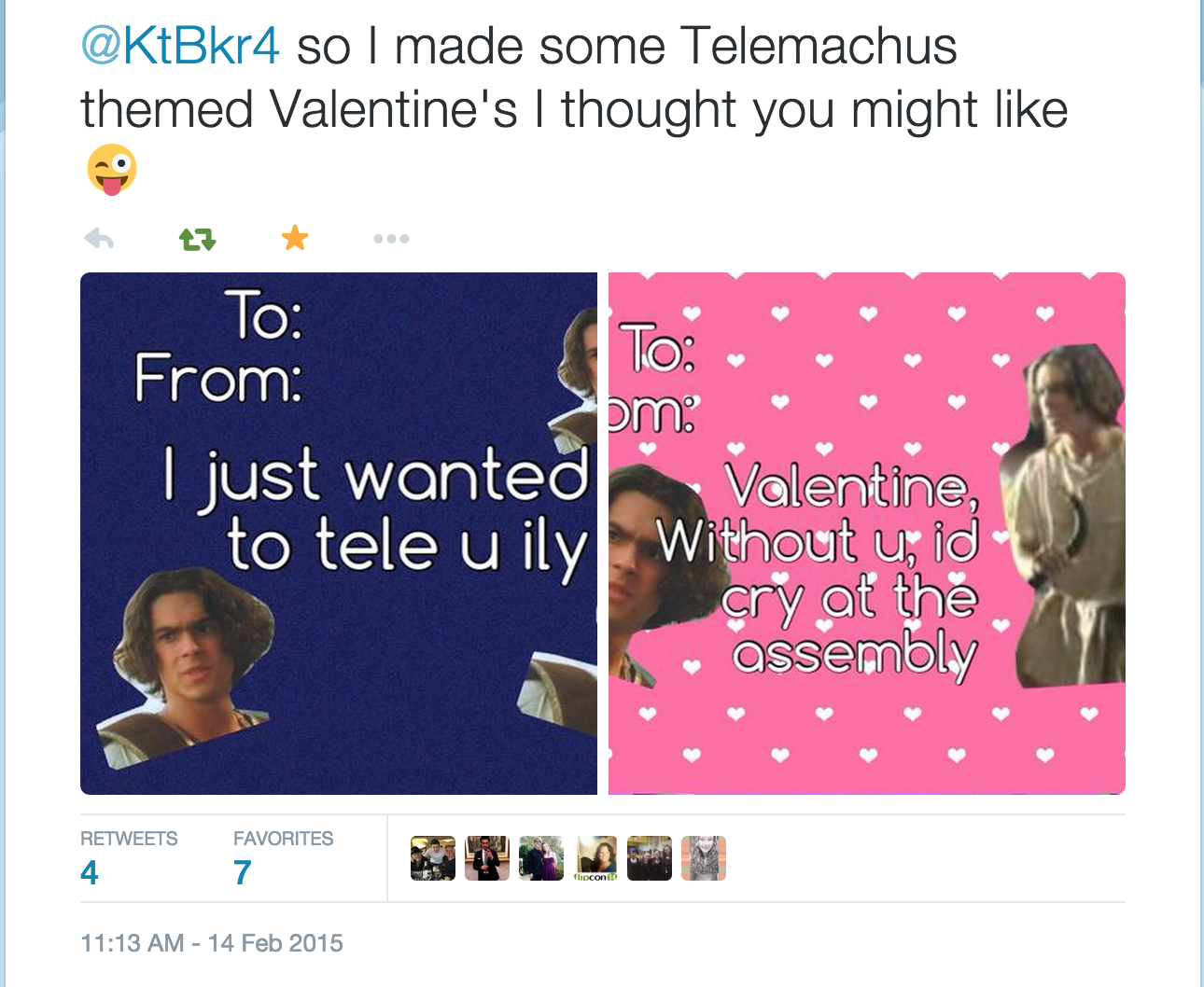
And if that wasn't enough, almost a year later on Valentine's Day, one of these same students sent me Telemachus themed valentines via Twitter and, of course, tweeted them to Mr. Stenson.


So here we are, April 17th, and this year's crop of students are reading/watching The Odyssey, and in honor of seeing Telemachus projected on the screen in my room, my wonderfully nerdy former students deemed today "Telemachus Appreciation Day."


My current senior students aren't as impressed with our nerdiness, but one joined the fun, tweeting...


So in honor of Telemachus Appreciation Day, we wore our shirts again...


And tweeted more pics to Alan Stenson....


Thank the gods, actor Alan Stenson is a good sport!