This year I am trying a more transparent and strategic approach to my technology integration. I've always been mindful of the purpose of the tool, but I wonder if I've consistently conveyed that purpose to my students and colleagues. I have a plan. I know what I'm doing, but do others see it?
So, to get things started, I created a Digital Dashboard Google Document on which my students will see what sites we will be using consistently, the rationale for using that site, and an area in which they will type in login information---not their actual password, but hints or clues in case they forget. There are important class links to district sites, as well as extra rows for students to add additional sites they may choose to frequent.
Both Edmodo and Google Classroom give users the ability to generate an editable copy for each student with the file name and sharing permissions, so in the event that someone does not remember his/her password, the student can access the doc or I can offer clues. Many of the tools we will employ in class allow the teacher to reset passwords, but I want students to be responsible for their accounts before I access my dashboard.
If you like this design, go ahead and snag a copy, customizing it for your students. In the comments for this blog post, please share how you convey the purpose of technology integration to your staff and students.

Showing posts with label blended learning. Show all posts
Showing posts with label blended learning. Show all posts
Sunday, September 3, 2017

Saturday, September 2, 2017
How to Flip Back to School Night
In a previous post I shared about the results of flipping Back to School Night. Today, I'm going to show you step by step how I used blended learning to achieve those results.
The first few days of school: (Nothing crazy here) Have your Class Expectations typed up on either a Gdoc or Word document, photocopied and distributed to the students. I also include an area on the document for student and parent signatures. Give your students a few days to obtain the parent signatures.
I do not read the expectations document to the students in class because all teachers in all other classes are doing the same thing and my expectations will get lost in the shuffle. I do tell the students that they are to read the document carefully before signing.
So what do students do instead of passively sitting listing to me drone on about the course expectations? We are jumping right in to learning activities: icebreakers, group work, problem solving, etc. For the 2017-18 school year, I'm going to start with an editable Escape Room / Break Out activity created by Nouvelle ELA. I don't normally purchase items from Teachers Pay Teachers, but not being experienced in creating my own breakouts yet, I thought this was a worthy investment, and at less than $6, a real deal!
Recording & Delivering the Video:
There are a few simple steps for recording your video and making it interactive for parents and students.
After the Video: Following up with parents after the video is important for community building and creating an open dialogue with parents. All parents should be sent an email thanking them for their completion of this task and inviting them to Back to School Night.
If your Back to School Night is anything like mine (9 minutes per class with 5 minutes between each), it is impossible to do a deep dive and convey all of the information about your course to parents. Also, due to work schedules and such, not all parents attend Back to School Night, so rather than thinking of this event in terms of information delivery, focus on how to let the parents in the room experience your class with a short learning activity. Let the video be the information delivery mechanism, as you can ensure all parents and students take the time to view it and answer the corresponding questions.
The first few days of school: (Nothing crazy here) Have your Class Expectations typed up on either a Gdoc or Word document, photocopied and distributed to the students. I also include an area on the document for student and parent signatures. Give your students a few days to obtain the parent signatures.
I do not read the expectations document to the students in class because all teachers in all other classes are doing the same thing and my expectations will get lost in the shuffle. I do tell the students that they are to read the document carefully before signing.
So what do students do instead of passively sitting listing to me drone on about the course expectations? We are jumping right in to learning activities: icebreakers, group work, problem solving, etc. For the 2017-18 school year, I'm going to start with an editable Escape Room / Break Out activity created by Nouvelle ELA. I don't normally purchase items from Teachers Pay Teachers, but not being experienced in creating my own breakouts yet, I thought this was a worthy investment, and at less than $6, a real deal!
Recording & Delivering the Video:
There are a few simple steps for recording your video and making it interactive for parents and students.
- Prepare your recording space by adjusting the lightning, background props, and alerting others that you don't want to be interrupted. Since you are providing an overview of your course, it is important to record your video in your classroom space. I put a sign on the door stating that I'm recording and do not want to be disturbed.
- Create a title slide for your video using Google Slides or PowerPoint. Keep it open on your desktop.
- Have open your Course Expectations document.
- Open Screencastomatic or Camtasia, and select recording a portion of your screen and have the picture in picture on. You want folks to see and hear you. So don't be camera shy! You will size the frame so that it captures the slide first. Tip: you don't need to put your slide in present mode, simply have the recording frame capture the area of the slide.

- Record a quick introduction stating your name and the course. Hit PAUSE on the recording.
- Switch to your course expectations document, resize the recording frame, and hit record.
- As you talk through the expectations, you will slowly scroll through the document. Try not to read from the document verbatim, and do not ramble! This video must be kept under 15 minutes.

- If you plan on importing the video into EDpuzzle or another interactive video tool, strategically pause after important moments so that you will have spaces to insert the questions which will check for understanding while watching the video.
- After you have finished talking through your course expectations, pause the recording, switch back to the title slide or create a slide that includes your contact information, resize the recording frame, and record a brief closing message. This will give your video a more polished feel by capping the ends with an opening and closing slide.
- Create a handout of questions to accompany the video. If using an interactive video tools such as EDpuzzle, insert the questions to check for understanding.
- At least two weeks prior to Back to School Night, assign the video lesson as homework, the student and parent must watch it together! The two week time frame allows parents to work around their schedules.
- So as to prevent tech issues from occurring, provide multiple avenues with which parents and students can access the video and reinforce that all answers are to be written on the question handout page. No matter the hardware, EDpuzzle allows for folks to view either by signing in to their account or through Guest Mode, so parents can experience the tool along side their student, but you don't have to worry about the student not completing the assignment if they have trouble logging in to their account at home.
- As students turn in the questions page, review the responses and make note of any patterns: if many got the same question incorrect, then you need to address the issue on Back to School Night and follow up with the parent individually in an email.


If your Back to School Night is anything like mine (9 minutes per class with 5 minutes between each), it is impossible to do a deep dive and convey all of the information about your course to parents. Also, due to work schedules and such, not all parents attend Back to School Night, so rather than thinking of this event in terms of information delivery, focus on how to let the parents in the room experience your class with a short learning activity. Let the video be the information delivery mechanism, as you can ensure all parents and students take the time to view it and answer the corresponding questions.
Thursday, December 15, 2016
Digital Portfolios with Google Tools
I realized that I was over complicating matters and making things too complex when it came to creating digital portfolios with my 9th grade ELA students. I am passionate about technology integration in my class, but I am mindful of how/why we use the technology. As I flip the learning in my class, it is easy to get inundated with the myriad of edtech tools and sites that are available. So, keeping things very simple, and sticking with what we know, I decided to capitalize on the power of Google Docs and hyperlinks to create digital portfolios with my students.
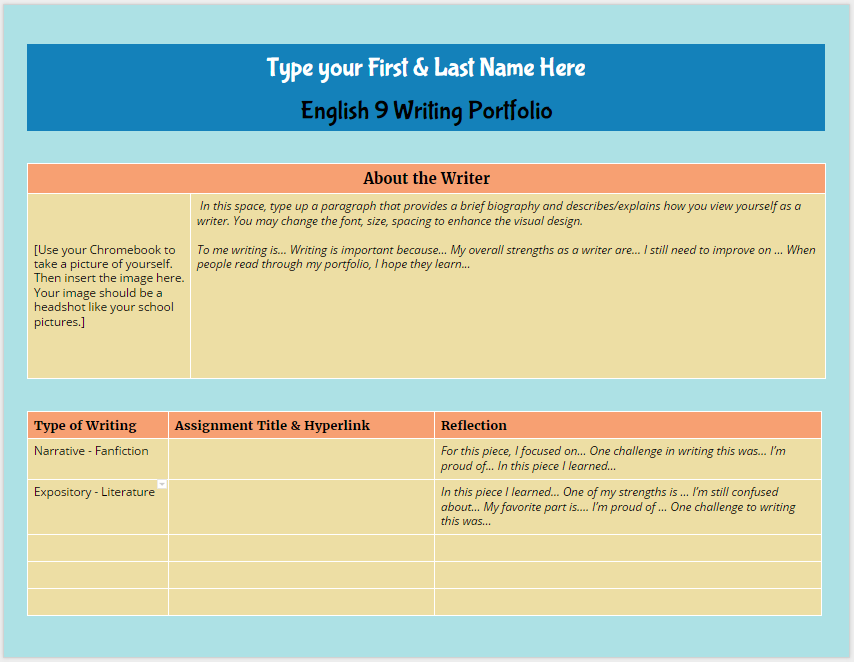
The portfolio is one Google Doc on which the student will list and link to each of the writing pieces, as well as write a brief reflection of what was learned about the process of writing.
If you notice, the rubric adds up to 100 points, but the columns for scoring are equivalent to a specific percentage and letter grade that aligns with the grade breakdown of my district:
A = 100-92
B = 91-83
C = 82-75
D = 74-70
F = 69-0
20/20 = A
18/20 = B
15/20 = C
12/20 = F
I do not give half scores or use other numbers for each column listed above. The numbers are the numbers, but you will see a greater range of scores when you look at the permutations of the possible rubric scores and what score shows mastery versus lacks proficiency.

Rubric design and scoring will have to be saved for another post. But, if you look at the permutations above, because I made set each column score to a specific number that aligns on the 100 percent/point scale, I've allowed for more possible passing scores than failing scores. As Rick Wormeli will tell you, the 100 point scale (especially in my district with 100-70 as passing) puts way too much emphasis on failing grades. My scoring flips this dynamic and puts the emphasis on the upper range.
BUT, the whole purpose of the digital writing portfolio is to de-emphasize grades and focus on publishing student work in a manner that is organized, reflective, and on-going, and using Google Docs as the housing system of students assignments is a method that is simple and sustainable. I don't have to worry about a special website or an app closing down in a few years, and students can easily replicate this process after high school graduation with their own personal Google Doc accounts to create portfolios for college and career.
The portfolio is one Google Doc on which the student will list and link to each of the writing pieces, as well as write a brief reflection of what was learned about the process of writing.
The Quick Steps:
- In Google Docs, create a template hyperdoc of the portfolio.
- In Google Slides, create a slide deck that walks students through the set-up process.
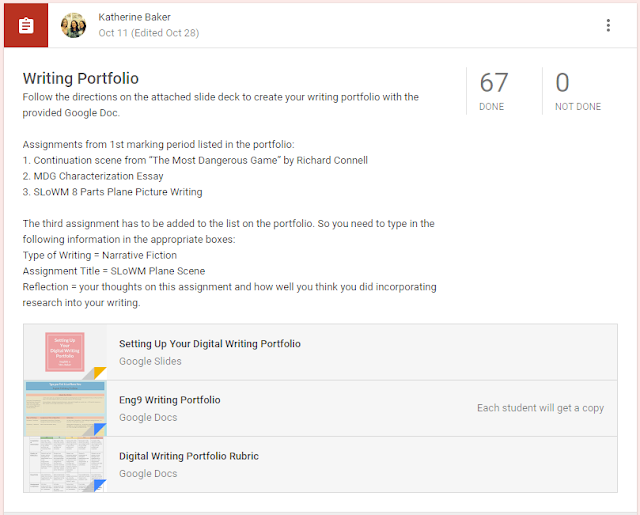
- In Google Classroom create an assignment and attach the slide deck ("anyone can view") and template doc ("generate an editable copy for each student").
- Allocate time in class for students to work on the portfolio.
- Score the portfolio each marking period.
The Template
If you haven't picked up a copy of The Hyperdoc Handbook, you better do so NOW. Author Lisa Highfill and all share strategies for creating Google Docs with an enhanced visual design. The template I created for the portfolio is organized by inserting tables to create title areas and lists of assignments. Also, I changed the background color of the page and the fill color of each table section. By changing the visual design from the usual white Google Doc, I am influencing students' initial reaction to the doc: because the portfolio doc looks differently than the other docs they've seen, they will react to it differently.
Students are allowed to personalize the doc and change the fonts and colors, but I want to make sure that they have a consistent theme to their visual design. Color palette generator such as Coolors and other activities that teach students about visual design facilitate the process.
 |
| Open the doc and go to FILE, MAKE A COPY to create your own editable version of my template. |
The sections of the portfolio doc include a heading area for the student's name, an about the Author section, and a list of the assignments that include a label for the type of writing, the assignment title and link to the student's writing piece, and an area for reflection on the specifics of the writing task. The most important area is the reflection. If I want students to act like authors, then I need them to think about the intention of their writing and reflection on the process of creation.
Setting Up the Portfolio
To lead students through the set up process in a flipped instructional manner, I created this slide deck that walks students through the process.
You'll notice that I also included the rubric for scoring the portfolio with in the slide deck. More on scoring later in this post.
Google Classroom Assignment
If you aren't using Google Classroom yet for your Google Docs workflow with students, you are missing out! Google Classroom makes managing student docs so much easier. For each assignment I create, I can attach resources and templates. Each attachment can be set to view only or editable by all, or I can have Google generate an individual copy for each student that has the file name and sharing permissions automatically created. No more untitled docs!
For the Digital Writing Portfolio Assignment in Google Classroom, I attached the slide deck (set to view only) and had Google generate an editable copy of the portfolio doc for each individual student. All docs created are housed in the folder for this assignment in my Classroom folder in my Google Drive.

As we finished up individual writing pieces, I allocated class time so that students could add the latest assignment. The beauty of using hyperlinks for each assignment is that my students are not just limited in creating Google docs of their assignments: anything that they create that is housed on the web can be linked to their digital portfolio doc.
Scoring the Portfolios
At the end of each marking period, I give students time to finalize their digital portfolio. In Google Classroom, the students click DONE to submit their assignment, thus removing editing privileges on the doc. I score the portfolio with the rubric below using the Doctopus and Goobric add-on in Google Sheets. After all portfolio docs are scored, I return the files to the students. At the end of the next marking period, they revise the portfolio doc and hit DONE on the same assignment I first created-- no need to create a new assignment for each marking period!
Philosophically, I am against putting grades on writing, but working within a system that mandates grades on assignments, I focus on providing feedback and ample opportunity to revise assignments until the student (and I) feel that the piece has met the objectives while also finding a way to get a numeric grade on the assignment.
 |
If you notice, the rubric adds up to 100 points, but the columns for scoring are equivalent to a specific percentage and letter grade that aligns with the grade breakdown of my district:
A = 100-92
B = 91-83
C = 82-75
D = 74-70
F = 69-0
20/20 = A
18/20 = B
15/20 = C
12/20 = F
I do not give half scores or use other numbers for each column listed above. The numbers are the numbers, but you will see a greater range of scores when you look at the permutations of the possible rubric scores and what score shows mastery versus lacks proficiency.

Rubric design and scoring will have to be saved for another post. But, if you look at the permutations above, because I made set each column score to a specific number that aligns on the 100 percent/point scale, I've allowed for more possible passing scores than failing scores. As Rick Wormeli will tell you, the 100 point scale (especially in my district with 100-70 as passing) puts way too much emphasis on failing grades. My scoring flips this dynamic and puts the emphasis on the upper range.
BUT, the whole purpose of the digital writing portfolio is to de-emphasize grades and focus on publishing student work in a manner that is organized, reflective, and on-going, and using Google Docs as the housing system of students assignments is a method that is simple and sustainable. I don't have to worry about a special website or an app closing down in a few years, and students can easily replicate this process after high school graduation with their own personal Google Doc accounts to create portfolios for college and career.
Sunday, October 16, 2016
Blending Active Reading & Conversations with EDpuzzle
As I integrate technology into my classroom, I want to make sure that my students do not have their faces in a screen all the time. Also, I want to capitalize on creating opportunities for my students to practice listening and self-pacing skills. Blending paper with digital media and face to face interactions with digital learning, I created checkpoints in an EDpuzzle video lesson that would encourage students to close read a text and "Turn and Talk" to answer text-based questions accurately.
Building on previous teacher-centered lessons from our reading of Richard Peck's “Priscilla and the Wimps” and Richard Connell's “The Most Dangerous Game” in which we actively read texts together, students encountered a text for the first time in such as a way as to practice self-pacing skills during an in-class flipped lesson. In an effort to flip my reading instruction and to encourage students to actively read, I edited a preexisting audiobook video on YouTube to include the text of "The Secret Life of Walter Mitty" by James Thurber. I then uploaded the new version to EDpuzzle and embedded the checkpoint questions, tagging each with a NJ Learning Standard for ELA 9th grade (formerly known as Common Core Curriculum Standards).
Each student logged in to EDpuzzle on his/her class Chromebook, and then synchronizing with a partner, hit play and listened with personal headphones to the audiobook while reading along with a paper copy of the story.
As you can see from the EDpuzzle lesson below (go ahead, try!), at various points in the story, the video would pause and students were directed to mark up their paper copy of the text so that they could better understand the narrative structure, as well as answer comprehension questions. Students would turn and talk to their partner to discuss the directions and questions. I navigated around the room, listening to the partner conversations and seeing what students marked on their paper copy. It was immediately apparent if a student recognized the ellipsis or not, and I was able to quickly confirm or redirect as needed.
After marking up the paper text, students submitted their answers to the questions in EDpuzzle and were given immediate feedback on their accuracy, including an explanation as to why each answer was correct or wrong. I also tracked student progress in EDpuzzle and mark typed-in responses as correct/incorrect while students work through the video.
Despite the video being under 12 minutes, student conversations extended the lesson time. Those who talked too long or got off topic soon realized the consequence of not staying on task: Students who did not finish the lesson in class were instructed to complete the lesson prior to the next class meeting.
Even though the visual design of EDpuzzle’s site is different from PARCC or other online tests, the digital literacy skills students are using to answer standards-based questions will help prepare students for future digital standardized assessments. And by having students work synchronously with a partner, they are able to practice interpersonal, conversational skills.
Building on previous teacher-centered lessons from our reading of Richard Peck's “Priscilla and the Wimps” and Richard Connell's “The Most Dangerous Game” in which we actively read texts together, students encountered a text for the first time in such as a way as to practice self-pacing skills during an in-class flipped lesson. In an effort to flip my reading instruction and to encourage students to actively read, I edited a preexisting audiobook video on YouTube to include the text of "The Secret Life of Walter Mitty" by James Thurber. I then uploaded the new version to EDpuzzle and embedded the checkpoint questions, tagging each with a NJ Learning Standard for ELA 9th grade (formerly known as Common Core Curriculum Standards).
Each student logged in to EDpuzzle on his/her class Chromebook, and then synchronizing with a partner, hit play and listened with personal headphones to the audiobook while reading along with a paper copy of the story.
As you can see from the EDpuzzle lesson below (go ahead, try!), at various points in the story, the video would pause and students were directed to mark up their paper copy of the text so that they could better understand the narrative structure, as well as answer comprehension questions. Students would turn and talk to their partner to discuss the directions and questions. I navigated around the room, listening to the partner conversations and seeing what students marked on their paper copy. It was immediately apparent if a student recognized the ellipsis or not, and I was able to quickly confirm or redirect as needed.
After marking up the paper text, students submitted their answers to the questions in EDpuzzle and were given immediate feedback on their accuracy, including an explanation as to why each answer was correct or wrong. I also tracked student progress in EDpuzzle and mark typed-in responses as correct/incorrect while students work through the video.
Despite the video being under 12 minutes, student conversations extended the lesson time. Those who talked too long or got off topic soon realized the consequence of not staying on task: Students who did not finish the lesson in class were instructed to complete the lesson prior to the next class meeting.
Even though the visual design of EDpuzzle’s site is different from PARCC or other online tests, the digital literacy skills students are using to answer standards-based questions will help prepare students for future digital standardized assessments. And by having students work synchronously with a partner, they are able to practice interpersonal, conversational skills.
Subscribe to:
Posts (Atom)